Preview
 Send
Send Share
Share
 Details
 Guide
Guide

 Download
 Similars
 X-Ray
X-Ray Diaporama
 Stats
StatsElm Trees at Garsington
 Oil
Oil- WallArt
- Impressionism
 1925
1925- Modern
 51.0 x 61.0 cm
 The Ashmolean Museum of Art And Archaeology
 Read More
The artwork displayed on this page is protected by copyright law, which means we cannot legally create or sell an identical reproduction. This protection is enforced under international agreements such as the Berne Convention and by national laws, including those outlined by the U.S. Copyright Law - Title 17.
As a respectful and legal alternative, we offer custom, hand-painted artworks inspired by the original. Our skilled and professional artists carefully study the original's style, mood, and artistic essence to create a new, unique piece that evokes the same feeling - while remaining an original creation in its own right.
This method fully complies with copyright regulations because it does not involve copying or duplicating the protected artwork. Instead, it is a creative reinterpretation - a new painting that is influenced by the original but not identical to it.
Hand Made Oil Reproduction
Hand-painted oil on canvas in your size and frame, made to order by our artists. ( Switch to Print Switch to Digital Image)




P118B $10

P118H $10

P118W $10

P438Z $10

P508JH $12

P508YH $12

P805H $10

P805Z $10

P919BZ $10

P919G $10

P919XJ $10

P959ZH $10

P968JZ $12

W106C $8

W218G $10

W218JH $8

W218Y $10

W307PJ $10

W316G $10

W316PJ $8

W316Y $10

W398PJ $8

W4111J $10

W500HY $15

W500JH $15

W692G $12

W849H $8

W940BG $15

W953PJ $8




Pick from our preset sizes that match the artwork's original proportions.

Type the width and the height you need, to fit your frame or your wall. This is hand-painted, so for a size with a different shape the artist can paint a bit more around the picture, or cut a bit — you choose. We send you a digital mockup to approve before the painting starts. The picture shown on this page does not show the real result — only the mockup does.
After order, OriginalUniqueArt.com team will email client for instructions and provide a mockup preview
Worldwide Delivery () in 3/4 weeks instead of standard 5 weeks. (23 October). No compromise on quality.

Free Worldwide Express Shipping

High-Quality Linen Canvas

Full Shipping Insurance

Customs Tax Refund Guarantee

True Color Matching Guarantee

100-Day Return Policy (Defects Only)

100% Money-Back Guarantee

Bulk Discount Offer
 Glass option is only available in size under 110 CM

Elm Trees at Garsington
Reproduction Medium
Reproduction Size
-


Total Price
$ 300
A Serene Vision of the English Countryside
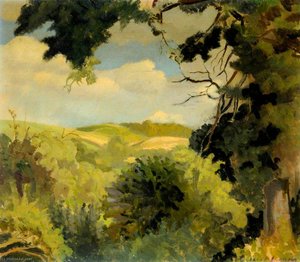
In the quietude of 1925, Gilbert Spencer captured a moment of profound stillness in his masterpiece, Elm Trees at Garsington. This evocative landscape serves as more than just a depiction of the Oxfordshire countryside; it is an invitation into a world where time seems to slow, allowing the viewer to breathe in the pastoral tranquility of rural England. The composition is anchored by a majestic group of elm trees that rise prominently on the left, their towering forms acting as silent sentinels over the landscape. Through Spencer’s lens, these trees are not merely botanical subjects but characters in a larger narrative of endurance and peace, their leafy canopies rendered with a delicate touch that suggests the gentle rustle of a summer breeze.
The painting masterfully balances the grandeur of nature with the subtle presence of human civilization. In the soft distance, the silhouette of a village emerges, marked by the graceful ascent of a church spire. This inclusion creates a beautiful dialogue between the wilder elements of the natural world and the structured, rhythmic life of the community. The interplay of light and shadow across the rolling terrain suggests a late afternoon glow, where the sky, heavy with soft, diffused clouds, filters the sunlight to create a luminous, ethereal atmosphere. For the collector or interior designer, this piece offers a sense of groundedness, making it an ideal centerpiece for spaces designed to evoke contemplation and calm.
Technique and the Impressionist Spirit
Spencer’s technical approach in Elm Trees at Garsington reflects a sophisticated command of the Impressionist tradition, adapted through his own unique, realist sensibility. Rather than adhering to rigid, photographic precision, he employs loose, expressive brushstrokes that prioritize the essence of light and movement. The palette is a harmonious blend of earthy greens, deep blues, and warm ochres, creating a chromatic depth that feels both organic and intentional. Each stroke of paint contributes to a textured surface that captures the flickering quality of light as it passes through foliage and settles upon the meadow.
The artist’s ability to manipulate color allows for a subtle transition between the vibrant life of the foreground trees and the hazy, atmospheric perspective of the distant town. This technique does not merely replicate a scene; it translates an emotional state. There is a palpable sense of nostalgia and connection woven into the fabric of the canvas—a longing for the simplicity of the English landscape. For those seeking to adorn a home with art that possesses both historical weight and aesthetic grace, this reproduction offers a window into a vanished era of pastoral splendor, bringing the timeless beauty of Garsington into the modern interior.
Questions & Answers
Where can I buy a digital image of "Elm Trees at Garsington" by Gilbert Spencer?
To get a digital file of "Elm Trees at Garsington" by Gilbert Spencer, order a high-resolution digital image download on its Digital Image page.
What is the dominant hue of "Elm Trees at Garsington" by Gilbert Spencer?
"Elm Trees at Garsington" leans toward a green to violet spectrum tone.
How strong is the contrast in "Elm Trees at Garsington" by Gilbert Spencer?
The light-dark contrast of "Elm Trees at Garsington" is recorded as balanced. Contrast describes how strongly light and dark areas differ.
Artist Biography
A Life Rooted in English Soil: The World of Gilbert Spencer
Gilbert Spencer, born August 4th, 1892, in the idyllic village of Cookham, United Kingdom, was a painter deeply attuned to the rhythms and nuances of English life. He lived until 1979, leaving behind a body of work that quietly yet powerfully captures the essence of his nation’s landscapes and people. Coming from a large family—the eighth of eleven children—and with a father who instilled a love for music through his role as an organist and teacher, Spencer's early life was one of modest means but rich in intellectual stimulation. This upbringing fostered a sensitivity that would profoundly shape his artistic vision. Perhaps the most significant familial connection was his younger brother, Sir Stanley Spencer, a renowned painter whose own distinctive style often drew comparisons, yet Gilbert forged his own path with unwavering dedication to realism and a uniquely personal interpretation of the world around him. Formal education was limited by financial constraints, but the lively conversations within his family circle provided an invaluable substitute, nurturing a curious mind eager to explore artistic expression.Formative Years and Artistic Awakening
Spencer’s formal artistic training began in 1911 at the Camberwell School of Arts and Crafts, followed by studies in wood carving at the Royal College of Art. However, it was his time at the Slade School of Fine Art in London (1913-1915) that proved truly pivotal. There, he came under the profound influence of Henry Tonks, a master draughtsman whose emphasis on observation and technical skill left an indelible mark on Spencer’s approach to painting. He excelled at the Slade, winning the life drawing prize in 1914 and achieving recognition for his ambitious mural project, "The Seven Ages of Man." This early success hinted at a talent for large-scale compositions that would later manifest in his significant mural work. Beyond the formal curriculum, Spencer’s exposure to the Bloomsbury set through Lady Ottoline Morrell—a prominent patron of the arts and hostess at Garsington Manor—broadened his artistic horizons and introduced him to a vibrant intellectual circle. These early experiences laid the foundation for a career characterized by both technical mastery and a deep engagement with the cultural currents of his time.Evolving Styles and Enduring Themes
Spencer’s artistic development was marked by an exploration of various styles, yet he consistently returned to a core commitment to realism. His early landscapes, such as “Sashes Meadow, Cookham” (1914), reveal the influence of Impressionism in their delicate handling of light and color. Later works, like "Mountain Landscape with a Windmill," demonstrate an embrace of Fauvist and Post-Impressionist elements, characterized by bolder brushstrokes and simplified forms. However, Spencer never fully abandoned his dedication to accurately depicting the English countryside and its inhabitants. His subject matter consistently revolved around landscapes, portraits, genre scenes, and mural decorations—all reflecting a profound connection to rural England. He possessed an exceptional ability to capture the quiet dignity of everyday life, imbuing even seemingly mundane scenes with a sense of beauty and significance. This dedication to portraying English life with clarity and directness became a hallmark of his artistic identity.Achievements and Legacy
Throughout his career, Gilbert Spencer achieved significant recognition for his contributions to British art. His creation of murals at Holywell Manor (1934-1936), depicting the foundation legend of Balliol College, showcased his skill in large-scale narrative painting. During World War II, he served as an official war artist (1940–1943), documenting scenes of military training and life on the home front. This period provided a unique opportunity to observe and record the impact of conflict on the English landscape and its people. Spencer’s talent was further acknowledged through his election as an Associate Royal Academician in 1950, followed by full membership in 1959. He also enjoyed a distinguished teaching career, holding professorships at the Royal College of Art (1932-1948), Glasgow School of Art (1948–1950), and Camberwell School of Arts and Crafts (1950–1957). His published works, including his autobiography "Memoirs of a Painter" (1974) and a biography of his brother Stanley Spencer (1961), offer valuable insights into his artistic philosophy and the creative dynamics within his family. Notable works include “Troops in the Countryside,” which beautifully captures a peaceful coexistence between soldiers and rural life; "Summer Evening, Durdham Downs," a dramatic depiction of social gathering; and “Boy Holding a Rabbit” (1931), a tender portrayal of childhood innocence. Gilbert Spencer is remembered as a significant British painter who captured the essence of English life with clarity, directness, and a keen eye for detail. His work provides valuable insights into the social and rural landscapes of 20th-century England, and his legacy continues to inspire artists and art lovers alike. He also holds significance as Stanley Spencer's brother, contributing to understanding both artists’ careers within a familial context.
Gilbert Spencer
1892 - 1979 , United Kingdom
Quick Facts
- Full Name: Gilbert Spencer
- Nationality: British
- Date Of Birth: 1892
- Date Of Death: 1979
- Place Of Birth: Cookham, United Kingdom
- Notable Artworks:
- Troops in the Countryside
- Summer Evening, Durdham Downs
- Boy Holding a Rabbit
- A Cotswold Farm
- Artistic Movement Or Style:
- Impressionism
- Fauvism
- Realism
- Artists Who Influenced This Artist: ['Henry Tonks']
Related Articles
Verdant Visions: Exploring the Symbolism & Aesthetic Impact of Green in Art History
Explore the rich history & symbolism of green in art! Discover iconic paintings, techniques, and how to bring verdant harmony into your home with OriginalUniqueArt's expert guide.

John Constable's Masterpieces: Explore 25 Iconic Landscapes for Your Home
Journey through John Constable's 25 most celebrated landscapes. Explore Romanticism, Dedham Vale & his masterful use of light in iconic paintings like 'Hay Wain'. Find museum-quality art reproductions and elevate your home decor on OriginalUniqueArt.com.

Impressionist Landscapes: 10 Masterpieces for Your Home | OriginalUniqueArt
Journey through 10 iconic Impressionist landscapes by Monet, Renoir & Degas. Explore the history, techniques & emotions behind these masterpieces. Find museum-quality reproductions for your home at OriginalUniqueArt.com – where art comes to life! Discover all masterpieces on OriginalUniqueArt.com

Sir Alfred Munnings' Masterpieces: 25 Paintings That Define Equine Art | OriginalUniqueArt
Explore 25 iconic Sir Alfred Munnings paintings! Discover the beauty of British Impressionism, equine art & rural England. Find museum-quality reproductions and elevate your home decor with OriginalUniqueArt. Explore the full collection online.

Impressionistic Landscapes: 10 Masterpieces That Changed Art & Decor
Journey into the heart of Impressionism! Explore 10 masterpieces by Monet, Renoir & Degas that revolutionized landscape art. Discover their stories, techniques & find museum-quality reproductions to elevate your home decor on OriginalUniqueArt.com.