Preview
 Send
Send Share
Share
 Details
 Guide
Guide

 Download
 Similars
 X-Ray
X-Ray Diaporama
 Stats
StatsSleeping Pilgrim
 Oil On Canvas
- WallArt
- Baroque
 1740
1740- Early Modern
 212.0 x 140.0 cm
 Fondazione di Studi di Storia dell'Arte Roberto Longhi
 Read More
Giclée / Art Print
Museum-quality giclée or canvas print with fast production and flexible finish options. ( Buy Hand Made Painting Switch to Digital Image)




P118B $10

P118H $10

P118W $10

P438Z $10

P508JH $12

P508YH $12

P805H $10

P805Z $10

P919BZ $10

P919G $10

P919XJ $10

P959ZH $10

P968JZ $12

W106C $8

W218G $10

W218JH $8

W218Y $10

W307PJ $10

W316G $10

W316PJ $8

W316Y $10

W398PJ $8

W4111J $10

W500HY $15

W500JH $15

W692G $12

W849H $8

W940BG $15

W953PJ $8




Pick from our preset sizes that match the artwork's original proportions.

Type the width and the height you need, to fit your frame or your wall. A print can only be cut, never made bigger than the picture, so a size with a different shape loses a part of the image. We send you a digital mockup to approve before we print anything. The picture shown on this page does not show the real cut — only the mockup does.
Worldwide Delivery () in 2 weeks instead of standard 4/5 weeks. (23 October)

Free Worldwide Express Shipping

High-Quality Linen Canvas

Full Shipping Insurance

Customs Tax Refund Guarantee

True Color Matching Guarantee

100-Day Return Policy (Defects Only)

100% Money-Back Guarantee

Bulk Discount Offer
 Glass option is only available in size under 110 CM

Sleeping Pilgrim
Giclée / Art Print
Reproduction Size
-


Total Price
$ 81
A Moment Suspended in Time: The Serenity of the Sleeping Pilgrim
To gaze upon Giacomo Ceruti's Sleeping Pilgrim is to step through a veil and into a quiet, sun-dappled moment of profound repose. Painted in 1740, this masterpiece by the late Baroque master, Pitocchetto, transcends mere depiction; it captures the very essence of tranquility. The scene unfolds in what feels like a pastoral dreamscape, where the hustle of daily life has momentarily ceased. Two figures rest beneath the gentle canopy of foliage, their slumber suggesting a deep communion with nature and peace. The composition immediately draws the eye into its muted palette—a symphony of earth tones that wrap the viewer in a blanket of calm. It is an invitation to pause, to breathe deeply, and to contemplate the quiet dignity found even in exhaustion.
Mastery of Genre and Light
Ceruti was celebrated for his genre scenes, those intimate glimpses into the lives of ordinary people, often focusing on the humble or marginalized. In Sleeping Pilgrim, this focus is executed with breathtaking technical skill. Observe the detailed brushwork; it lends a palpable texture to the rough cloak of the seated pilgrim and the soft folds of the lying figure's garments. The artist masterfully employs dramatic lighting, characteristic of the Baroque tradition, yet here it is softened, diffused by an overcast sky that bathes the scene in a cool, even glow. This handling of light does not merely illuminate; it sculpts emotion, highlighting the peaceful contours of sleep against the backdrop of the distant church spire. The realism achieved is remarkable, making the viewer question if this vision is paint or memory.
Symbolism Woven into the Landscape
The narrative depth of the painting invites scholarly contemplation. Beyond the immediate rest depicted, symbolism enriches the viewing experience. The presence of the sheep nearby whispers tales of innocence and purity, classic motifs in Italian art that ground the scene in pastoral virtue. Furthermore, the visible church structure anchors the transient moment within a framework of enduring faith and community. These elements—the pilgrim, the repose, the sacred architecture, and the gentle animal—combine to suggest a journey not just across physical land, but perhaps through the spiritual landscape of life itself. It is a meditation on rest as preparation for renewal.
Bringing History Home: Owning a Masterpiece
For those who wish to incorporate such profound artistry into their own living spaces or collections, reproductions of Sleeping Pilgrim offer an unparalleled opportunity. To possess a hand-painted rendering of this 1740 work is to curate a piece of history that speaks volumes without uttering a word. The size—212 x 140 cm—suggests its monumental presence, capable of anchoring a grand hall or lending soulful depth to a formal reception room. It remains a testament to Ceruti's enduring ability to transform the everyday into the eternal, offering collectors and designers alike a touchstone of quiet, Baroque-infused grace.
Questions & Answers
What is the art-historical place of "Sleeping Pilgrim" by Giacomo Ceruti (Pitocchetto)?
The art-historical classification of "Sleeping Pilgrim" by Giacomo Ceruti (Pitocchetto) is Baroque, in the Early-Modern period.
What is the recommended use of a print of "Sleeping Pilgrim"?
A reproduction of "Sleeping Pilgrim" by Giacomo Ceruti (Pitocchetto) is recommended for focal. This suggestion follows from the work's subject, mood and colors.
How light is "Sleeping Pilgrim" overall?
Overall, "Sleeping Pilgrim" is recorded as shadow. Perceived brightness describes how light or dark the work appears.
Artist Biography
The Soul of the Humble: The Life of Giacomo Ceruti
Born in Milan, Giacomo Antonio Melchiorre Ceruti emerged as one of the most empathetic voices of the Italian late Baroque period. While his early years were rooted in the vibrant artistic atmosphere of Milan, his journey led him to Brescia, where he settled with his family in the parish of Sant'Agata. This transition marked the beginning of a career that would forever link his name to the very people he sought to immortalize. Though his initial forays into history painting were noted by some as clumsy, Ceruti found his true calling not in the grand, sweeping narratives of myth or religion, but in the quiet, dignified realities of the common man.
His profound connection to the marginalized members of society—the beggars, the paupers, and the simple craftsmen—was so central to his oeuvre that he earned the affectionate and descriptive nickname Pitocchetto, or "little beggar." This moniker was not merely a label but a testament to his artistic mission: to elevate the subjects of the street to the status of portraiture, treating their struggles and daily labors with a level of respect and psychological depth rarely afforded to the lower classes during the eighteenth century.
A Mastery of Light and Earthly Tones
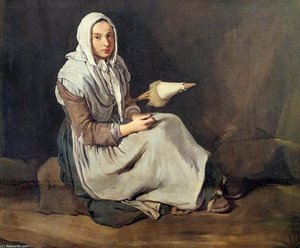
Ceruti’s technical prowess is most evident in his ability to manipulate light and texture to evoke a sense of profound realism. His style, deeply influenced by the Baroque emphasis on chiaroscuro, utilizes dramatic lighting to create volume and emotional weight within his compositions. In works such as The Spinner, one can observe how he employs subtle shadows and warm colors to cultivate an atmosphere of tranquility and contemplation, drawing the viewer's eye to the intricate details of a woman’s hands or the texture of her clothing.
His palette was often dominated by earthy tones, a choice that reinforced the connection between his subjects and the rugged, natural world they inhabited. Whether depicting the weathered face of a man in The Dwarf or the weary posture of a figure in Beggar Resting, Ceruti used muted colors and rough textures to achieve an authenticity that feels almost tactile. This focus on the material reality of his subjects—the weight of a heavy coat, the coarseness of a thatched roof, or the dampness of laundry in The Laundress—allowed him to bridge the gap between the observer and the observed.
Legacy and Artistic Significance
The historical significance of Giacomo Ceruti lies in his ability to transform genre painting into a medium of profound humanism. While he was capable of executing religious scenes, altarpieces, and even portraits for the local nobility, it is his large-scale depictions of everyday life that secure his place in the canon of Italian art. His work serves as a vital historical window into the social strata of Northern Italy, capturing the essence of 18th-century domesticity and survival.
Today, the enduring power of his vision is preserved in prestigious collections, such as the Musei Civici d'Arte e Storia in Brescia and the Fundación Colección Thyssen-Bornemisza in Spain. Through his empathetic lens, Ceruti ensured that the fleeting moments of the disenfranchised—a moment of rest, a repetitive task, or a quiet gaze—were granted a permanent and dignified existence in the annals of art history.

Giacomo Ceruti (Pitocchetto)
1698 - 1767 , Italy
Quick Facts
- Artistic Movement Or Style: Late Baroque
- Artists Who Influenced This Artist: ['Antonio Lucini']
- Full Name: Giacomo Antonio Melchiorre Ceruti
- Nationality: Italian
- Notable Artworks:
- Beggar Resting
- The Dwarf
- The Spinner
- The Laundress
- Place Of Birth: Milan, Italy
- Date Of Birth: 1698
- Date Of Death: 1767
Related Articles

The Enduring Legacy of Fine Art Prints: Technique, History & Aesthetic Impact
Explore the rich history & techniques of fine art prints. Discover investment potential, assess authenticity, and learn how to preserve your collection with expert guidance. Trusted insights for discerning collectors.

Baroque Masterpieces: 10 Paintings That Defined an Era |
Journey through the drama & grandeur of Baroque art! Explore 10 masterpieces by Caravaggio, Rembrandt, Rubens & more. Discover stunning oil paintings, rich colors & timeless stories. Find museum-quality reproductions at .

Giclée Prints: Archival Quality & Aesthetic Nuances for the Discerning Collector
Explore the world of giclée prints with OriginalUniqueArt. Learn about archival quality, aesthetic nuances & investment potential. Expert guidance for discerning art collectors seeking museum-quality reproductions and lasting value.

Echoes of Time: Exploring the Enduring Appeal & Historical Context of Vintage Art Prints
Explore the captivating world of vintage art prints! Discover their history, collecting tips & enduring appeal. Expert insights on chromolithography and building a legacy collection with OriginalUniqueArt.

Baroque Drama: Bringing Opulence & Emotion into Contemporary Interiors
Explore the opulent world of Baroque interior design! Discover key elements, modern applications & how to bring dramatic elegance into your home with OriginalUniqueArt.com's authentic reproductions.