The Soul of the Humble: The Life of Giacomo Ceruti
Born in Milan, Giacomo Antonio Melchiorre Ceruti emerged as one of the most empathetic voices of the Italian late Baroque period. While his early years were rooted in the vibrant artistic atmosphere of Milan, his journey led him to Brescia, where he settled with his family in the parish of Sant'Agata. This transition marked the beginning of a career that would forever link his name to the very people he sought to immortalize. Though his initial forays into history painting were noted by some as clumsy, Ceruti found his true calling not in the grand, sweeping narratives of myth or religion, but in the quiet, dignified realities of the common man.
His profound connection to the marginalized members of society—the beggars, the paupers, and the simple craftsmen—was so central to his oeuvre that he earned the affectionate and descriptive nickname Pitocchetto, or "little beggar." This moniker was not merely a label but a testament to his artistic mission: to elevate the subjects of the street to the status of portraiture, treating their struggles and daily labors with a level of respect and psychological depth rarely afforded to the lower classes during the eighteenth century.
A Mastery of Light and Earthly Tones
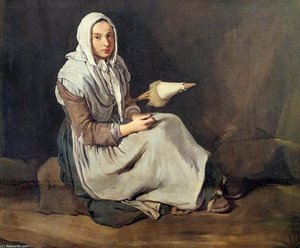
Ceruti’s technical prowess is most evident in his ability to manipulate light and texture to evoke a sense of profound realism. His style, deeply influenced by the Baroque emphasis on chiaroscuro, utilizes dramatic lighting to create volume and emotional weight within his compositions. In works such as The Spinner, one can observe how he employs subtle shadows and warm colors to cultivate an atmosphere of tranquility and contemplation, drawing the viewer's eye to the intricate details of a woman’s hands or the texture of her clothing.
His palette was often dominated by earthy tones, a choice that reinforced the connection between his subjects and the rugged, natural world they inhabited. Whether depicting the weathered face of a man in The Dwarf or the weary posture of a figure in Beggar Resting, Ceruti used muted colors and rough textures to achieve an authenticity that feels almost tactile. This focus on the material reality of his subjects—the weight of a heavy coat, the coarseness of a thatched roof, or the dampness of laundry in The Laundress—allowed him to bridge the gap between the observer and the observed.
Legacy and Artistic Significance
The historical significance of Giacomo Ceruti lies in his ability to transform genre painting into a medium of profound humanism. While he was capable of executing religious scenes, altarpieces, and even portraits for the local nobility, it is his large-scale depictions of everyday life that secure his place in the canon of Italian art. His work serves as a vital historical window into the social strata of Northern Italy, capturing the essence of 18th-century domesticity and survival.
Today, the enduring power of his vision is preserved in prestigious collections, such as the Musei Civici d'Arte e Storia in Brescia and the Fundación Colección Thyssen-Bornemisza in Spain. Through his empathetic lens, Ceruti ensured that the fleeting moments of the disenfranchised—a moment of rest, a repetitive task, or a quiet gaze—were granted a permanent and dignified existence in the annals of art history.
Questions & Answers
How many artworks by Giacomo Ceruti (Pitocchetto) are available to browse?
You can browse 34 artworks by Giacomo Ceruti (Pitocchetto) on the All Artworks page.
Where can I see Giacomo Ceruti (Pitocchetto)'s artworks arranged by atmosphere?
The artist's Mood Room page shows Giacomo Ceruti (Pitocchetto)'s artworks arranged by their atmosphere.
Where is Giacomo Ceruti (Pitocchetto) from?
Giacomo Ceruti (Pitocchetto) was born in Italy.