Preview
 Send
Send Share
Share
 Details
 Guide
Guide

 Download
 Similars
 X-Ray
X-Ray Diaporama
 Stats
StatsSpeeding Automobile
 Futurist Painting
 1912
1912 56.0 x 69.0 cm
 MOMA - Museum of Modern Art
 Read More
The artwork displayed on this page is protected by copyright law, which means we cannot legally create or sell an identical reproduction. This protection is enforced under international agreements such as the Berne Convention and by national laws, including those outlined by the U.S. Copyright Law - Title 17.
This method fully complies with copyright regulations because it does not involve copying or duplicating the protected artwork. Instead, it is a creative reinterpretation - a new painting that is influenced by the original but not identical to it.
Giclée / Art Print
Museum-quality giclée or canvas print with fast production and flexible finish options. ( Buy Hand Made Painting Switch to Digital Image)




P118B $10

P118H $10

P118W $10

P438Z $10

P508JH $12

P508YH $12

P805H $10

P805Z $10

P919BZ $10

P919G $10

P919XJ $10

P959ZH $10

P968JZ $12

W106C $8

W218G $10

W218JH $8

W218Y $10

W307PJ $10

W316G $10

W316PJ $8

W316Y $10

W398PJ $8

W4111J $10

W500HY $15

W500JH $15

W692G $12

W849H $8

W940BG $15

W953PJ $8




Pick from our preset sizes that match the artwork's original proportions.

Type the width and the height you need, to fit your frame or your wall. A print can only be cut, never made bigger than the picture, so a size with a different shape loses a part of the image. We send you a digital mockup to approve before we print anything. The picture shown on this page does not show the real cut — only the mockup does.
Worldwide Delivery () in 2 weeks instead of standard 4/5 weeks. (23 October)

Free Worldwide Express Shipping

High-Quality Linen Canvas

Full Shipping Insurance

Customs Tax Refund Guarantee

True Color Matching Guarantee

100-Day Return Policy (Defects Only)

100% Money-Back Guarantee

Bulk Discount Offer
 Glass option is only available in size under 110 CM

Speeding Automobile
Giclée / Art Print
Reproduction Size
-


Total Price
$ 81
Speeding Automobile: A Futurist Vision of Modernity
Giacomo Balla’s “Speeding Automobile,” completed in 1912, stands as a cornerstone of Futurism—a movement that vehemently rejected the past and embraced speed, dynamism, and technological advancement. Painted on wood, this striking artwork exemplifies the Futurist aesthetic's obsession with capturing fleeting moments of motion and disrupting traditional artistic conventions.
- Subject Matter: The painting depicts a car in rapid movement, illuminated by its headlights, traversing an urban landscape populated by buildings. This deliberate choice reflects Futurists’ fascination with the transformative influence of automobiles on society and daily life.
- Style & Technique: Balla employed Divisionism—a technique pioneered by Monet and others—to achieve a luminous effect through juxtaposed patches of pure color. However, he pushed beyond mere optical representation, prioritizing expressive gesture and conveying the sensation of speed rather than precise visual detail. The artist’s meticulous attention to capturing the car's wheels at varying positions underscores this commitment to portraying movement effectively.
The inclusion of two figures—one positioned on the left side of the canvas and another closer to the center—adds a human element to the scene, emphasizing the relationship between individuals and the burgeoning pace of industrialization. These figures aren’t merely incidental; they serve as conduits for conveying the emotional impact of this accelerated world.
Historical Context: The Birth of Futurism
Born in Turin in 1871, Giacomo Balla's artistic journey began with an initial inclination towards music before shifting his focus to visual art following his father’s untimely death. His formative years were spent honing his skills in lithograph printmaking and studying at academies and the University of Turin. Moving to Rome in 1895 broadened his horizons creatively, fostering collaborations with illustrators and portrait painters.
The painting emerged during a period defined by fervent optimism about technological progress and fueled by the revolutionary manifesto penned by Filippo Tommaso Marinetti in 1910. Futurism championed concepts like violence, speed, and the glorification of machines—ideas that profoundly challenged artistic sensibilities of the time.
Symbolism & Emotional Resonance
"Speeding Automobile" transcends mere depiction; it embodies Futurist ideals. The vibrant colors and fractured forms symbolize the disruption of established order and celebrate the exhilarating energy of modernity. The headlights, strategically placed, represent illumination—both literal and metaphorical—guiding viewers toward a new understanding of time and space.
Resources for Further Exploration
- MoMA: Giacomo Balla. Speeding Automobile. 1912
- Obelisk Art History: Speeding Automobile by Giacomo Balla
Questions & Answers
How old was Giacomo Balla when creating "Speeding Automobile" in 1912?
When "Speeding Automobile" was created in 1912, Giacomo Balla - born in 1871 - was 41 years old.
Is there a slideshow for "Speeding Automobile" by Giacomo Balla?
"Speeding Automobile" by Giacomo Balla can be viewed as a slideshow on the artwork's Diaporama page.
How is the palette of "Speeding Automobile" by Giacomo Balla described?
The palette of "Speeding Automobile" by Giacomo Balla is described as earthy. It is a compact description of the work's colors.
Artist Biography
Early Life and Training
- Born: Turin, Italy (July 18, 1871)
- Died: 1958
- Giacomo Balla was born into a family with artistic connections; his father was a photographer.
- Initially studied music until the age of nine.
- Following his father's passing, he worked in a lithograph print shop, developing an interest in visual art.
- Studied at local academies and later at the University of Turin.
- Moved to Rome in 1895 where he began working as an illustrator, caricaturist, and portrait painter.
Development and Key Artistic Periods
- Divisionism: Early works were influenced by Divisionism, a technique employing small strokes of pure color to create luminosity. This period demonstrated his interest in capturing light effects.
- Futurism: A pivotal moment was his embrace of Futurism after meeting Filippo Tommaso Marinetti. He became a signatory of the Futurist Manifesto in 1910.
- Futurist Principles: Balla's futurist works focused on depicting light, movement, and speed, often incorporating abstract elements. He extended Futurist principles to furniture design and clothing.
- Later Work: In later years, he distanced himself from the more radical aspects of Futurism, returning to a more traditional figurative style.
Major Works and Artistic Style
- Abstract Speed + Sound (Velocità Astratta + Rumore): A significant work exploring speed symbolized by an automobile.
- The Street Light: Exemplifies his exploration of light, atmosphere, and motion.
- Dynamism of a Dog on a Leash: A key piece demonstrating efforts to express movement through painting.
- Boccioni's Fist: Showcases his work as a sculptor within the Futurist movement.
- Style: Balla’s style evolved from Divisionist techniques to dynamic and abstract representations of motion, light, and modern life. He utilized fragmented forms, overlapping planes, and vibrant colors to convey a sense of energy and speed.
Influences and Historical Significance
- Etienne-Jules Marey: Influenced by Marey's chronophotographic experiments which recorded successive stages of movement.
- Filippo Tommaso Marinetti: The Futurist Manifesto and Marinetti’s ideas were crucial in shaping Balla’s artistic direction.
- Historical Significance: As a founding member of the Futurist movement, Balla played a vital role in developing its aesthetic principles and promoting its influence across various art forms. His work helped define early 20th-century modernism and continues to be celebrated for its innovative approach to representing motion and technology.
Legacy and Recognition
- Membership: Became a member of Rome's Accademia di San Luca in 1935.
- Exhibitions: Participated in Documenta 1 in Kassel (1955) and had works exhibited at Documenta 8 (1987).
- Museum Collections: His artworks are held in collections such as the Albright-Knox Art Gallery, the National Academy of Saint Luke in Rome, and the Estorick Collection.
- Balla's legacy lies in his pioneering exploration of movement and dynamism in art, contributing significantly to the development of Futurism and modern artistic expression.

Giacomo Balla
1871 - 1958 , Italy
Quick Facts
- Artistic Movement Or Style: Divisionism and Futurism
- Artists Who Influenced This Artist: ['Etienne-Jules Marey']
- Full Name: Giacomo Balla
- Nationality: Italian
- Notable Artworks:
- Abstract Speed + Sound
- The Street Light
- Dynamism of a Dog on a Leash
- Boccioni's Fist
- Nuns and Landscape
- Girl Running on a Balcony
- Farmer
- Place Of Birth: Turin, Italy
- Date Of Birth: 1871
- Date Of Death: 1958
Related Articles

Carlo Carrà: Futurist Visions & Metaphysical Transformations in Early 20th-Century Italian Painting
Explore the artistic journey of Carlo Carrà, a pivotal figure in Italian Futurism & Metaphysical painting. Discover his dynamic compositions, collaborations with de Chirico, and lasting influence on modern art history.

Speed, Power, and Motion: A Journey Through the Energetic Soul of Futurism
Explore the exhilarating energy of Futurism. From Italian dynamism to Russian Cubo-Futurism, journey through a masterclass in speed, power, and motion in art history with our expert cultural reflections.
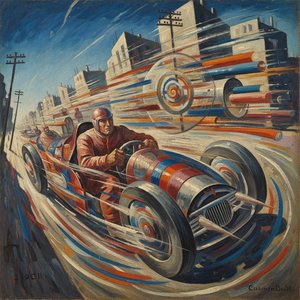
Giacomo Balla: Dynamism, Futurism & the Aesthetic of Speed – A Comprehensive Exploration
Explore the revolutionary art of Giacomo Balla, a key figure in Futurism. Discover his dynamic paintings capturing speed, light & movement. Learn about his techniques, masterpieces & legacy with our comprehensive guide.
Dynamism & Disruption: The Enduring Legacy of Futurism
Explore the revolutionary world of Futurism! Discover its key artists like Boccioni & Balla, defining principles, and lasting impact on modern art. A deep dive into this influential movement.

Speed, Power, and Motion: A Collector's Guide to the Dynamic World of Futurism
Explore the exhilarating world of Futurism with our expert guide. Discover how masters like Balla and Boccioni captured speed, power, and modern motion through dynamic avant-garde techniques—essential knowledge for any discerning art collector.