Preview
 Send
Send Share
Share
 Details
 Guide
Guide

 Download
 Similars
 X-Ray
X-Ray Diaporama
 Stats
StatsPappagalli


 Read More
The artwork displayed on this page is protected by copyright law, which means we cannot legally create or sell an identical reproduction. This protection is enforced under international agreements such as the Berne Convention and by national laws, including those outlined by the U.S. Copyright Law - Title 17.
This method fully complies with copyright regulations because it does not involve copying or duplicating the protected artwork. Instead, it is a creative reinterpretation - a new painting that is influenced by the original but not identical to it.
Giclée / Art Print
Museum-quality giclée or canvas print with fast production and flexible finish options. ( Buy Hand Made Painting Switch to Digital Image)




P118B $10

P118H $10

P118W $10

P438Z $10

P508JH $12

P508YH $12

P805H $10

P805Z $10

P919BZ $10

P919G $10

P919XJ $10

P959ZH $10

P968JZ $12

W106C $8

W218G $10

W218JH $8

W218Y $10

W307PJ $10

W316G $10

W316PJ $8

W316Y $10

W398PJ $8

W4111J $10

W500HY $15

W500JH $15

W692G $12

W849H $8

W940BG $15

W953PJ $8




Pick from our preset sizes that match the artwork's original proportions.

Type the width and the height you need, to fit your frame or your wall. A print can only be cut, never made bigger than the picture, so a size with a different shape loses a part of the image. We send you a digital mockup to approve before we print anything. The picture shown on this page does not show the real cut — only the mockup does.
Worldwide Delivery () in 2 weeks instead of standard 4/5 weeks. (22 October)

Free Worldwide Express Shipping

High-Quality Linen Canvas

Full Shipping Insurance

Customs Tax Refund Guarantee

True Color Matching Guarantee

100-Day Return Policy (Defects Only)

100% Money-Back Guarantee

Bulk Discount Offer
 Glass option is only available in size under 110 CM

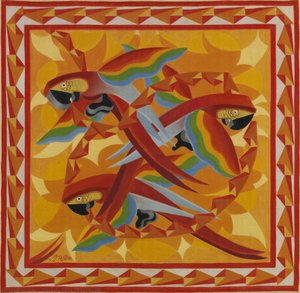
Pappagalli
Giclée / Art Print
Reproduction Size
-


Total Price
$ 81
A Symphony in Motion: Exploring Pappagalli's Vibrant Depths
To gaze upon this painting of fish is not merely to observe aquatic life; it is to witness captured energy, a vibrant ballet unfolding against a field of luminous yellow. The composition, teeming with at least twelve distinct forms, suggests a moment suspended in time—a collective surge through unseen currents. Each scale, each fin, seems imbued with an independent will, yet they move as one unified body. This piece radiates an almost palpable sense of life, inviting the viewer to lean closer and feel the cool rush of water against their skin.
The Echoes of Modern Movement
While the subject matter—the school of fish—is timelessly natural, the execution speaks volumes about early 20th-century artistic fervor. The style echoes the dynamic concerns of artists grappling with speed and perception. One senses the influence of movements that sought to break down reality into its constituent parts: light, motion, and pure color. The way the forms overlap and interact suggests a scientific yet ecstatic rendering of natural physics, hallmarks of an era obsessed with capturing the ephemeral nature of modern existence.
Technique and Luminous Play
The artist has masterfully employed color to create depth and vitality. Against that brilliant yellow ground—a hue itself suggesting sunshine filtering through water or perhaps pure, unadulterated joy—the various shades of the fish pop with incredible intensity. The technique appears to favor distinct strokes of pure pigment, allowing the colors to vibrate against one another. This careful handling of light and shadow across multiple overlapping subjects gives the entire scene a shimmering, almost optical quality, making it an immediate focal point for any richly decorated space.
Symbolism of Community and Flow
In art history, schools of fish often carry potent symbolism. They can represent community, migration, or the relentless passage of time. Here, the sheer number and varied positioning suggest a powerful collective journey—a shared destiny moving forward together. For collectors and designers alike, this piece offers more than mere decoration; it introduces an element of dynamic narrative into a room. It speaks to connection, resilience, and the beautiful chaos inherent in life's greatest movements.
Bringing Aquatic Energy Home
Considering its size of 125 x 125 cm, this artwork commands attention without overwhelming a space. Whether placed above a console table or centered as a striking piece over a sofa, it acts as an immediate source of visual refreshment. Reproducing the vibrancy and movement captured in Pappagalli allows one to infuse any interior with the exhilarating spirit of nature's most vibrant ballet.
Questions & Answers
What mood and emotion does "Pappagalli" by Giacomo Balla express?
"Pappagalli" by Giacomo Balla conveys a joyful feeling within an overall playful mood.
Where is the square format of "Pappagalli" recommended to be displayed?
With its square shape, a reproduction of "Pappagalli" is suggested for a lounge.
What orientation does "Pappagalli" by Giacomo Balla have?
"Pappagalli" by Giacomo Balla has a square format. The format describes the proportions of the composition.
Artist Biography
Early Life and Training
- Born: Turin, Italy (July 18, 1871)
- Died: 1958
- Giacomo Balla was born into a family with artistic connections; his father was a photographer.
- Initially studied music until the age of nine.
- Following his father's passing, he worked in a lithograph print shop, developing an interest in visual art.
- Studied at local academies and later at the University of Turin.
- Moved to Rome in 1895 where he began working as an illustrator, caricaturist, and portrait painter.
Development and Key Artistic Periods
- Divisionism: Early works were influenced by Divisionism, a technique employing small strokes of pure color to create luminosity. This period demonstrated his interest in capturing light effects.
- Futurism: A pivotal moment was his embrace of Futurism after meeting Filippo Tommaso Marinetti. He became a signatory of the Futurist Manifesto in 1910.
- Futurist Principles: Balla's futurist works focused on depicting light, movement, and speed, often incorporating abstract elements. He extended Futurist principles to furniture design and clothing.
- Later Work: In later years, he distanced himself from the more radical aspects of Futurism, returning to a more traditional figurative style.
Major Works and Artistic Style
- Abstract Speed + Sound (Velocità Astratta + Rumore): A significant work exploring speed symbolized by an automobile.
- The Street Light: Exemplifies his exploration of light, atmosphere, and motion.
- Dynamism of a Dog on a Leash: A key piece demonstrating efforts to express movement through painting.
- Boccioni's Fist: Showcases his work as a sculptor within the Futurist movement.
- Style: Balla’s style evolved from Divisionist techniques to dynamic and abstract representations of motion, light, and modern life. He utilized fragmented forms, overlapping planes, and vibrant colors to convey a sense of energy and speed.
Influences and Historical Significance
- Etienne-Jules Marey: Influenced by Marey's chronophotographic experiments which recorded successive stages of movement.
- Filippo Tommaso Marinetti: The Futurist Manifesto and Marinetti’s ideas were crucial in shaping Balla’s artistic direction.
- Historical Significance: As a founding member of the Futurist movement, Balla played a vital role in developing its aesthetic principles and promoting its influence across various art forms. His work helped define early 20th-century modernism and continues to be celebrated for its innovative approach to representing motion and technology.
Legacy and Recognition
- Membership: Became a member of Rome's Accademia di San Luca in 1935.
- Exhibitions: Participated in Documenta 1 in Kassel (1955) and had works exhibited at Documenta 8 (1987).
- Museum Collections: His artworks are held in collections such as the Albright-Knox Art Gallery, the National Academy of Saint Luke in Rome, and the Estorick Collection.
- Balla's legacy lies in his pioneering exploration of movement and dynamism in art, contributing significantly to the development of Futurism and modern artistic expression.

Giacomo Balla
1871 - 1958 , Italy
Quick Facts
- Artistic Movement Or Style: Divisionism and Futurism
- Artists Who Influenced This Artist: ['Etienne-Jules Marey']
- Full Name: Giacomo Balla
- Nationality: Italian
- Notable Artworks:
- Abstract Speed + Sound
- The Street Light
- Dynamism of a Dog on a Leash
- Boccioni's Fist
- Nuns and Landscape
- Girl Running on a Balcony
- Farmer
- Place Of Birth: Turin, Italy
- Date Of Birth: 1871
- Date Of Death: 1958
Related Articles

Geometric Abstraction's 10 Defining Masterpieces | Art for Your Home - OriginalUniqueArt
Explore 10 defining masterpieces of Geometric Abstraction! Discover Kandinsky, Mondrian & Malevich’s iconic works. Find museum-quality art reproductions and curated decor ideas to elevate your home at OriginalUniqueArt.com.

Abstract Expressionism's 10 Defining Masterpieces |
Explore 10 defining Abstract Expressionism masterpieces by Pollock, Rothko & de Kooning. Discover the stories behind these iconic paintings and find museum-quality art reproductions to elevate your home decor on .
Fernand Léger's Masterpieces: 25 Iconic Paintings & The Machine Age Aesthetic | OriginalUniqueArt
Explore 25 iconic Fernand Léger paintings that defined the Machine Age & Cubism. Discover the stories behind his bold colors, geometric forms & avant-garde style. Find museum-quality art reproductions on OriginalUniqueArt.com.

Kandinsky's Masterpieces: 25 Paintings That Define Abstract Art | OriginalUniqueArt
Journey through Wassily Kandinsky's 25 most iconic abstract paintings. Explore his revolutionary use of color, form & spiritual expressionism. Find museum-quality Kandinsky reproductions and elevate your home decor with OriginalUniqueArt.com. Discover all masterpieces on OriginalUniqueArt.com!
Paul Klee's Masterpieces: Explore 25 Iconic Paintings & Prints | OriginalUniqueArt
Journey through Paul Klee's 25 most iconic paintings & prints. Explore his abstract style, Bauhaus influence, and vibrant color palettes. Find museum-quality art reproductions & decor ideas at OriginalUniqueArt.com. Discover all masterpieces online.