Preview
 Send
Send Share
Share
 Details
 Guide
Guide

 Download
 Similars
 X-Ray
X-Ray Diaporama
 Stats
StatsThe Visit
 Oil On Canvas
- WallArt
- Dutch Golden Age Genre
 78.0 x 74.0 cm
 Staatliches Museum
 Read More
Giclée / Art Print
Museum-quality giclée or canvas print with fast production and flexible finish options. ( Buy Hand Made Painting Switch to Digital Image)




P118B $10

P118H $10

P118W $10

P438Z $10

P508JH $12

P508YH $12

P805H $10

P805Z $10

P919BZ $10

P919G $10

P919XJ $10

P959ZH $10

P968JZ $12

W106C $8

W218G $10

W218JH $8

W218Y $10

W307PJ $10

W316G $10

W316PJ $8

W316Y $10

W398PJ $8

W4111J $10

W500HY $15

W500JH $15

W692G $12

W849H $8

W940BG $15

W953PJ $8




Pick from our preset sizes that match the artwork's original proportions.

Type the width and the height you need, to fit your frame or your wall. A print can only be cut, never made bigger than the picture, so a size with a different shape loses a part of the image. We send you a digital mockup to approve before we print anything. The picture shown on this page does not show the real cut — only the mockup does.
Worldwide Delivery () in 2 weeks instead of standard 4/5 weeks. (23 October)

Free Worldwide Express Shipping

High-Quality Linen Canvas

Full Shipping Insurance

Customs Tax Refund Guarantee

True Color Matching Guarantee

100-Day Return Policy (Defects Only)

100% Money-Back Guarantee

Bulk Discount Offer
 Glass option is only available in size under 110 CM

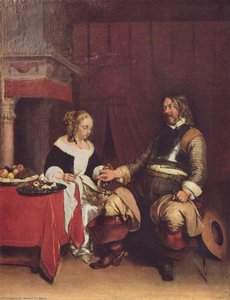
The Visit
Giclée / Art Print
Reproduction Size
-


Total Price
$ 81
A Window Into Seventeenth-Century Domestic Life: Exploring Gerard Ter Borch’s “The Visit”
Gerard ter Borch, a pivotal figure in Dutch Golden Age art history, stands as a beacon of psychological realism and meticulous observation within the genre of domestic painting. Born in Zwolle in 1617, he embarked on an artistic journey that traversed Europe, absorbing influences from diverse artistic traditions – notably the Baroque – shaping his distinctive style and cementing his legacy as one of the era’s foremost masters. His sister, Gesina ter Borch, also pursued a career in painting, fostering a familial commitment to artistic excellence that would resonate throughout their lives. Ter Borch's oeuvre is characterized by an unparalleled sensitivity to capturing subtle emotions and nuanced interactions within seemingly commonplace settings—a hallmark that distinguishes him from many of his contemporaries.Composition and Technique: Mastering Light and Texture
“The Visit,” painted circa 1655, exemplifies ter Borch’s masterful command of technique. Executed in oil on canvas – a medium favored for its ability to achieve remarkable luminosity and textural detail – the artwork presents four figures engaged in conversation within a richly furnished bedroom. The artist skillfully employs chiaroscuro—the dramatic interplay between light and shadow—to sculpt the forms of the women seated on a bench and the men standing nearby, creating an illusionistic depth that draws the viewer into the scene. Ter Borch’s meticulous brushwork captures the delicate weave of fabric, the sheen of polished surfaces, and the subtle nuances of skin tones with astonishing accuracy. This painstaking attention to detail underscores ter Borch's dedication to portraying reality as faithfully as possible—a cornerstone of his artistic philosophy.Symbolism Within Everyday Reality: Decoding Gestures and Expressions
Beyond its technical brilliance, “The Visit” is laden with symbolic significance. The bed draped in a scarlet blanket serves as a visual anchor, representing comfort, intimacy, and perhaps even unspoken desires. The postures and gestures of the figures convey a complex tapestry of emotions—ranging from polite cordiality to veiled apprehension—reflecting the psychological depth that ter Borch sought to achieve. Scholars have interpreted subtle facial expressions and glances as indicators of hidden agendas and unspoken feelings, prompting ongoing debate about the artwork’s intended message. Ter Borch's ability to transform ordinary domestic life into a vehicle for profound emotional exploration distinguishes him from many other artists of his time.Historical Context: Reflecting Dutch Society’s Values
“The Visit” emerged during a period of considerable social and intellectual ferment in Holland—the Dutch Golden Age (approximately 1648-1702). This era witnessed unprecedented economic prosperity, fueled by maritime trade and colonial expansion, fostering a vibrant cultural landscape characterized by artistic innovation and humanist ideals. Genre painting flourished as a response to the prevailing fascination with portraying the realities of everyday life—a deliberate departure from grand mythological narratives favored by earlier Baroque artists. Ter Borch’s work reflects the Dutch obsession with moral virtue and social decorum—values that underpinned the nation's reputation for stability and sophistication.Emotional Resonance: Capturing Transient Moments
Ultimately, “The Visit” transcends its formal qualities to evoke a powerful emotional response in the viewer. The artwork captures a fleeting moment of human connection—a conversation between friends or family members—rendered with breathtaking tenderness and sensitivity. Ter Borch’s masterful depiction of psychological realism invites contemplation about the complexities of human relationships and the enduring power of unspoken emotions. Like many of his contemporaries, ter Borch aimed to elevate genre painting beyond mere visual representation, transforming it into a medium for conveying profound truths about the human condition—a testament to his artistic genius and lasting influence on art history.Location: Staatliches Museum Schwerin
The Staatliches Museum Schwerin houses an impressive collection of artworks from various periods and styles. You can find more information about the museum on Wikipedia: https://en.wikipedia.org/wiki/Staatliches_MusQuestions & Answers
What luminance does "The Visit" by Gerard ter Borch have?
The colors of "The Visit" show a dark luminance.
What does "The Visit" share with the rest of Gerard ter Borch's output?
"The Visit" belongs to Gerard ter Borch's Dutch Golden Age Genre work, whose recorded themes include domestic intimacy, psychological realism, genre painting style, dutch artistic heritage, symbolic interior space.
Can I see an X-ray view of "The Visit" by Gerard ter Borch?
The X-Ray page of "The Visit" by Gerard ter Borch is an interactive viewer that lets you slide through eleven optical layers of the artwork's image, including an X-ray style view.
Artist Biography
**a pioneer of dutch genre painting**
gerard ter borch, a prominent figure in the dutch golden age, left an indelible mark on the art world with his genre paintings. born in december 1617 and passing away on december 8, 1681, ter borch's life was a testament to his artistic prowess.**early life and influences**
ter borch's early life is not well-documented, but it is known that he traveled extensively throughout europe, including london, germany, france, spain, and italy. this exposure broadened his artistic horizons, influencing his unique style. his sister, gesina ter borch, also pursued a career in painting, further solidifying the family's artistic inclinations.**notable works and achievements**
- **the letter**: a masterpiece showcasing ter borch's skill in capturing texture and light. - **the gallant conversation**: engraved by johann georg wille, this piece exemplifies the artist's ability to convey nuanced emotions. - **man on horseback (1634)**: an early work demonstrating ter borch's emerging talent. - **adrian pauw's arrival in münster (1646)**: a significant piece that highlights the artist's narrative capabilities.**museums and collections featuring ter borch's work**
- the hermitage: with six of his works, it boasts one of the largest collections. - berlin museum: features six pieces, showcasing ter borch's international appeal. - getty center: three of his paintings are part of this esteemed collection.**legacy and impact**
ter borch's influence on dutch painters like gabriel metsu, gerrit dou, eglon van der neer, and johannes vermeer is well-documented. his innovative approach to genre painting has made him a pivotal figure in the history of art.- for more on ter borch's life and works, visit https://OriginalUniqueArt.com/@/gerard-ter-borch
- explore the museum boijmans van beuningen rotterdam, netherlands, featuring some of ter borch's contemporaries at https://OriginalUniqueArt.com/@@/a@d3arrk-museum-boijmans-van-beuningen-rotterdam-netherlands
- learn more about the dutch golden age and its notable artists at https://en.wikipedia.org/wiki/dutch_golden_age

Gerard ter Borch
1617 - 1681 , Netherlands
Quick Facts
- Full Name: Gerard ter Borch
- Nationality: Dutch
- Date Of Birth: 1617
- Date Of Death: 1681
- Place Of Birth: Zwolle, Netherlands
- Notable Artworks:
- The Letter
- The Gallant Conversation
- Man on horseback
- Adrian Pauw's arrival in Münster
- Artistic Movement Or Style: Genre painting
- Artists Who Influenced This Artist:
- Gabriel Metsu
- Gerrit Dou
- Eglon van der Neer
- Johannes Vermeer
- Artists Or Movements Influenced By This Artist: ['Diego Velázquez']
Related Articles

Gerard ter Borch: Intimacy & Light in the Dutch Golden Age
Explore the captivating world of Gerard ter Borch, a master of Dutch Golden Age genre painting. Discover his intimate scenes, masterful light, and lasting influence on art history. Learn more at OriginalUniqueArt.

Golden Age Reflections: Dutch Baroque Painting & Cultural Innovation
Explore the Dutch Golden Age of painting! Discover key artists like Vermeer & ter Borch, their innovative techniques, and the rich cultural context behind these Baroque masterpieces. Learn about collecting & appreciating this iconic art period.
Gerard van Honthorst: Illuminating the Dutch Golden Age with Caravaggism & Courtly Grace
Explore the captivating world of Gerard van Honthorst, a Dutch Golden Age master renowned for his dramatic chiaroscuro & courtly portraits. Discover his life, art, and lasting influence on Baroque painting.

Chiaroscuro and Character: A Definitive Guide to Light and Shadow in the Dutch Baroque Era
Explore the dramatic mastery of the Dutch Baroque era. Discover how masters like Rembrandt used chiaroscuro to transform everyday life into timeless art. An expert guide for collectors and enthusiasts seeking to understand the profound interplay of light and shadow.

Dutch Baroque Masters: 10 Paintings That Shaped an Era | OriginalUniqueArt
Journey through the Golden Age with our guide to the Top 10 Dutch Baroque masterpieces! Explore iconic paintings by Rembrandt, Vermeer & Frans Hals. Find museum-quality art reproductions and elevate your home decor at OriginalUniqueArt.com.