Preview
 Send
Send Share
Share
 Details
 Guide
Guide

 Download
 Similars
 X-Ray
X-Ray Diaporama
 Q&A
Q&A Stats
StatsThe Suitor's Visit

- 80.0 x 75.0 cm


 Read More
Giclée / Art Print
Museum-quality giclée or canvas print with fast production and flexible finish options. ( Buy Hand Made Painting Switch to Digital Image)




P118B $10

P118H $10

P118W $10

P438Z $10

P508JH $12

P508YH $12

P805H $10

P805Z $10

P919BZ $10

P919G $10

P919XJ $10

P959ZH $10

P968JZ $12

W106C $8

W218G $10

W218JH $8

W218Y $10

W307PJ $10

W316G $10

W316PJ $8

W316Y $10

W398PJ $8

W4111J $10

W500HY $15

W500JH $15

W692G $12

W849H $8

W940BG $15

W953PJ $8




Pick from our preset sizes that match the artwork's original proportions.

Type the width and the height you need, to fit your frame or your wall. A print can only be cut, never made bigger than the picture, so a size with a different shape loses a part of the image. We send you a digital mockup to approve before we print anything. The picture shown on this page does not show the real cut — only the mockup does.
Worldwide Delivery () in 2 weeks instead of standard 4/5 weeks. (7 November)

Free Worldwide Express Shipping

High-Quality Linen Canvas

Full Shipping Insurance

Customs Tax Refund Guarantee

True Color Matching Guarantee

100-Day Return Policy (Defects Only)

100% Money-Back Guarantee

Bulk Discount Offer
 Glass option is only available in size under 110 CM

The Suitor's Visit
Giclée / Art Print
Reproduction Size
-


Total Price
$ 81
A Quiet Intimacy: The Soul of Dutch Domesticity
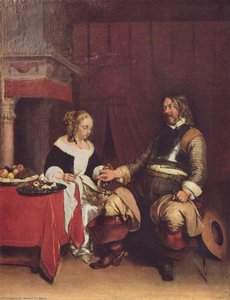
In the soft, amber glow of a seventeenth-century interior, Gerard ter Borch’s “The Suitor’s Visit” invites us to witness a moment suspended in time. Painted in 1658, this masterpiece serves as a profound window into the Dutch Golden Age, a period when the burgeoning merchant class sought art that mirrored their own refined, private worlds. Rather than grand mythological battles or sweeping religious epics, ter Borch turns his gaze inward, capturing the subtle, psychological dance of human interaction. The scene unfolds with a quiet elegance, presenting a triangular composition that draws the eye toward a central woman, whose presence anchors the domestic tableau. As we observe the figures—a man in somber, dignified attire, a woman draped in a striking red gown, and a companion lost in the melody of a lute—we are not merely spectators to a social call, but participants in a carefully orchestrated moment of grace.
The emotional resonance of the work lies in its restraint. There is an undercurrent of tension and tenderness, a whispered dialogue between the characters that transcends the stillness of the canvas. The inclusion of a small dog at the feet of the figures adds a layer of domestic warmth, grounding the aristocratic setting in a sense of lived-in reality. For the collector or the lover of fine art, this painting offers more than visual beauty; it provides an emotional sanctuary, a piece of history that speaks to the enduring human desire for connection and the quiet dignity found within the sanctity of the home.
Mastery of Light and Texture: The Baroque Realism of Ter Borch
Technically, “The Suitor’s Visit” is a triumph of Baroque realism. Ter Borch was a virtuoso of texture, possessing an almost supernatural ability to render the tactile qualities of his subjects. One can almost feel the heavy weight of the man's dark cloak and the shimmering, liquid luster of the woman’s satin dress. His use of chiaroscuro—the dramatic interplay between light and shadow—is employed not for theatrical shock, but to sculpt form and direct the viewer's focus. The dark, indistinct background acts as a velvet void, pushing the illuminated faces and vibrant fabrics forward, creating a sense of three-dimensional depth that breathes life into the composition.
Every brushstroke serves a purpose in building this atmospheric world. The artist’s meticulous attention to detail—from the delicate strings of the lute to the subtle folds in the drapery—demonstrates a level of precision that influenced many of his contemporaries, including the legendary Johannes Vermeer. For interior designers seeking to infuse a space with sophistication, the painting's rich color palette and balanced composition offer a timeless elegance. A high-quality reproduction of this work brings with it a sense of historical weight and textural richness, making it an ideal centerpiece for a room designed for contemplation and quiet luxury.
Symbolism and the Art of the Everyday
Beyond its surface beauty, “The Suitor’s Visit” is rich with the symbolic language of the Dutch seventeenth century. In this era, objects were rarely just objects; they were carriers of meaning. The lute, for instance, serves as a classic emblem of harmony and refinement, suggesting that the social interaction taking place is as much about cultural grace as it is about personal courtship. The man’s hat and structured clothing signal his status within the prosperous burgher society, while the very act of a "visit" underscores the importance of social ritual and the maintenance of domestic order.
This painting is an invitation to appreciate the extraordinary within the ordinary. It celebrates the beauty of a well-ordered life and the subtle complexities of the human heart. Whether displayed in a sunlit gallery or a cozy, private study, Ter Borch’s work continues to captivate because it captures a universal truth: that the most profound stories are often told in the quietest moments. Owning a piece of this legacy allows one to surround themselves with the enduring spirit of the Dutch Golden Age, bringing a sense of historical depth and artistic mastery into the modern home.
Questions & Answers
What palette and what feeling does "The Suitor's Visit" combine?
The earthy palette of "The Suitor's Visit" by Gerard ter Borch goes together with its calm emotional tone. Color is one of the ways a work conveys feeling.
What use is suggested for "The Suitor's Visit" by Gerard ter Borch?
The suggested use for "The Suitor's Visit" by Gerard ter Borch is accent. It can serve other purposes as well.
What placement suits the format of "The Suitor's Visit" by Gerard ter Borch?
Format (square) and recommended space (living room) are the two placement facts recorded for "The Suitor's Visit" by Gerard ter Borch.
Artist Biography
**a pioneer of dutch genre painting**
gerard ter borch, a prominent figure in the dutch golden age, left an indelible mark on the art world with his genre paintings. born in december 1617 and passing away on december 8, 1681, ter borch's life was a testament to his artistic prowess.**early life and influences**
ter borch's early life is not well-documented, but it is known that he traveled extensively throughout europe, including london, germany, france, spain, and italy. this exposure broadened his artistic horizons, influencing his unique style. his sister, gesina ter borch, also pursued a career in painting, further solidifying the family's artistic inclinations.**notable works and achievements**
- **the letter**: a masterpiece showcasing ter borch's skill in capturing texture and light. - **the gallant conversation**: engraved by johann georg wille, this piece exemplifies the artist's ability to convey nuanced emotions. - **man on horseback (1634)**: an early work demonstrating ter borch's emerging talent. - **adrian pauw's arrival in münster (1646)**: a significant piece that highlights the artist's narrative capabilities.**museums and collections featuring ter borch's work**
- the hermitage: with six of his works, it boasts one of the largest collections. - berlin museum: features six pieces, showcasing ter borch's international appeal. - getty center: three of his paintings are part of this esteemed collection.**legacy and impact**
ter borch's influence on dutch painters like gabriel metsu, gerrit dou, eglon van der neer, and johannes vermeer is well-documented. his innovative approach to genre painting has made him a pivotal figure in the history of art.- for more on ter borch's life and works, visit https://OriginalUniqueArt.com/@/gerard-ter-borch
- explore the museum boijmans van beuningen rotterdam, netherlands, featuring some of ter borch's contemporaries at https://OriginalUniqueArt.com/@@/a@d3arrk-museum-boijmans-van-beuningen-rotterdam-netherlands
- learn more about the dutch golden age and its notable artists at https://en.wikipedia.org/wiki/dutch_golden_age

Gerard ter Borch
1617 - 1681 , Netherlands
Quick Facts
- Full Name: Gerard ter Borch
- Nationality: Dutch
- Date Of Birth: 1617
- Date Of Death: 1681
- Place Of Birth: Zwolle, Netherlands
- Notable Artworks:
- The Letter
- The Gallant Conversation
- Man on horseback
- Adrian Pauw's arrival in Münster
- Artistic Movement Or Style: Genre painting
- Artists Who Influenced This Artist:
- Gabriel Metsu
- Gerrit Dou
- Eglon van der Neer
- Johannes Vermeer
- Artists Or Movements Influenced By This Artist: ['Diego Velázquez']
Related Articles

Mastering Light & Shadow: A Journey Through the Dutch Golden Age's Luminous Legacy
Embark on a cultural journey through the Dutch Golden Age. Explore the masterful interplay of light and shadow in 17th-century masterpieces, from Rembrandt to Vermeer, and discover how this era of profound realism continues to inspire fine art collectors today.

Gerard ter Borch: Intimacy & Light in the Dutch Golden Age
Explore the captivating world of Gerard ter Borch, a master of Dutch Golden Age genre painting. Discover his intimate scenes, masterful light, and lasting influence on art history. Learn more at OriginalUniqueArt.

Golden Light & Dutch Skies: The Timeless Magic of Dutch Golden Age Landscapes
Discover the breathtaking beauty of Dutch Golden Age landscapes. Explore the mastery of light, chiaroscuro, and 17th-century realism through an expert art history lens, celebrating the enduring legacy of the Dutch Masters for discerning collectors and art lovers.

Dutch Masters: 10 Golden Age Paintings That Still Inspire |
Journey into the Dutch Golden Age! Explore 10 iconic paintings by Rembrandt, Vermeer & Hals. Discover the stories behind these Baroque masterpieces and find museum-quality art reproductions to elevate your home decor on .

Golden Age Reflections: Dutch Baroque Painting & Cultural Innovation
Explore the Dutch Golden Age of painting! Discover key artists like Vermeer & ter Borch, their innovative techniques, and the rich cultural context behind these Baroque masterpieces. Learn about collecting & appreciating this iconic art period.