Preview
 Send
Send Share
Share
 Details
 Guide
Guide

 Download
 Similars
 X-Ray
X-Ray Diaporama
 Q&A
Q&A Stats
StatsFan

- 22.0 x 40.0 cm


 Read More
Giclée / Art Print
Museum-quality giclée or canvas print with fast production and flexible finish options. ( Buy Hand Made Painting Switch to Digital Image)




P118B $10

P118H $10

P118W $10

P438Z $10

P508JH $12

P508YH $12

P805H $10

P805Z $10

P919BZ $10

P919G $10

P919XJ $10

P959ZH $10

P968JZ $12

W106C $8

W218G $10

W218JH $8

W218Y $10

W307PJ $10

W316G $10

W316PJ $8

W316Y $10

W398PJ $8

W4111J $10

W500HY $15

W500JH $15

W692G $12

W849H $8

W940BG $15

W953PJ $8




Pick from our preset sizes that match the artwork's original proportions.

Type the width and the height you need, to fit your frame or your wall. A print can only be cut, never made bigger than the picture, so a size with a different shape loses a part of the image. We send you a digital mockup to approve before we print anything. The picture shown on this page does not show the real cut — only the mockup does.
Worldwide Delivery () in 2 weeks instead of standard 4/5 weeks. (10 November)

Free Worldwide Express Shipping

High-Quality Linen Canvas

Full Shipping Insurance

Customs Tax Refund Guarantee

True Color Matching Guarantee

100-Day Return Policy (Defects Only)

100% Money-Back Guarantee

Bulk Discount Offer
 Glass option is only available in size under 110 CM

Fan
Giclée / Art Print
Reproduction Size
-


Total Price
$ 81
A Whisper of Elegance: George Barbier’s “Fan” – A Dance of Deco Style
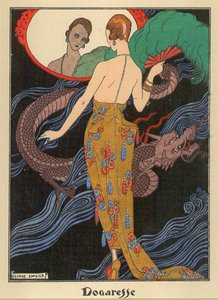
George Barbier's "Fan," painted in 1914, isn’t merely an illustration; it’s a portal into the heart of Art Deco’s opulent androgyny. This exquisite piece, now meticulously reproduced, captures a fleeting moment of sophisticated leisure within a world brimming with theatrical glamour and subtle symbolism. Barbier, a master orchestrator of visual style, didn't simply depict a fan; he constructed an entire atmosphere—a shimmering tableau vivant that speaks volumes about the era’s fascination with beauty, movement, and the blurring lines between masculine and feminine allure.
The artwork immediately draws the eye to its central subject: two figures engaged in a graceful dance within a richly appointed architectural setting. The composition is deliberately fluid, mirroring the delicate curve of the fan itself, creating a sense of perpetual motion. Barbier’s figures are rendered with an almost dreamlike quality—their poses suggest both intimacy and theatricality, hinting at a private performance unfolding before our eyes. Notice how their garments flow and drape, echoing the fan's intricate design, further emphasizing the interconnectedness of form and movement. The inclusion of a partially visible figure on the left adds to this sense of mystery, inviting us to imagine the narrative behind this captivating scene.
The Palette of Luxury: Color, Line, and Texture
Barbier’s masterful use of color is central to the artwork's impact. Deep blues, vibrant reds, shimmering golds, and creamy whites coalesce into a luxurious palette that evokes both opulence and sophistication. The contrast between the figures’ skin tones and the darker background creates a dramatic effect, highlighting their beauty while simultaneously emphasizing the setting’s grandeur. Barbier expertly employs strong, defined lines to delineate the figures' forms and architectural elements, lending the composition a sense of clarity and precision—a hallmark of Art Deco style. Furthermore, the texture is remarkably rendered; you can almost feel the smooth surface of the fan, the delicate folds of the fabric, and the subtle sheen of the gilded details.
The artwork’s lines aren't simply structural; they are imbued with a sense of dynamism. The ribs of the fan itself form a linear framework that reinforces the composition’s semi-circular shape, while geometric patterns subtly permeate the background, adding to the overall visual richness. These elements work in harmony to create an image that is both visually arresting and intellectually stimulating.
A Deco Dialogue: Symbolism and Historical Context
"Fan" is deeply rooted in the artistic currents of its time—specifically, the rise of Art Deco. Emerging in the 1920s, this style rejected the ornate excesses of previous eras, embracing streamlined forms, geometric patterns, and a fascination with exotic materials and cultures. Barbier’s work reflects these trends perfectly, incorporating elements of both classical mythology (evoked by the figures' poses) and modern design sensibilities. The fan itself—a symbol of elegance, refinement, and social status—takes on new significance within this context.
The scene subtly alludes to themes of courtship and performance, reminiscent of the lavish balls and theatrical productions that defined Parisian society during the early 20th century. Barbier’s meticulous attention to detail—from the intricate fan design to the luxurious fabrics—creates a world where beauty is paramount and social rituals are elevated to an art form. The artwork can be seen as a visual manifesto of Art Deco's celebration of glamour, sophistication, and the pursuit of pleasure.
Bringing “Fan” Home: Reproduction and Artistic Legacy
Today, George Barbier’s "Fan" continues to captivate audiences with its timeless beauty and evocative atmosphere. A meticulously crafted reproduction allows you to bring this exquisite artwork into your home or office, adding a touch of Deco elegance to any space. The high-quality print captures the original's rich colors and intricate details, while the canvas provides a durable and visually appealing surface. Whether displayed as a statement piece in a living room or incorporated into an interior design scheme, “Fan” is sure to spark conversation and admiration.
Consider this artwork not just as a decorative object, but as a window into a bygone era—a testament to the artistic vision of George Barbier and the enduring allure of Art Deco style. It’s a reminder that beauty, sophistication, and a touch of mystery can still be found in the most carefully crafted details.
Questions & Answers
Where should a reproduction of "Fan" by Georges Barbier be hung?
With its landscape shape, a reproduction of "Fan" is suggested for a living room.
Who made "Fan", and when?
The author of "Fan" is Georges Barbier, and the work is dated 1914.
In which year and which movement was "Fan" made?
"Fan" by Georges Barbier is dated 1914 and belongs to Art Deco.
Artist Biography
George Barbier: The Architect of Art Deco Elegance
George Barbier (1882-1932) wasn’t merely an illustrator; he was a meticulous architect of style, a visual storyteller who shaped the aesthetic landscape of the early 20th century. Born in Nantes, France, into a family steeped in artistic tradition – his father was a painter and his cousin Paul Iribe a celebrated designer – Barbier inherited a deep appreciation for beauty and an innate ability to translate it onto paper. His career, though relatively brief, left an indelible mark on fashion, theatre, and decorative arts, establishing him as one of the foremost figures of the Art Deco movement.
Barbier’s early training at the École des Beaux-Arts in Paris provided a solid foundation in classical drawing techniques, but it was his exposure to the vibrant social circles surrounding magazines like *La Gazette du Bon Ton* that truly ignited his creative spirit. He became part of a close-knit group of artists – including Paul Iribe, Bernard Boutet de Monvel, and Georges Lepape – known affectionately as “The Knights of the Bracelet,” a moniker reflecting their penchant for flamboyant attire and sophisticated designs. This environment fostered experimentation and collaboration, pushing Barbier to explore new approaches to illustration and design.
A Symphony of Fashion and Theatre
Barbier’s work is instantly recognizable by its opulent detail, intricate patterns, and a masterful command of color. He initially gained prominence through his illustrations for fashion magazines, particularly *La Gazette du Bon Ton*, where he captured the spirit of Parisian society with breathtaking elegance. His depictions of women in shimmering gowns, adorned with feathers, jewels, and elaborate headwear, were not simply portraits; they were miniature narratives, conveying a sense of glamour, sophistication, and even playful sensuality. He didn’t just draw dresses; he created entire worlds around them.
However, Barbier's talent extended far beyond the realm of fashion. He quickly established himself as a sought-after designer for theatre productions, creating stunning costumes for ballet companies like Sergei Diaghilev’s Ballets Russes and collaborating on lavish sets for the Folies Bergère in Paris. His designs were characterized by their exotic influences – incorporating motifs from ancient Egypt, Persia, and the Far East – blended seamlessly with Art Deco geometric forms and luxurious fabrics. His work for *Casanova* (1928), a production starring Rudolph Valentino, cemented his reputation as a master of theatrical costume design.
The Falbalas & Fanfreluches: A Visual Legacy
Perhaps Barbier’s most enduring legacy lies in his series of almanacs, *Falbalas et Fanfreluches* (1922-1926). These beautifully illustrated books were a showcase for his distinctive style – a dazzling blend of fashion, fantasy, and decorative motifs. Each page was a miniature masterpiece, filled with exquisitely rendered figures, intricate patterns, and a palpable sense of joie de vivre. The titles themselves—"falbalas" (ruffles) and "fanfreluches" (frills)—perfectly captured the essence of his work: a celebration of luxurious fabrics and playful ornamentation.
These almanacs weren’t merely decorative; they were carefully constructed visual narratives, often depicting social gatherings, exotic travels, and moments of romantic intrigue. Barbier's meticulous attention to detail—from the texture of silk to the sparkle of diamonds—created a world of unparalleled beauty and sophistication. The influence of *Falbalas et Fanfreluches* can still be seen today in contemporary fashion and design, demonstrating the enduring power of Barbier’s vision.
Influences and Artistic Connections
Barbier's artistic development was shaped by a diverse range of influences. The classical training he received at the École des Beaux-Arts provided him with a strong foundation in drawing and composition, while his exposure to contemporary movements like Fauvism and Cubism broadened his aesthetic horizons. He also drew inspiration from Orientalist art, particularly the vibrant colors and intricate patterns of Persian textiles. His close relationships with other prominent artists – including Paul Iribe and Georges Lepape – fostered a spirit of collaboration and experimentation that fueled his creative growth.
Furthermore, Barbier’s work reflects the broader cultural trends of the 1920s—a period marked by economic prosperity, technological innovation, and a fascination with exotic cultures. The rise of mass media, particularly magazines like *La Gazette du Bon Ton*, provided him with a platform to reach a wide audience and establish his reputation as one of the leading illustrators of his time.
A Lasting Impact
George Barbier’s career was tragically cut short by illness in 1932, at the age of 50. Despite his untimely death, his work continues to captivate and inspire. His illustrations are prized for their beauty, elegance, and technical virtuosity, and they remain a defining example of Art Deco style. Barbier’s legacy extends beyond the realm of illustration; he helped to shape the visual language of fashion, theatre, and decorative arts, leaving an enduring mark on the cultural landscape.

Georges Barbier
1882 - 1932 , France
Quick Facts
- Full Name: Georges Augustin Barbier
- Nationality: French
- Date Of Birth: 1882
- Date Of Death: 1932
- Place Of Birth: Nantes, France
- Notable Artworks:
- Falbalas et Fanfreluches
- Le Gout De Chales
- Artistic Movement Or Style: Art Deco
- Artists Who Influenced This Artist:
- Paul Iribe
- Bernard Boutet
- Artists Or Movements Influenced By This Artist:
- Diane Von Furstenberg
- Ken Russell
Related Articles

Georges Seurat's Masterpieces: 25 Paintings That Defined Pointillism | OriginalUniqueArt
Explore 25 iconic Georges Seurat paintings & discover the brilliance of Pointillism. From 'La Grande Jatte' to his harbor scenes, delve into art history with OriginalUniqueArt.com. Find museum-quality reproductions for your home decor. Explore the full collection online!

The Theatrical Elegance of Art Deco: The Line Work and Fashion Genius of Erté
Discover the unparalleled elegance of Art Deco through the lens of Erté. Explore a masterclass in linear precision, theatrical costume design, and high-fashion illustration that continues to define modern luxury and sophisticated interior aesthetics.

Mastering Cubism: The Top 25 Georges Braque Artworks
Explore 25 iconic Georges Braque masterpieces and the birth of Cubism. Discover museum-quality art on OriginalUniqueArt.com.

Georges Barbier: A Synthesis of Art Nouveau Elegance & Early 20th-Century Fashion Illustration
Explore the exquisite world of Georges Barbier, a leading Art Nouveau illustrator celebrated for his opulent fashion designs & masterful pochoir technique. Discover his legacy and find collectible art at OriginalUniqueArt.
Theatrical Elegance: The Art Deco Genius of Erté and the Era of Fashion Illustration
Explore the theatrical elegance of Erté and the Art Deco era. Discover how his mastery of geometric line and fashion illustration can elevate luxury hospitality design through premium, hand-painted reproductions and bespoke architectural art solutions.