Switch to Print
 Read More







































 For artworks or reproductions larger than 105 cm (approximately 41 inches) on any side, the frame will be shipped as a kit, disassembled. This method ensures safe delivery and prevents damage during transport.


The Enigmatic Figure: Unveiling Gentile Bellini's Masterpiece
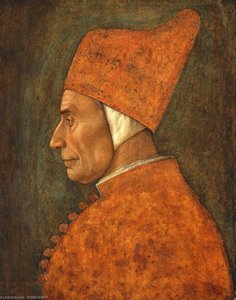
Before us lies a captivating pencil drawing, a testament to the extraordinary skill and keen observation of Gentile Bellini. More than simply a portrait, it’s a window into the vibrant world of 15th-century Venice – a city brimming with artistic innovation, political intrigue, and burgeoning mercantile power. The subject, identified through meticulous historical research as likely the same individual depicted in a profile portrait by his teacher, Gentile da Fabriano, possesses an arresting presence, immediately drawing the viewer into a moment of quiet contemplation. Bellini’s genius lies not just in capturing likeness but in imbuing the figure with a profound sense of individuality and psychological depth – a rare achievement for his time.
The composition is remarkably restrained yet powerfully effective. The subject, rendered in three-quarter view, faces slightly to the right, creating an immediate connection with the observer. His gaze, direct and unwavering, suggests both awareness and a subtle reserve. Bellini masterfully employs a limited palette of dark grays and blacks, skillfully layering hatching and cross-hatching techniques to build up tonal values and create a remarkable sense of volume and texture. The careful manipulation of light and shadow not only defines the contours of the face but also subtly hints at the character’s inner life – a quiet dignity tempered by an underlying complexity.
A Venetian Identity: Context and Symbolism
To fully appreciate Bellini's portrait, it is crucial to understand its historical context. Venice in the mid-15th century was a hub of artistic exchange, a melting pot of influences from across Europe and the East. The city’s wealth, derived largely from trade with the Orient, fueled an unprecedented patronage of the arts, attracting some of the greatest artists of the era. Bellini himself benefited immensely from this environment, securing prestigious commissions as the official painter to the Doges – the rulers of Venice.
Several elements within the portrait contribute to its symbolic richness. The beretta (a type of Venetian hat), a prominent feature of the subject’s attire, immediately identifies him as a Venetian citizen. The stole-like becchetto draped over his right shoulder is another characteristic element of Venetian fashion, further anchoring the figure within this specific cultural milieu. Beyond these immediate markers of identity, the portrait speaks to broader themes of status, power, and perhaps even melancholy – qualities that resonate deeply with viewers across centuries.
The Technique: A Masterclass in Pencil Drawing
Bellini’s skill as a draftsman is undeniable. The precision of his lines, the subtle gradations of tone, and the remarkable detail evident in the rendering of the subject's face and hair are testaments to his exceptional talent. He demonstrates an intimate understanding of how pencil can be used to capture texture – from the smooth expanse of the robe to the unruly strands of hair. The artist’s attention to anatomical accuracy is particularly noteworthy, reflecting a deep appreciation for the human form.
The use of hatching and cross-hatching creates an illusion of depth and volume that belies the limitations of the medium. Bellini skillfully manipulates these techniques to suggest the folds of fabric, the contours of the face, and the play of light and shadow across the subject’s features. This masterful control over line and tone elevates the portrait beyond a mere likeness; it becomes a study in form, texture, and psychological expression.
A Legacy Enduring: Reproduction and Appreciation
Today, Bellini's portrait stands as a remarkable example of Renaissance artistry – a testament to the enduring power of observation, skill, and artistic vision. Reproductions offer an accessible way to experience this masterpiece firsthand, allowing us to appreciate its beauty and complexity in our own homes or offices. When selecting a reproduction, consider the quality of the print and the attention to detail paid by the artisan. A faithful reproduction will capture the essence of Bellini’s original drawing – his quiet dignity, his subtle psychological depth, and his profound connection to the vibrant world of 15th-century Venice.
Questions & Answers
Can I see "Self-Portrait(?)" by Gentile Bellini on my own wall before buying?
"Self-Portrait(?)" has an augmented reality preview: the artwork's AR Preview page shows it in your own space on a compatible device.
What is "Self-Portrait(?)" made with, and in which style?
"Self-Portrait(?)" by Gentile Bellini combines the acrylic on canvas technique with the Renaissance style. Technique and movement describe the making and the style of the work.
Where does "Self-Portrait(?)" fall in Gentile Bellini's career?
"Self-Portrait(?)" represents the Mature Period of Gentile Bellini.
More about this painting
 Preview
 Send
Send Share
Share
 Details
 Guide
Guide

 Download
 Similars
 X-Ray
X-Ray Diaporama
 Q&A
Q&A Stats
Stats