Preview
 Send
Send Share
Share
 Details
 Guide
Guide

 Download
 Similars
 X-Ray
X-Ray Diaporama
 Q&A
Q&A Stats
StatsThe Sick Girl

- 30.0 x 26.0 cm


 Read More
Giclée / Art Print
Museum-quality giclée or canvas print with fast production and flexible finish options. ( Buy Hand Made Painting Switch to Digital Image)




P118B $10

P118H $10

P118W $10

P438Z $10

P508JH $12

P508YH $12

P805H $10

P805Z $10

P919BZ $10

P919G $10

P919XJ $10

P959ZH $10

P968JZ $12

W106C $8

W218G $10

W218JH $8

W218Y $10

W307PJ $10

W316G $10

W316PJ $8

W316Y $10

W398PJ $8

W4111J $10

W500HY $15

W500JH $15

W692G $12

W849H $8

W940BG $15

W953PJ $8




Pick from our preset sizes that match the artwork's original proportions.

Type the width and the height you need, to fit your frame or your wall. A print can only be cut, never made bigger than the picture, so a size with a different shape loses a part of the image. We send you a digital mockup to approve before we print anything. The picture shown on this page does not show the real cut — only the mockup does.
Worldwide Delivery () in 2 weeks instead of standard 4/5 weeks. (5 November)

Free Worldwide Express Shipping

High-Quality Linen Canvas

Full Shipping Insurance

Customs Tax Refund Guarantee

True Color Matching Guarantee

100-Day Return Policy (Defects Only)

100% Money-Back Guarantee

Bulk Discount Offer
 Glass option is only available in size under 110 CM

The Sick Girl
Giclée / Art Print
Reproduction Size
-


Total Price
$ 81
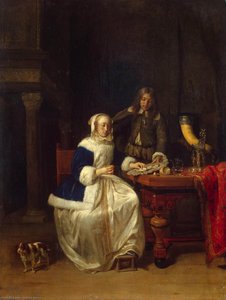
A Portrait of Vulnerability and Care: Exploring Gabriel Metsu’s “The Sick Girl”
Gabriel Metsu (1629–1667), a Dutch Golden Age painter, stands as an enigmatic figure whose artistic legacy continues to captivate scholars and admirers alike. Unlike his contemporaries Rembrandt and Vermeer who achieved widespread fame, Metsu's oeuvre remains relatively small—approximately 133 works—yet profoundly influential in capturing the nuanced realities of domestic life during the Baroque period. This essay delves into the intricacies of “The Sick Girl,” examining its artistic merits, symbolic resonance, and enduring appeal as a masterpiece of genre painting.
- Subject Matter: The painting depicts a young woman lying in bed, her eyes closed in repose—a poignant portrayal of illness or perhaps peaceful slumber. Her serene expression contrasts sharply with the palpable concern radiating from the man standing beside her, highlighting themes of compassion and familial devotion.
- Style & Technique: Metsu’s distinctive style is characterized by meticulous realism combined with a subtle atmospheric haze—a technique known as *tenebrismo*, which was heavily influenced by Rembrandt’s masterful use of chiaroscuro. The artist skillfully renders the textures of the bed linen, drapery, and woman's dress with remarkable precision, conveying an impression of palpable warmth and intimacy.
- Historical Context: Created in 1658 during the height of Dutch artistic innovation, “The Sick Girl” reflects the broader cultural preoccupation with mortality and spiritual contemplation prevalent at the time. It aligns perfectly with the burgeoning interest in portraying everyday life with psychological depth—a trend that distinguished Dutch painting from its counterparts in other European nations.
Symbolism Within Domestic Tranquility
Beyond its technical brilliance, “The Sick Girl” is laden with symbolic significance. The woman’s closed eyes represent vulnerability and surrender to illness, while the attentive gaze of the man symbolizes paternal care and unwavering support. The inclusion of a basket—likely containing medicinal herbs or remedies—underscores the importance of natural healing and reinforces the painting's overarching message of compassion and familial responsibility. These elements speak to broader humanist ideals that permeated Dutch society during Metsu’s lifetime.
Metsu’s Legacy: An Eclectic Vision
Gabriel Metsu’s artistic approach defied categorization, earning him the moniker “a highly eclectic artist.” He excelled in diverse genres—history paintings, still lifes, portraits, and genre scenes—demonstrating an unparalleled versatility that distinguishes him from many of his peers. While only 14 of his works bear dates, their enduring beauty and psychological insight attest to Metsu’s profound understanding of human emotion and experience. His influence can be discerned in the work of subsequent generations of Dutch painters who embraced similar stylistic conventions.
Resources for Further Exploration
Questions & Answers
What is the dominant hue of "The Sick Girl" by Gabriel Metsu?
The dominant hue of "The Sick Girl" by Gabriel Metsu is warm sunset tones. The hue is the underlying tone of the palette.
Where does "The Sick Girl" sit within Gabriel Metsu's body of work?
"The Sick Girl" belongs to Gabriel Metsu's Dutch Golden Age work, whose recorded themes include rembrandt’s realism & tonal shading, domestic tranquility, compassion shown, symbolic gesture of tenderness, reflecting humanist values.
Where can I buy a digital image of "The Sick Girl" by Gabriel Metsu?
A digital image of "The Sick Girl" by Gabriel Metsu can be purchased on its Digital Image page: a high-resolution digital image download.
Artist Biography
**a life of artistic exploration**
gabriël metsu, a dutch painter from the netherlands, lived a life marked by artistic exploration and innovation. born in 1629, metsu's work embodied the spirit of the dutch golden age, a period renowned for its prolific artistic output. this biography delves into the life and works of this enigmatic figure, whose contributions to the art world continue to fascinate.**early life and influences**
metsu was born in 1629, the son of jacques metsu, a tapestry worker and painter originally from hainault. this eclectic background likely influenced gabriel's early interest in diverse artistic techniques. the family's move to leiden, where metsu grew up, exposed him to various cultural influences.**artistic career**
metsu's career was marked by an adherence to no single style or technique, earning him the title of "a highly eclectic artist." his work spanned history paintings, still lifes, portraits, and genre works. notably, only 14 of his 133 works are dated, leaving much to be discovered about his creative process.- rembrandt van rijn's influence on metsu's early work is evident, particularly in his use of light and color.
- metsu's move to amsterdam in 1655 marked a significant shift in his style, with more emphasis on domestic interiors and genre scenes.
- his training of michiel van musscher and joost van geel reflects his commitment to the artistic community.
**notable works and legacy**
metsu's paintings often featured young women, market scenes, and old people, drawing from popular emblems. a notable example is the poultry seller, which showcases his use of symbolism. key works:- the sick child (c. 1664), reflecting metsu's admiration for vermeer's work.
- portrait of the family hinlopen, a masterpiece that blends genre and portrait painting.
**museums and collections**
metsu's works can be found in various museums, including the rijksmuseum in amsterdam. for more information on his art and to explore other dutch golden age painters, visit /en/art/show/art-d3c627-en/ for a comprehensive overview. **conclusion:** gabriel metsu's life and art are a testament to the innovative spirit of the dutch golden age. his eclectic style, though sometimes enigmatic, has left an indelible mark on the world of art. as we continue to uncover more about his life and works, we are reminded of the profound impact he had on the development of western art.- for a deeper understanding of the dutch golden age, refer to [https://en.wikipedia.org/wiki/dutch_golden_age_painting](https://en.wikipedia.org/wiki/dutch_golden_age_painting).
- explore more of metsu's works and those of his contemporaries at [https://OriginalUniqueArt.com/@/gabriel-metsu](https://OriginalUniqueArt.com/@/gabriel-metsu).
**references:**
- the house of orange-nassau historic collection trust (the hague, netherlands), [https://OriginalUniqueArt.com/@@/a@d3ccx5](https://OriginalUniqueArt.com/@@/a@d3ccx5).
- van gogh museum (netherlands) - a haven for art lovers, [https://OriginalUniqueArt.com/@@/a@d3c8x3](https://OriginalUniqueArt.com/@@/a@d3c8x3).
- dutch golden age painting, [https://en.wikipedia.org/wiki/dutch_golden_age_painting](https://en.wikipedia.org/wiki/dutch_golden_age_painting).

Gabriel Metsu
1629 - 1667 , Netherlands
Quick Facts
- Artistic Movement Or Style: Dutch Golden Age painting
- Artists Or Movements Influenced By This Artist:
- Michiel van Musscher
- Joost van Geel
- Artists Who Influenced This Artist:
- Rembrandt van Rijn
- Johannes Vermeer
- Date Of Birth: 1629
- Date Of Death: 1667
- Full Name: Gabriel Metsu
- Nationality: Dutch
- Notable Artworks:
- The Sick Child
- Poultry Seller
- Portrait of the Hinlopen Family
- Place Of Birth: Leiden, Netherlands
Related Articles

Golden Age Reflections: Dutch Baroque Painting & Cultural Innovation
Explore the Dutch Golden Age of painting! Discover key artists like Vermeer & ter Borch, their innovative techniques, and the rich cultural context behind these Baroque masterpieces. Learn about collecting & appreciating this iconic art period.

Dutch Masters: 10 Golden Age Paintings That Still Inspire |
Journey into the Dutch Golden Age! Explore 10 iconic paintings by Rembrandt, Vermeer & Hals. Discover the stories behind these Baroque masterpieces and find museum-quality art reproductions to elevate your home decor on .

Illuminating Innovation: Exploring the Dutch Golden Age of Painting
Explore the Dutch Golden Age of painting with OriginalUniqueArt. Discover Rembrandt, Vermeer & other Masters. Learn about key characteristics, iconic artworks, and lasting influence. Expert insights for collectors & enthusiasts.

Mastering Light & Shadow: A Journey Through the Dutch Golden Age's Luminous Legacy
Embark on a cultural journey through the Dutch Golden Age. Explore the masterful interplay of light and shadow in 17th-century masterpieces, from Rembrandt to Vermeer, and discover how this era of profound realism continues to inspire fine art collectors today.

Golden Light & Dutch Skies: The Timeless Magic of Dutch Golden Age Landscapes
Discover the breathtaking beauty of Dutch Golden Age landscapes. Explore the mastery of light, chiaroscuro, and 17th-century realism through an expert art history lens, celebrating the enduring legacy of the Dutch Masters for discerning collectors and art lovers.