Preview
 Send
Send Share
Share
 Details
 Guide
Guide

 Download
 Similars
 X-Ray
X-Ray Diaporama
 Stats
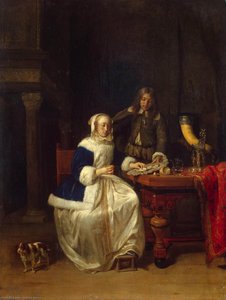
StatsThe Letter-Writer Surprised
 Oil
Oil- WallArt
- Baroque Dutch Painting
 1662
1662- Early Modern
 45.0 x 39.0 cm
 Wallace Collection
 Read More
Giclée / Art Print
Museum-quality giclée or canvas print with fast production and flexible finish options. ( Buy Hand Made Painting Switch to Digital Image)




P118B $10

P118H $10

P118W $10

P438Z $10

P508JH $12

P508YH $12

P805H $10

P805Z $10

P919BZ $10

P919G $10

P919XJ $10

P959ZH $10

P968JZ $12

W106C $8

W218G $10

W218JH $8

W218Y $10

W307PJ $10

W316G $10

W316PJ $8

W316Y $10

W398PJ $8

W4111J $10

W500HY $15

W500JH $15

W692G $12

W849H $8

W940BG $15

W953PJ $8




Pick from our preset sizes that match the artwork's original proportions.

Type the width and the height you need, to fit your frame or your wall. A print can only be cut, never made bigger than the picture, so a size with a different shape loses a part of the image. We send you a digital mockup to approve before we print anything. The picture shown on this page does not show the real cut — only the mockup does.
Worldwide Delivery () in 2 weeks instead of standard 4/5 weeks. (24 October)

Free Worldwide Express Shipping

High-Quality Linen Canvas

Full Shipping Insurance

Customs Tax Refund Guarantee

True Color Matching Guarantee

100-Day Return Policy (Defects Only)

100% Money-Back Guarantee

Bulk Discount Offer
 Glass option is only available in size under 110 CM

The Letter-Writer Surprised
Giclée / Art Print
Reproduction Size
-


Total Price
$ 81
A Quiet Intrusion: The Intimacy of Metsu’s Masterpiece
In the soft, amber glow of a seventeenth-century Dutch interior, a single moment is suspended in time, caught between the act of creation and the sting of discovery. Gabriel Metsu’s “The Letter-Writer Surprised,” painted around 1662, is far more than a mere domestic scene; it is a psychological drama played out in the hushed tones of a bourgeois home. As we gaze upon the woman seated at her desk, her focus entirely consumed by the parchment before her, we feel the weight of the unseen observer. The painting invites us into a world where every fold of fabric and every flicker of candlelight tells a story of secret thoughts and social boundaries. For the collector or the lover of fine art, this work offers a profound window into the Dutch Golden Age, capturing that delicate, fleeting instant when privacy is breached by a sudden, unexpected presence.
The composition is a masterclass in the Baroque use of chiaroscuro, where light does not merely illuminate but actively sculpts the narrative. Metsu employs a dramatic contrast between deep, velvety shadows and luminous highlights to draw the eye toward the central figures. The light spills across the woman’s linen attire and the textured surface of the wooden table, lending an almost tactile realism to the scene. This technique, reminiscent of the legendary Vermeer, creates a sense of three-dimensional depth that pulls the viewer into the room. One can almost hear the scratch of the quill against paper and the heavy silence that follows the man's sudden appearance. The presence of objects like the violin resting nearby and the glint of a wine glass adds layers of sensory richness, suggesting a life of cultured leisure interrupted by a moment of tension.
Symbolism and the Art of Observation
Beyond its technical brilliance, “The Letter-Writer Surprised” is rich with the symbolic language characteristic of the Dutch genre painting. The act of letter writing itself was often a metaphor for intimacy, longing, and the exchange of private emotions. By placing a man in the periphery—seemingly attentive yet subtly distanced—Metsu explores the complex interplay between presence and absence. Is he a protector, or is his gaze an intrusion? This ambiguity is what gives the painting its enduring emotional impact. The carefully placed books and musical instruments serve as emblems of a refined, intellectual lifestyle, yet they also ground the scene in a tangible reality that resonates with anyone who appreciates the beauty of domestic tranquility.
For those looking to bring a sense of historical elegance and contemplative depth into a contemporary space, this masterpiece serves as an incomparable focal point. Whether placed in a sunlit study or a sophisticated dining room, a high-quality reproduction of Metsu’s work commands attention through its quiet power. It does not shout for recognition; instead, it rewards the patient observer with subtle nuances of expression and a timeless atmosphere of grace. To possess such a piece is to hold a fragment of history—a beautifully rendered testament to the human desire to capture the ephemeral beauty of life's most private moments.
Questions & Answers
Who is "The Letter-Writer Surprised" suggested for as a present, and for what use?
"The Letter-Writer Surprised" is suggested for anniversary as a present, with statement in mind.
From which era does "The Letter-Writer Surprised" date?
"The Letter-Writer Surprised" belongs to the Early-Modern era.
How many people view "The Letter-Writer Surprised"?
A Stats page exists for "The Letter-Writer Surprised". It charts the monthly visits of the artwork and of the artist's other works, with country and language breakdowns.
Artist Biography
**a life of artistic exploration**
gabriël metsu, a dutch painter from the netherlands, lived a life marked by artistic exploration and innovation. born in 1629, metsu's work embodied the spirit of the dutch golden age, a period renowned for its prolific artistic output. this biography delves into the life and works of this enigmatic figure, whose contributions to the art world continue to fascinate.**early life and influences**
metsu was born in 1629, the son of jacques metsu, a tapestry worker and painter originally from hainault. this eclectic background likely influenced gabriel's early interest in diverse artistic techniques. the family's move to leiden, where metsu grew up, exposed him to various cultural influences.**artistic career**
metsu's career was marked by an adherence to no single style or technique, earning him the title of "a highly eclectic artist." his work spanned history paintings, still lifes, portraits, and genre works. notably, only 14 of his 133 works are dated, leaving much to be discovered about his creative process.- rembrandt van rijn's influence on metsu's early work is evident, particularly in his use of light and color.
- metsu's move to amsterdam in 1655 marked a significant shift in his style, with more emphasis on domestic interiors and genre scenes.
- his training of michiel van musscher and joost van geel reflects his commitment to the artistic community.
**notable works and legacy**
metsu's paintings often featured young women, market scenes, and old people, drawing from popular emblems. a notable example is the poultry seller, which showcases his use of symbolism. key works:- the sick child (c. 1664), reflecting metsu's admiration for vermeer's work.
- portrait of the family hinlopen, a masterpiece that blends genre and portrait painting.
**museums and collections**
metsu's works can be found in various museums, including the rijksmuseum in amsterdam. for more information on his art and to explore other dutch golden age painters, visit /en/art/show/art-d3c627-en/ for a comprehensive overview. **conclusion:** gabriel metsu's life and art are a testament to the innovative spirit of the dutch golden age. his eclectic style, though sometimes enigmatic, has left an indelible mark on the world of art. as we continue to uncover more about his life and works, we are reminded of the profound impact he had on the development of western art.- for a deeper understanding of the dutch golden age, refer to [https://en.wikipedia.org/wiki/dutch_golden_age_painting](https://en.wikipedia.org/wiki/dutch_golden_age_painting).
- explore more of metsu's works and those of his contemporaries at [https://OriginalUniqueArt.com/@/gabriel-metsu](https://OriginalUniqueArt.com/@/gabriel-metsu).
**references:**
- the house of orange-nassau historic collection trust (the hague, netherlands), [https://OriginalUniqueArt.com/@@/a@d3ccx5](https://OriginalUniqueArt.com/@@/a@d3ccx5).
- van gogh museum (netherlands) - a haven for art lovers, [https://OriginalUniqueArt.com/@@/a@d3c8x3](https://OriginalUniqueArt.com/@@/a@d3c8x3).
- dutch golden age painting, [https://en.wikipedia.org/wiki/dutch_golden_age_painting](https://en.wikipedia.org/wiki/dutch_golden_age_painting).

Gabriel Metsu
1629 - 1667 , Netherlands
Quick Facts
- Artistic Movement Or Style: Dutch Golden Age painting
- Artists Or Movements Influenced By This Artist:
- Michiel van Musscher
- Joost van Geel
- Artists Who Influenced This Artist:
- Rembrandt van Rijn
- Johannes Vermeer
- Date Of Birth: 1629
- Date Of Death: 1667
- Full Name: Gabriel Metsu
- Nationality: Dutch
- Notable Artworks:
- The Sick Child
- Poultry Seller
- Portrait of the Hinlopen Family
- Place Of Birth: Leiden, Netherlands
Related Articles

Gabriel Metsu: Illuminating Dutch Daily Life with Exquisite Detail
Explore the captivating world of Gabriel Metsu, a leading Dutch Golden Age painter. Discover his exquisite genre scenes, masterful realism, and insightful social commentary. Learn about key works & his lasting legacy.
Dutch Baroque Unlocked: Mastering Chiaroscuro, Epic Drama, and the High-Impact Legacy of Rembrandt
Explore the dramatic power of Dutch Baroque art. Master the secrets of Rembrandt’s chiaroscuro, discover the epic scale of the Golden Age, and learn how to bring high-impact, hand-painted historical masterpieces into your modern collection with expert precision.

Golden Light & Dutch Skies: The Timeless Magic of Dutch Golden Age Landscapes
Discover the breathtaking beauty of Dutch Golden Age landscapes. Explore the mastery of light, chiaroscuro, and 17th-century realism through an expert art history lens, celebrating the enduring legacy of the Dutch Masters for discerning collectors and art lovers.

Dutch Baroque Masters: 10 Paintings That Shaped an Era | OriginalUniqueArt
Journey through the Golden Age with our guide to the Top 10 Dutch Baroque masterpieces! Explore iconic paintings by Rembrandt, Vermeer & Frans Hals. Find museum-quality art reproductions and elevate your home decor at OriginalUniqueArt.com.

Golden Age Reflections: Dutch Baroque Painting & Cultural Innovation
Explore the Dutch Golden Age of painting! Discover key artists like Vermeer & ter Borch, their innovative techniques, and the rich cultural context behind these Baroque masterpieces. Learn about collecting & appreciating this iconic art period.