Preview
 Send
Send Share
Share
 Details
 Guide
Guide

 Download
 Similars
 X-Ray
X-Ray Diaporama
 Q&A
Q&A Stats
StatsGloucester Harbor


 Read More
Giclée / Art Print
Museum-quality giclée or canvas print with fast production and flexible finish options. ( Buy Hand Made Painting Switch to Digital Image)




P118B $10

P118H $10

P118W $10

P438Z $10

P508JH $12

P508YH $12

P805H $10

P805Z $10

P919BZ $10

P919G $10

P919XJ $10

P959ZH $10

P968JZ $12

W106C $8

W218G $10

W218JH $8

W218Y $10

W307PJ $10

W316G $10

W316PJ $8

W316Y $10

W398PJ $8

W4111J $10

W500HY $15

W500JH $15

W692G $12

W849H $8

W940BG $15

W953PJ $8




Pick from our preset sizes that match the artwork's original proportions.

Type the width and the height you need, to fit your frame or your wall. A print can only be cut, never made bigger than the picture, so a size with a different shape loses a part of the image. We send you a digital mockup to approve before we print anything. The picture shown on this page does not show the real cut — only the mockup does.
Worldwide Delivery () in 2 weeks instead of standard 4/5 weeks. (31 October)

Free Worldwide Express Shipping

High-Quality Linen Canvas

Full Shipping Insurance

Customs Tax Refund Guarantee

True Color Matching Guarantee

100-Day Return Policy (Defects Only)

100% Money-Back Guarantee

Bulk Discount Offer
 Glass option is only available in size under 110 CM

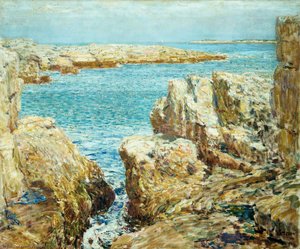
Gloucester Harbor
Giclée / Art Print
Reproduction Size
-


Total Price
$ 81
A Glimpse into American Leisure: Gloucester Harbor
To stand before this depiction of Gloucester Harbor is to be instantly transported to a sun-drenched afternoon in the late nineteenth or early twentieth century. Frederick Childe Hassam, master chronicler of American life, has gifted us more than just a painting; he has captured an atmosphere—a palpable sense of tranquil industry and leisurely grace. The scene unfolds across a vast expanse of water, dotted with at least thirteen vessels, each boat seeming to rest in the gentle embrace of the tide. One can almost hear the distant cries of gulls mingling with the soft lapping of waves against the pilings.
The Artistry of Impressionism in American Shores
Hassam’s command of Impressionist technique is breathtakingly evident here. He was a pioneer who helped cement this style within the American art consciousness, moving beyond mere imitation to capture the very essence of light itself. Notice how the sunlight doesn't just illuminate; it refracts. The water is not a flat mirror but a complex tapestry of shifting blues, greens, and reflected sky—a testament to his masterful handling of color theory. His brushwork, while conveying an overall sense of serene calm, retains that characteristic broken touch, allowing the viewer’s eye to complete the visual symphony. This technique ensures that even in reproduction, the vibrancy and immediacy of Hassam's original vision remain startlingly alive.
Life Interwoven with the Tide
What elevates this piece beyond a mere seascape is the vibrant human element. Scattered across the foreground and along the quayside are at least fourteen figures, engaged in the quiet ballet of harbor life. Some stand observing the water, others perhaps returning from their day's labors. These individuals are not merely props; they imbue the scene with narrative depth. They speak to a time when coastal towns like Gloucester were vital hubs—places where commerce met community, and where the rhythm of daily existence was dictated by the tides. The overall feeling is one of contented repose, a perfect pause in the relentless march of modern life.
A Timeless Appeal for the Modern Collector
For the discerning collector or designer seeking to infuse a space with history and light, this reproduction offers unparalleled emotional resonance. It speaks to an idealized American past—a time perceived as more connected to nature and community. Whether placed in a sunlit drawing-room overlooking water or within a study dedicated to maritime history, Gloucester Harbor acts as a visual balm. It invites contemplation, suggesting that true beauty is found not in grand gestures, but in the quiet moments shared between people and the enduring majesty of the natural world.
Questions & Answers
How does "Gloucester Harbor" by Frederick Childe Hassam connect American Impressionism to the artist's home country?
"Gloucester Harbor" was created by Frederick Childe Hassam, born in United States of America, within the American Impressionism movement. The artist's origin links the work to American Impressionism as practiced by artists from United States of America.
Who created "Gloucester Harbor"?
The artist behind "Gloucester Harbor" is Frederick Childe Hassam. The work is catalogued under Frederick Childe Hassam's name.
What does the 1918 date of "Gloucester Harbor" correspond to in Frederick Childe Hassam's career?
The 1918 date places "Gloucester Harbor" in the Mature Period of Frederick Childe Hassam's development.
Artist Biography
A Pioneer of American Impressionism: The Life and Art of Frederick Childe Hassam
Born in Boston on October 17, 1859, Frederick Childe Hassam emerged as a pivotal figure in the blossoming of American Impressionism. His journey from a childhood inclination towards art to becoming one of the nation’s most celebrated painters is a testament to his dedication and unique vision. Unlike many of his contemporaries who sought extensive formal training in Europe, Hassam largely developed his skills through self-study and practical application, initially working as an illustrator for magazines like *Harper's Weekly* and *Scribner’s Monthly*. This early experience honed his observational skills and instilled a sense of narrative within his compositions—qualities that would remain hallmarks of his style. Though he did eventually travel to Europe in 1886, studying briefly in Paris, it was the American landscape and urban life that truly captured his artistic imagination. He wasn’t simply replicating European techniques; he was adapting them to depict a distinctly *American* experience.Capturing Light and Modern Life
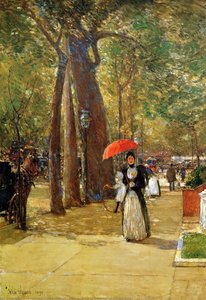
Hassam's art is immediately recognizable for its luminous quality, achieved through a masterful manipulation of light and color. Influenced by Claude Monet and Edgar Degas, he embraced the Impressionist principles of capturing fleeting moments and atmospheric effects. However, Hassam wasn’t merely an imitator; he infused his work with a uniquely American sensibility. He found beauty not only in idyllic landscapes but also in the bustling energy of modern cities like New York and Boston. His paintings often depict scenes of urban life – fashionable ladies strolling along Fifth Avenue, horse-drawn carriages navigating crowded streets, or quiet moments within domestic interiors. These weren’t just depictions of places; they were portraits of a rapidly changing society, capturing the vibrancy and dynamism of late 19th and early 20th century America. Works like *The Sonata* (1893) exemplify his ability to evoke mood and atmosphere through subtle color harmonies and delicate brushwork, creating an intimate and contemplative experience for the viewer. His coastal scenes, such as *Gloucester* (1899), demonstrate a similar sensitivity to light and atmosphere, transforming ordinary harbors into shimmering visions of tranquility.The Ten American Painters and Artistic Independence
A significant chapter in Hassam’s career was his involvement with “The Ten American Painters,” a group formed in 1897 as a protest against the conservative policies of the Society of American Artists. This collective, which included artists like John Henry Twachtman, Willard Leroy Metcalf, and Edmund Tarbell, aimed to exhibit independently and promote a more progressive approach to art. Hassam served as the first president of The Ten, solidifying his role as a leader within the American art world. This period marked a commitment to artistic independence and a rejection of academic constraints, allowing him and his colleagues to explore their individual styles without compromise. His participation in these independent exhibitions helped to establish Impressionism as a legitimate and respected movement within the United States.Patriotism and Later Years: The Flag Paintings
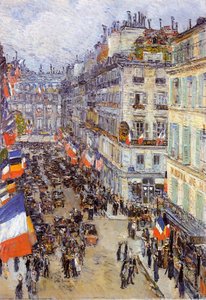
With the outbreak of World War I, Hassam’s artistic focus shifted dramatically. Inspired by a surge of patriotic fervor, he embarked on a series of paintings depicting American flags waving along Fifth Avenue in New York City. These “Flag” paintings, created between 1916 and 1919, are perhaps his most iconic works. They aren't simply representations of national symbols; they are powerful expressions of civic pride and wartime solidarity. The vibrant colors and dynamic compositions convey a sense of energy and optimism amidst the turmoil of global conflict. *Victory Day, May 1919* is a prime example, capturing the jubilant atmosphere of New York City following the armistice. In his later years, Hassam continued to paint, experimenting with etching and lithography alongside his oil paintings. He remained committed to Impressionist principles throughout his career, constantly refining his technique and exploring new ways to capture the beauty of the world around him.Legacy and Enduring Influence
Frederick Childe Hassam passed away in East Hampton, New York, on August 27, 1935, leaving behind a vast and influential body of work. His legacy extends far beyond his technical mastery; he played a crucial role in establishing American Impressionism as a distinct artistic movement. He demonstrated that American artists could not only embrace European techniques but also adapt them to create something uniquely their own. His paintings continue to resonate with audiences today, offering glimpses into a bygone era and reminding us of the enduring power of art to capture the spirit of a time and place. Hassam’s influence can be seen in the work of countless artists who followed him, solidifying his position as one of the most important figures in American art history. His dedication to capturing light, color, and the essence of modern life ensures that his paintings will continue to inspire and captivate generations to come.
Frederick Childe Hassam
1859 - 1935 , United States of America
Quick Facts
- Full Name: Frederick Childe Hassam
- Nationality: American
- Date Of Birth: 1859
- Date Of Death: 1935
- Place Of Birth: Boston, United States of America
- Notable Artworks:
- Maids in the Mist
- Mt. Beacon at Newburgh
- The Jewel Box
- Gloucester
- The Sonata
- Victory Day, May 1919
- Artistic Movement Or Style: Impressionism, Tonalism
- Artists Who Influenced This Artist: ['Claude Monet']
- Artists Or Movements Influenced By This Artist: ['American Impressionism']
Related Articles

Frederick Childe Hassam: American Impressionism's Chronicler of Light & Modern Life
Explore the captivating world of Frederick Childe Hassam, a pioneer of American Impressionism. Discover his iconic paintings capturing light, urban life & coastal beauty. Learn about his legacy and influence on American art history.
Capturing the Light: A Journey Through the Soul of American Impressionism and the Hudson River School
Explore the luminous beauty of American Impressionism and the Hudson River School. Discover a curated journey through light, landscape, and history, celebrating the enduring legacy of masters through exquisite, hand-painted oil reproductions for the discerning art lover.
Evoking the Horizon: A Historical & Artistic Exploration of Coastal Scenes in Painting
Explore the rich history of coastal scenes in painting! Discover Impressionist masterpieces, American realism & contemporary visions. Learn about renowned artists and find your perfect seascape at OriginalUniqueArt.
Capturing a Nation's Light: Exploring the American Impressionist Movement
Explore the captivating world of American Impressionism! Discover key artists, techniques & its lasting impact on art history. Find museum-quality reproductions and expert guidance at OriginalUniqueArt.

Grant Wood & American Regionalism: Identity, Myth & the Rural Landscape
Explore the world of Grant Wood & American Regionalism with OriginalUniqueArt. Discover the symbolism behind 'American Gothic', recurring themes, and the movement's lasting impact on art history. High-quality reproductions available.