Switch to Print
 Read More







































 For artworks or reproductions larger than 105 cm (approximately 41 inches) on any side, the frame will be shipped as a kit, disassembled. This method ensures safe delivery and prevents damage during transport.


A Serene Escape into American Impressionism
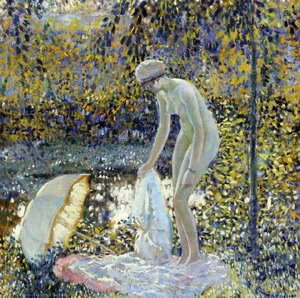
In the gentle embrace of Under the Willows, Frederick Carl Frieseke invites us into a world where time seems to suspend itself amidst the shimmering reflections of a summer afternoon. Created in 1906, this exquisite oil on canvas stands as a quintessential masterpiece of American Impressionism, capturing a moment of profound tranquility. The scene unfolds upon a quiet waterway, where two women reside within the gentle cradle of a boat, surrounded by the lush, cascading greenery of weeping willow trees. There is an immediate, palpable sense of peace that washes over the viewer, as if one has stumbled upon a private, sun-drenched sanctuary far removed from the clamor of modern life.
Frieseke’s mastery lies in his ability to weave light and color into a cohesive, decorative tapestry. The composition is defined by soft, feathery brushstrokes that blur the boundaries between the water, the foliage, and the figures, creating a dreamlike atmosphere. Rather than relying on harsh outlines, the artist utilizes a muted yet luminous palette to suggest the fleeting effects of sunlight filtering through leaves. This technique, deeply rooted in the Impressionist tradition, allows for a magnificent play of light and shadow that lends a remarkable sense of depth and dimensionality to the canvas. For the discerning collector or interior designer, this painting offers a sophisticated interplay of texture and tone that can anchor a room with elegance and grace.
The Artistry of Light and Leisure
Beyond its aesthetic beauty, Under the Willows serves as a window into the cultural zeitgeist of the early 20th century. Frieseke, an artist whose journey took him from the American Midwest to the vibrant studios of Paris, was deeply influenced by the French Impressionist movement. His work often explored themes of leisure, femininity, and the beauty of the natural world, frequently featuring women in idyllic outdoor settings. In this particular piece, the figures are not merely subjects but are integral components of the landscape itself, their presence harmonizing with the rhythmic patterns of the water and the organic curves of the willow branches.
The emotional impact of the work is one of quiet contemplation and nostalgic longing. The subtle inclusion of other figures in the background, engaged in distant activities, adds a layer of narrative depth, suggesting a shared experience of summer bliss. This sense of community within nature provides a comforting warmth to the composition. For those looking to bring a piece of art history into their personal spaces, a high-quality reproduction of this work offers more than just decoration; it provides an enduring window into a period of artistic innovation and a permanent invitation to step into a world of light, color, and eternal serenity.
Questions & Answers
Where do the visitors of "Under the Willows" by Frederick Carl Frieseke come from?
Statistics about "Under the Willows" by Frederick Carl Frieseke are on the artwork's Stats page: monthly visits of the artwork, visits of the artist's works, and country and language breakdowns of recent visitors.
How do I discover artworks close to "Under the Willows" by Frederick Carl Frieseke?
The Similars page of "Under the Willows" by Frederick Carl Frieseke presents related artworks.
In which year and which movement was "Under the Willows" made?
"Under the Willows" by Frederick Carl Frieseke is dated 1906 and belongs to Impressionism.
More about this painting
 Preview
 Send
Send Share
Share
 Details
 Guide
Guide

 Download
 Similars
 X-Ray
X-Ray Diaporama
 Q&A
Q&A Stats
Stats