Oil Edition
 Everything about Mahoning







































 For artworks or reproductions larger than 105 cm (approximately 41 inches) on any side, the frame will be shipped as a kit, disassembled. This method ensures safe delivery and prevents damage during transport.


The Architecture of Chaos: Rediscovering Franz Kline’s Mahoning
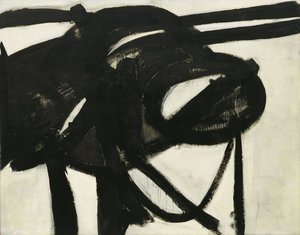
In the pantheon of Abstract Expressionism, few works command the room with such visceral authority as Franz Kline’s “Mahoning,” completed in 1956. To stand before this monumental canvas is to witness a profound dialogue between presence and absence, a struggle captured in the rhythmic collision of black enamel and stark white space. This is not merely a painting; it is an event. As a cornerstone of the New York School, “Mahoning” embodies the very essence of Action Painting, where the artist’s physical gesture becomes the primary subject. The work eschews traditional representation to instead offer a raw, kinetic energy that vibrates with the pulse of mid-century urban life.
The brilliance of Kline’s technique lies in his ability to orchestrate what might initially appear as spontaneous disorder. While many associate the era with the unpredictable drips of Jackson Pollock, Kline’s approach was far more structural and deliberate. He often utilized a projector to enlarge sketches onto massive canvases, allowing him to manipulate the scale of his strokes with architectural precision. In “Mahonoming,” the heavy, black muscularity of the brushwork is balanced by the luminous white voids that press back against the dark forms. Through the meticulous layering of oil and enamel, Kline created a textured, tactile surface that invites the eye to wander through its thick impasto, discovering how light catches the ridges of his energetic, sweeping movements.
A Symphony of Contrast and Memory
Beyond its formalist triumphs, “Mahoning” is deeply rooted in the artist's personal geography and the turbulent zeitgeist of the 1950s. The title itself serves as a poignant tether to Kline’s origins in Pennsylvania, evoking the industrial landscapes and river valleys of his youth. This connection between the monumental scale of the painting and the ruggedness of his namesake suggests a bridge between personal memory and universal abstraction. During the height of the Cold War, as the world grappled with technological shifts and societal anxieties, Kline’s work offered an alternative language—one rooted in primal instinct rather than the sterile rationality of the age.
For the discerning collector or interior designer, “Mahoning” represents a masterclass in tonal balance. Its monochromatic palette provides a sophisticated anchor for modern spaces, offering a sense of dramatic weight that can transform a minimalist room into a gallery-worthy sanctuary. The painting does not merely decorate a wall; it commands the atmosphere, injecting a sense of movement and intellectual depth. Whether viewed as a study of structural tension or an emotional release of energy, this masterpiece remains an enduring symbol of the human struggle to find order within chaos, making it an incomparable centerpiece for any curated collection.
Questions & Answers
Is this Mahoning painted by hand or printed?
Painted by hand: a trained painter copies Mahoning in oil on linen canvas.
What size should I choose for Mahoning?
The original measures 203 x 254 cm. Sizes run from 28.3 x 35.3 cm ($200) to 196.8 x 245.6 cm ($1772); the table on this page lists the main steps and their prices.
How long does delivery take?
Delivery takes 4 to 5 weeks, with free worldwide express shipping; an urgent production option is offered on this page. You can return it within 100 days for a full refund, with no condition.
Where is the original Mahoning?
The original is in the collection of the Whitney Museum of American Art, New York.
What medium did Franz Kline use for Mahoning?
Oil On Canvas.
More about this painting
 Preview

 Send
 Share
 Details
 Fact sheet


 Download
 Similars
 X-Ray
 Diaporama
 Q&A

 Stats