Switch to Print
 Read More







































 For artworks or reproductions larger than 105 cm (approximately 41 inches) on any side, the frame will be shipped as a kit, disassembled. This method ensures safe delivery and prevents damage during transport.


Singing Boy with a Flute: A Window into Dutch Golden Age Life
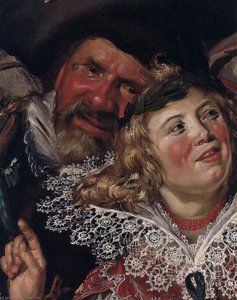
Frans Hals’ “Singing Boy with a Flute,” painted in 1623, isn't merely a portrait; it’s a vibrant snapshot of a fleeting moment, a testament to the artist’s revolutionary approach to capturing human character and emotion. This intimate piece, measuring just 62 x 55 cm, immediately draws the viewer into a scene brimming with youthful exuberance and quiet contemplation. The subject, a young man dressed in a simple yet elegant black hat adorned with a striking white feather – a detail that hints at both status and perhaps a touch of playful vanity – holds a flute to his lips, poised as if about to release a cascade of melody. His gaze, directed squarely at the viewer, is not one of grand pronouncements but rather an expression of absorbed enjoyment, suggesting he’s lost in the pleasure of the music itself.
Hals' genius lies in his masterful manipulation of brushwork. Unlike many of his contemporaries who meticulously rendered every detail with painstaking precision, Hals employed a remarkably loose and expressive technique. Notice how the paint seems to dance across the canvas – short, broken strokes create an immediate sense of movement and vitality. This spontaneity isn’t haphazard; it's deliberate, designed to capture not just the appearance of the boy but also his spirit, his energy, and the very essence of a joyful moment. The background, a deceptively simple blue sky, provides a crucial contrast, emphasizing the figure and adding depth to the composition without distracting from the central subject.
The Artist and His Time: Frans Hals’ Revolutionary Portraiture
Frans Hals I (1582-1585), though his life was tragically short, left an indelible mark on the art world. Born in Antwerp and trained initially in that vibrant artistic hub, he later found a home in Haarlem, where he quickly established himself as one of the most important figures of the Dutch Golden Age. Hals’s work stands apart from the prevailing trends of his era. While other artists focused on idealized representations or elaborate courtly scenes, Hals favored capturing everyday life – portraits of merchants, militia members, and ordinary citizens. This shift reflected a broader cultural change in the Netherlands, where there was growing interest in depicting the lives of common people.
His innovative approach to portraiture wasn’t simply about recording likenesses; it was about revealing personality. Hals frequently used informal poses, direct gazes, and subtle gestures to convey character. He understood that a truly compelling portrait wasn't just a visual representation but an intimate glimpse into the soul of his subject. The inclusion of the feather, for example, is not merely decorative; it’s a detail that adds to the boy’s personality, suggesting perhaps a youthful confidence or a connection to social standing.
Symbolism and Context: A Portrait of Youthful Joy
Beyond the immediate depiction of a young man enjoying music, “Singing Boy with a Flute” offers clues about the cultural context of 17th-century Haarlem. The flute itself was a popular instrument during this period, often associated with entertainment and leisure. The boy’s attire – the simple black hat and clothing – suggests he is likely from a modest background, yet his posture and expression convey a sense of self-possession and contentment. It's a scene that speaks to the pleasures of youth, the importance of community, and the value of artistic expression.
The painting’s placement within the Gemäldegalerie in Berlin is particularly significant. It stands as a cornerstone of Hals’s oeuvre, demonstrating his mastery of capturing fleeting moments and conveying profound emotion with remarkable economy. The work's enduring appeal lies not just in its technical brilliance but also in its ability to transport us back to a specific time and place – a vibrant corner of the Dutch Golden Age where youthful joy and artistic spirit flourished.
Bringing Hals’ Masterpiece Home: A High-Quality Reproduction
OriginalUniqueArt offers meticulously crafted, hand-painted reproductions of “Singing Boy with a Flute,” allowing you to experience the artistry of Frans Hals in your own home. Our skilled artisans replicate Hals's distinctive brushwork and vibrant colors with exceptional accuracy, ensuring that your reproduction captures the essence of this iconic painting. Whether you’re an art enthusiast, a collector, or simply seeking a beautiful addition to your interior décor, our reproductions provide a stunning way to connect with one of the greatest masters of the Dutch Golden Age. Explore our collection today and bring a touch of Hals's brilliance into your life.
Questions & Answers
What level of contrast does "Singing Boy with a Flute" by Frans Hals I show?
The contrast level of "Singing Boy with a Flute" by Frans Hals I is gentle.
Who created "Singing Boy with a Flute"?
"Singing Boy with a Flute" is attributed to Frans Hals I.
Can I examine "Singing Boy with a Flute" in more detail?
The X-Ray view of "Singing Boy with a Flute" by Frans Hals I is on the artwork's X-Ray page: an interactive examination of the image through eleven optical layers.
More about this painting
 Preview
 Send
Send Share
Share
 Details
 Guide
Guide

 Download
 Similars
 X-Ray
X-Ray Diaporama
 Q&A
Q&A Stats
Stats