Preview
 Send
Send Share
Share
 Details

 Download
 Similars
 X-Ray
X-Ray Diaporama
Hyena Stomp


 Read More
Hand Made Oil Reproduction
Hand-painted oil on canvas in your size and frame, made to order by our artists. ( Buy Print Buy Image)




































Pick from our preset sizes that match the artwork's original proportions.

You may enter your own dimensions to fit a specific frame or space. If your selected size does not match the original image's proportions, we will either crop the artwork or extend the painting with additional hand-painted elements. A digital mockup will be sent for your approval before production begins.
Please note that the on-screen preview does not reflect the actual cropping or extension. Only the mockup will accurately show the final composition.
While custom sizes are available, we recommend selecting a dimension from the predefined list to preserve the original proportions.
After order, OriginalUniqueArt.com team will email client for instructions and provide a mockup preview
Worldwide Delivery () in 3/4 weeks instead of standard 5 weeks. (23 August). No compromise on quality.

Free Worldwide Express Shipping

High-Quality Linen Canvas

Full Shipping Insurance

Customs Tax Refund Guarantee

True Color Matching Guarantee

60-Day Return Policy (Defects Only)

100% Money-Back Guarantee

Bulk Discount Offer
 Glass option is only available in size under 110 CM

Hyena Stomp
Reproduction Medium
Reproduction Size
-


Total Price
$ 300
Artwork Description
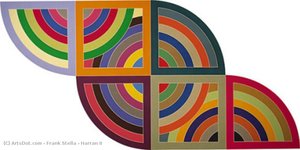
A Symphony of Geometry: The Vibrancy of Hyena Stomp
In the vast landscape of twentieth-century abstraction, few works capture the electric pulse of innovation quite like Frank Stella’s 1962 masterpiece, Hyena Stomp. This painting serves as a breathtaking testament to a pivotal moment in art history when the boundaries of the canvas were being radically redefined. At first glance, the viewer is met with an explosion of color—a rhythmic dance of concentric squares that seem to pulse with their own internal heartbeat. The composition is a masterclass in precision, utilizing a spectrum of hues ranging from fiery reds and sun-drenched yellows to deep, tranquil blues and regal purples. Each layer of color acts as a structural element, drawing the eye inward toward a singular, enigmatic white triangle that anchors the entire visual whirlwind.
The technique employed in Hyena Stomp is a brilliant marriage of Minimalism and Op Art. Stella moved away from the heavy, emotional brushwork characteristic of the Abstract Expressionists, opting instead for clean, decisive lines and a mathematical rigor that feels both modern and timeless. The way the squares diminish in size creates a profound illusion of depth, transforming a flat surface into a hypnotic tunnel of light and rhythmic shadow. This optical complexity is not merely a trick of the eye; it is an exploration of how color and shape can interact to create movement without the need for representational subject matter. For the discerning collector or interior designer, this piece offers a dynamic focal point that commands attention through its sheer structural integrity and chromatic intensity.
The Evolution of the Object
Beyond its formal beauty, Hyena Stomp reveals a profound historical shift within the American avant-garde. Created during a period when Stella was challenging the very definition of what a painting could be, this work embodies the transition from the subjective "gesture" to the objective "object." During the late 1950s and early 1960s, Stella famously declared that a painting should be nothing more than a flat surface with paint on it. This philosophy sought to strip away the biographical struggle and hidden narratives found in the works of Pollock or Kline, replacing them with a pure, distilled essence of form. In Hyena Stomp, we see the culmination of this reductionist approach, where the painting ceases to be a window into another world and instead becomes a powerful, self-contained reality.
For those looking to bring a sense of sophisticated energy into a contemporary space, a high-quality reproduction of this work provides more than just decoration; it offers a conversation piece rooted in intellectual depth. The painting’s ability to balance intense color with rigid geometry makes it an ideal selection for modern interiors that crave both warmth and order. Whether placed in a minimalist gallery setting or as a bold statement in a curated living space, Hyena Stomp continues to resonate with the same transformative power it possessed over six decades ago, inviting viewers to lose themselves in its infinite, colorful depths.
Artist Biography
A Life Dedicated to the Essence of Painting
Frank Stella, who passed away on May 4, 2024, at the age of 87, was a towering figure in American art, a relentless innovator whose career spanned seven decades and challenged conventional notions of painting, sculpture, and architectural design. Born in Malden, Massachusetts, in 1936 to first-generation Italian-American parents, Stella’s artistic journey began with an early exposure to the visual world through his mother's landscape paintings and a formative education at Phillips Academy Andover, where he encountered the rigorous color theories of Josef Albers and the expressive power of Hans Hofmann. These influences, coupled with studies in history at Princeton University and frequent trips to New York City galleries, laid the groundwork for a radical departure from the prevailing Abstract Expressionism of the time. Stella wasn’t interested in the emotional turmoil or subjective gesture that defined artists like Pollock and Kline; he sought something purer, more objective—a distillation of painting down to its most fundamental elements.Rejecting Illusion: The Rise of Minimalism
Stella's emergence onto the art scene in the late 1950s was nothing short of revolutionary. He famously declared that “a painting should be a flat surface with paint on it—nothing more,” a statement that became a manifesto for the burgeoning Minimalist movement. This philosophy materialized most strikingly in his *Black Paintings* (1958-1960), a series of canvases defined by precisely spaced, symmetrical black stripes separated by bands of exposed canvas. Works like Die Fahne Hoch! (1959) – a title deliberately provocative, referencing the Nazi anthem – weren’t intended as expressions of political sentiment but rather as explorations of form and surface, challenging viewers to confront the painting as an object in itself. The deliberate coolness and rejection of emotional content were jarring at the time, signaling a decisive break from Abstract Expressionism's emphasis on subjective experience. He wasn’t aiming to depict something *about* the world; he was presenting the world—or rather, the painting—as it *is*. This focus on materiality and geometric precision extended into his shaped canvases of the 1960s, where Stella abandoned the traditional rectangular format in favor of complex polygons, often crafted from aluminum and copper paint. These weren’t merely paintings; they were sculptural objects that blurred the boundaries between two and three dimensions, further emphasizing the artwork's physical presence.Expanding Boundaries: From Protractor Series to Maximalism
The 1970s marked a period of significant experimentation for Stella. The *Protractor Series* (1971) saw him introduce sweeping arcs and vibrant colors arranged within square borders, creating dynamic compositions inspired by the circular cities he visited in the Middle East. Simultaneously, Stella embraced printmaking with enthusiasm, mastering techniques like lithography, screenprinting, and etching to create abstract prints that echoed his painting’s geometric vocabulary. His engagement extended beyond the visual arts; he designed sets and costumes for Merce Cunningham's dance piece *Scramble* in 1967, demonstrating a willingness to collaborate across disciplines. A retrospective at the Museum of Modern Art in 1970—a remarkable achievement for an artist still so young—cemented his status as a leading figure in contemporary art. However, Stella wasn’t content to rest on his laurels. He began incorporating relief into his work, gradually evolving towards what could be described as “maximalist” painting with sculptural qualities, utilizing collage elements and aluminum supports.A Legacy of Innovation
Stella's later career witnessed a dramatic shift in style. The austere geometry of his earlier works gave way to exuberant compositions characterized by curving forms, bold colors, and seemingly spontaneous brushstrokes—a move towards a more baroque aesthetic that surprised many but demonstrated his unwavering commitment to artistic exploration. His commission for the BMW Art Car Project in 1976 showcased his ability to adapt his distinctive drawing style to an unconventional canvas: a 3.0 CSL racing car. Throughout his life, Stella received numerous accolades, including the National Medal of Arts in 2009 and the Lifetime Achievement Award in Contemporary Sculpture from the International Sculpture Center in 2011. Frank Stella’s impact on art history is undeniable. He didn't just create paintings; he redefined what a painting *could be*. His relentless pursuit of formal clarity, his rejection of illusionism, and his willingness to push boundaries paved the way for generations of artists who followed, solidifying his place as one of the most important and influential figures of the 20th and 21st centuries. He leaves behind not only a vast body of work but also a legacy of intellectual rigor and artistic courage that will continue to inspire for years to come.
Frank Stella
1936 - , United States of America
Quick Facts
- Artistic Movement Or Style:
- Minimalism
- Post-Painterly Abstraction
- Artists Or Movements Influenced By This Artist:
- Minimalism
- Geometric abstraction
- Artists Who Influenced This Artist:
- Josef Albers
- Hans Hofmann
- Jackson Pollock
- Franz Kline
- Date Of Birth: May 12, 1936
- Date Of Death: May 4, 2024
- Full Name: Frank Philip Stella
- Nationality: American
- Notable Artworks:
- Die Fahne Hoch!
- Louisiana Lottery Co.
- Wolfeboro IV
- Place Of Birth: Malden, USA
Related Articles

Geometric Abstraction's 10 Defining Masterpieces | Art for Your Home - OriginalUniqueArt
Explore 10 defining masterpieces of Geometric Abstraction! Discover Kandinsky, Mondrian & Malevich’s iconic works. Find museum-quality art reproductions and curated decor ideas to elevate your home at OriginalUniqueArt.com.

Kazimir Malevich: 25 Masterpieces of Suprematism & Abstract Art | OriginalUniqueArt
Explore 25 iconic artworks by Kazimir Malevich, pioneer of Suprematism & abstract art. Discover the stories behind 'Black Square' and more! Find museum-quality prints & elevate your home decor with OriginalUniqueArt.com.

Neo-Abstract Art: The High-Impact Evolution of Modern Visual Energy and Geometric Sophistication
Discover the power of Neo-Abstract art. Explore how bold geometric forms and high-impact visual energy are redefining modern design. Learn to curate sophisticated, high-energy spaces with the latest trends in contemporary abstraction and structural color.

The Power of Less: A Definitive Guide to the Minimalism Movement and Geometric Abstraction
Explore the profound impact of Minimalism and Geometric Abstraction. From Mondrian to Malevich, discover how stripping art to its essential forms revolutionized modern aesthetics through our expert-led historical guide.

Beyond Form & Color: Geometric Abstraction's Enduring Legacy in Art History
Explore the captivating world of geometric abstraction! Discover its origins, key artists like Malevich & Mondrian, and why this movement remains highly valued by art collectors today. Expert insights at OriginalUniqueArt.