Preview
 Send
Send Share
Share
 Details
 Guide
Guide

 Download
 Similars
 X-Ray
X-Ray Diaporama
 Stats
StatsWalk in the hills


 Read More
The artwork displayed on this page is protected by copyright law, which means we cannot legally create or sell an identical reproduction. This protection is enforced under international agreements such as the Berne Convention and by national laws, including those outlined by the U.S. Copyright Law - Title 17.
This method fully complies with copyright regulations because it does not involve copying or duplicating the protected artwork. Instead, it is a creative reinterpretation - a new painting that is influenced by the original but not identical to it.
Giclée / Art Print
Museum-quality giclée or canvas print with fast production and flexible finish options. ( Buy Hand Made Painting Switch to Digital Image)




P118B $10

P118H $10

P118W $10

P438Z $10

P508JH $12

P508YH $12

P805H $10

P805Z $10

P919BZ $10

P919G $10

P919XJ $10

P959ZH $10

P968JZ $12

W106C $8

W218G $10

W218JH $8

W218Y $10

W307PJ $10

W316G $10

W316PJ $8

W316Y $10

W398PJ $8

W4111J $10

W500HY $15

W500JH $15

W692G $12

W849H $8

W940BG $15

W953PJ $8




Pick from our preset sizes that match the artwork's original proportions.

Type the width and the height you need, to fit your frame or your wall. A print can only be cut, never made bigger than the picture, so a size with a different shape loses a part of the image. We send you a digital mockup to approve before we print anything. The picture shown on this page does not show the real cut — only the mockup does.
Worldwide Delivery () in 2 weeks instead of standard 4/5 weeks. (23 October)

Free Worldwide Express Shipping

High-Quality Linen Canvas

Full Shipping Insurance

Customs Tax Refund Guarantee

True Color Matching Guarantee

100-Day Return Policy (Defects Only)

100% Money-Back Guarantee

Bulk Discount Offer
 Glass option is only available in size under 110 CM

Walk in the hills
Giclée / Art Print
Reproduction Size
-


Total Price
$ 81
A Vision of Volumetric Stillness
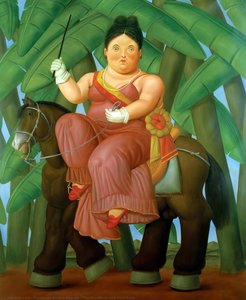
In the vast landscape of twentieth-century Latin American art, few figures command attention with as much whimsical gravity as Fernando Botero. His 1977 masterpiece, Walk in the hills, serves as a profound window into the artist's signature aesthetic, often referred to as "Boterismo." At first glance, the painting presents a scene of quietude: a solitary figure, draped in heavy, dark garments and crowned with a black hat, stands amidst the rolling greenery of a hillside. Yet, beneath this deceptively simple surface lies a complex exploration of form and presence. Botero utilizes exaggerated volumes to breathe life into his subjects, transforming the human figure into a monumental sculpture of flesh and fabric that commands the space it occupies.
The technique employed in this work is a masterful nod to the Naïve Art and Primitivism movements. Rather than striving for hyper-realistic anatomical precision, Botero embraces a deliberate, smoothed texture and a simplified perspective that evokes a sense of timelessness and innocence. This stylistic choice allows the viewer to bypass the distractions of modern complexity and focus on the pure, sculptural essence of the subject. The brushwork is controlled and smooth, creating a surface where light and shadow play softly across the rounded contours of the priest, lending the piece a tactile quality that makes it an exquisite centerpiece for any sophisticated interior.
Symbolism and the Weight of Tradition
Beyond its aesthetic allure, Walk in the hills is a deeply symbolic narrative that invites intense contemplation. The central figure, a priest characterized by a peculiar, cross-eyed gaze, stands as a silent sentinel within the natural world. He holds an umbrella—a curious object to carry on a clear day—which serves as a poignant metaphor for a psychological or institutional defense mechanism. This umbrella represents a barrier, a way of shielding oneself from the external realities of the world, much like the insulating layers of bureaucracy or religious dogma can isolate an individual from true experience. The presence of the cross in his hand further anchors the piece in themes of spirituality and the heavy mantle of tradition.
There is a palpable sense of inertia within the composition; the priest does not move through the hills so much as he exists within them, embodying a state of passive existence. This tension between the vibrant, living landscape and the static, shielded figure creates an emotional resonance that is both unsettling and deeply moving. For the collector, this painting offers more than just visual beauty; it provides a conversation piece that explores the human condition, the concept of isolation, and the delicate balance between protection and disconnection.
An Elegant Addition to the Modern Collection
For interior designers and art enthusiasts alike, a high-quality reproduction of Walk in the hills offers a unique opportunity to introduce character and intellectual depth into a living space. The painting’s palette—a harmonious blend of earthy greens, deep blacks, and soft sky tones—allows it to integrate seamlessly into various decor styles, from contemporary minimalism to classic, traditional settings. Its ability to evoke both a sense of peace and a subtle, underlying critique makes it a versatile and captivating work.
Owning a piece that captures the essence of Botero’s genius means bringing a fragment of Colombian visionary art into one's private sanctuary. Whether placed in a sunlit gallery or a quiet study, this work continues to perform its primary function: inviting the observer to pause, to look closer, and to reflect on the beautiful, voluminous complexities of life itself.
Questions & Answers
How does the subject of "Walk in the hills" relate to Fernando Botero's usual themes?
Fernando Botero's recurring themes include naive art influences, primitivism aesthetic, religious institution critique, societal inertia themes, symbolic religious imagery, exploration of volume, boterismo style development; "Walk in the hills" focuses on priest, nature, symbolism, religious, boterismo, hillside, introspection.
Is "Walk in the hills" more bright or more dark overall?
"Walk in the hills" by Fernando Botero is recorded as shadow, with a gentle luminance luminance.
How many people view "Walk in the hills"?
Statistics about "Walk in the hills" by Fernando Botero are on the artwork's Stats page: monthly visits of the artwork, visits of the artist's works, and country and language breakdowns of recent visitors.
Artist Biography
A Colombian Visionary: The Life and Art of Fernando Botero
Born in Medellín, Colombia, in 1932, Fernando Botero Angulo emerged as one of Latin America’s most celebrated and internationally recognized artists. His journey began not within the hallowed halls of art academies, but amidst the vibrant life and Baroque splendor of his native city. Isolated from mainstream artistic currents during his youth, young Botero found inspiration in the ornate colonial churches and bustling urban scenes of Medellín—a formative experience that would profoundly shape his unique aesthetic vision. This early exposure instilled a primitivist sensibility, an appreciation for simple yet powerful forms, which became a hallmark of his style. Initially drawn to the drama of bullfighting, he honed his skills through drawing, but quickly realized his path lay beyond the arena and towards a broader exploration of form and volume.The Genesis of ‘Boterismo’
Botero's artistic development was marked by a deliberate rejection of European modernism. After periods studying in Madrid and Paris, he found himself disillusioned with the prevailing avant-garde movements. Instead, he turned inward, seeking inspiration from the Old Masters—Velázquez, Goya, and Titian—and rediscovering the power of classical form. This exploration led to the birth of what would become known as ‘Boterismo,’ a style characterized by generous, exaggerated volumes. It wasn’t merely about depicting “fat people,” as some critics simplistically suggested; it was a conscious manipulation of proportion, a celebration of sensuality and abundance, and a subtle commentary on social and political realities. His figures—human, animal, or still life—possess a monumental presence, radiating both warmth and a quiet dignity. The early 1960s saw the solidification of this style, with paintings like *Presidential Family* (1967) becoming iconic representations of his burgeoning aesthetic. This work, in particular, subtly satirized Colombian political elites while simultaneously showcasing the captivating allure of Botero’s rounded forms.Expanding Horizons: Sculpture and Beyond
While initially renowned for his paintings, Botero's artistic ambition extended to sculpture in 1973 after relocating to Paris. This transition proved transformative, allowing him to explore volume and form in three dimensions. His monumental bronze sculptures began appearing in public spaces around the world—parks in New York, Florence, and Medellín—becoming beloved landmarks and symbols of his artistic vision. These sculptures weren’t merely scaled-up versions of his paintings; they possessed a unique physicality, inviting viewers to engage with them on a tactile level. Beyond painting and sculpture, Botero also demonstrated versatility through drawings and collages, often tackling politically charged subjects. His *Violence* series, created in response to the escalating conflict in Colombia, stands as a powerful testament to his commitment to social commentary. Similarly, his *Abu Ghraib* series directly addressed the abuses at the Iraqi prison, demonstrating his willingness to confront difficult truths through art.Legacy and Influence
Fernando Botero’s impact on the art world is undeniable. He became a cultural icon in Colombia, donating generously to museums and public spaces, solidifying his place as a national treasure. His work transcends geographical boundaries, resonating with audiences worldwide through its universal themes of humanity, sensuality, and social critique. While some initially dismissed ‘Boterismo’ as mere stylistic quirk, it has since been recognized as a significant contribution to figurative art. He challenged conventional notions of beauty and proportion, inviting viewers to reconsider their perceptions of the human form. His influence can be seen in the work of numerous contemporary artists who explore themes of body image, social satire, and cultural identity. Botero’s legacy extends beyond his artistic achievements; he inspired a generation of Latin American artists to embrace their own unique voices and perspectives on the world. He passed away in September 2023 at the age of 91, leaving behind an extraordinary body of work that continues to captivate and provoke thought.Key Characteristics & Notable Works
- Style: Boterismo – characterized by exaggerated volumes and proportions.
- Influences: Baroque art, Old Masters (Velázquez, Goya), Latin American folk art, pre-Columbian art.
- Themes: Colombian culture, social satire, political commentary, sensuality, the human form.
- Notable Works: *Mona Lisa, Age Twelve* (1959), *The Presidential Family* (1967), *Dancers* (1987), *Death of Pablo Escobar* (1999), *La Paloma de la Paz* (2016).
- Awards: International Sculpture Center’s Lifetime Achievement in Contemporary Sculpture Award (2012).

Fernando Botero
1932 - 1959 , Colombia
Quick Facts
- Full Name: Fernando Botero Angulo
- Nationality: Colombian
- Date Of Birth: 1932
- Date Of Death: 1959
- Place Of Birth: Medellín, Colombia
- Notable Artworks:
- Mona Lisa, Age Twelve
- The Presidential Family
- Walk in the hills
- Artistic Movement Or Style: Boterismo, Primitivism
- Artists Who Influenced This Artist:
- Diego Rivera
- Francisco de Goya
- Diego Velázquez
Related Articles
The Unconventional Vision: Exploring the Characteristics, History & Enduring Appeal of Naïve Art
Explore the captivating world of naïve art! Discover its history, characteristics, key artists & collecting tips from OriginalUniqueArt's experts. Find your perfect piece today.

The Pure Charm of Naïve Art: Finding Beauty in Simplicity, Soul, and the Unfiltered Vision
Discover the profound beauty of Naïve Art. Explore how self-taught masters bypass academic tradition to capture raw emotional truth through vibrant color and soulful simplicity. A cultural journey for the true art lover seeking depth beyond convention.

The Untamed Vision: Exploring Naïve Art & Primitivism's Rejection of Convention
Explore the revolutionary world of Naïve Art & Primitivism! Discover how artists challenged academic traditions with raw emotion & unique styles. Learn about Picasso, Rousseau & more at OriginalUniqueArt.
Primitivism in Art: Exploring the Roots of Modern Expression & its Enduring Legacy
Explore the fascinating history of Primitivism in art – its origins, key artists like Gauguin & Picasso, and lasting impact on modern expression. Uncover the complexities of this influential movement with OriginalUniqueArt.
Raw, Bold, Unfiltered: Why Naive Art is the Ultimate Vibe for Your Space
Ditch the boring decor. Discover why Naive Art's raw, bold, and unfiltered aesthetic is the ultimate trend for modern urban spaces. Learn how to use vibrant colors and unstudied sincerity to create a high-impact, authentic vibe in your home or studio.