Symbolic Expressionism · 1908
Composition study (Ferdinand Hodler, 1908)
Ferdinand Hodler (1853–1918) made Composition study. It dates from 1908. It belongs to the Symbolic Expressionism movement. It is made in acrylic on canvas. It is kept at National Gallery of Bosnia and Herzegovina in Sarajevo, Bosnia and Herzegovina. It measures 33 × 76 cm.
- 1908
- Acrylic On Canvas
- 33 × 76 cm
- National Gallery of Bosnia and Herzegovina, Sarajevo

 Preview

 Hand Made Oil Painting
 Send
 Share
 Fact sheet


 Download
 Similars
 X-Ray
 Diaporama
 Q&A

 Stats
Composition study, in brief
- Title
- Composition study
- Artist
- Ferdinand Hodler (1853–1918)
- Artist born in
- Bern, Switzerland
- Date
- 1908
- Medium
- Acrylic On Canvas
- Dimensions
- 33 × 76 cm
- Where to see it
- National Gallery of Bosnia and Herzegovina, Sarajevo, Bosnia and Herzegovina
- Movement
- Symbolic Expressionism
- Subject
- horsemen, swiss painting, sketch, dynamism, anatomy, symbolism
What does Composition study depict?
Composition Study: A Meditation on Movement and Mortality
Ferdinand Hodler’s “Composition Study,” executed in 1908, transcends mere visual representation; it embodies a profound exploration of human experience framed within the framework of Symbolism. Measuring 76 x 33 cm, this pencil sketch captures a moment frozen in time—a dynamic tableau featuring three horsemen engaged in strenuous exertion against a backdrop of figures observing their activity. The artwork’s genesis lies in Hodler's fascination with the human form and its relationship to the natural world, themes that would dominate his artistic output throughout his career.- Subject Matter: The central focus is undeniably athletic—three horsemen pushing themselves to their physical limits. However, Hodler doesn’t merely depict muscle and movement; he imbues it with a deeper significance.
- Style & Technique: Hodler's signature style is characterized by flattened planes of color and simplified forms, reflecting the influence of Cézanne and Japanese prints. The pencil strokes are deliberate and expressive, conveying both strength and vulnerability simultaneously. Notice how Hodler utilizes hatching to build up tonal values, creating a sense of depth without resorting to traditional perspective.
- Symbolism: The positioning of the figures—one actively engaged in lifting weights, another supporting him—suggests a collaborative effort against adversity. This visual metaphor speaks to the broader Symbolist concern with overcoming obstacles and achieving transcendence.
- Emotional Impact: “Composition Study” evokes a palpable sense of exertion and determination. Yet, beneath the surface lies an underlying melancholy – a subtle acknowledgment of human limitations. Hodler’s masterful use of tonal gradation contributes to this emotional depth, inviting contemplation on themes of struggle and resilience.
Which museum holds Composition study?
National Gallery of Bosnia and Herzegovina
Sarajevo, Bosnia and Herzegovina
A Sanctuary of Resilience: The Soul of Sarajevo In the beating heart of Sarajevo, a city that has weathered the most profound storms of the twentieth century, stands the National Gallery of Bosnia and Herzegovina as a luminous testament to the enduring power of human creativity. To walk through its doors is to enter a space where the scars of history meet the triumph of the artistic spirit, offering a profound dialogue between a turbulent past and an aspirational future. It serves as a sanctuary where the collective memory of a people is preserved within the delicate strokes of paint and the heavy textures of stone.


High-resolution images of Composition study

Ferdinand Hodler, Composition study (1908), National Gallery of Bosnia and Herzegovina. Public domain.
Questions on Composition study, answered
Where can I see the original "Composition study" by Ferdinand Hodler?
You can see the original "Composition study" at the National Gallery of Bosnia and Herzegovina, Sarajevo, Bosnia and Herzegovina.
What is the creation date of "Composition study" by Ferdinand Hodler?
"Composition study" dates from 1908. The date places the work within Ferdinand Hodler's career and its era.
What is "Composition study" made with?
"Composition study" is executed in acrylic on canvas.
What size is "Composition study" by Ferdinand Hodler in real life?
The recorded dimensions of "Composition study" by Ferdinand Hodler are 76 x 33 cm. Reproductions can be ordered in other sizes while keeping the same proportions.
What subjects appear in "Composition study" by Ferdinand Hodler?
"Composition study" by Ferdinand Hodler depicts: horsemen, swiss painting, sketch, dynamism, anatomy, symbolism, movement, composition.
Can the image of "Composition study" by Ferdinand Hodler be freely reproduced?
"Composition study" by Ferdinand Hodler is in the public domain - its copyright has expired. This status governs how the image of the work may be reproduced.
Who is the artist behind "Composition study"?
"Composition study" is attributed to Ferdinand Hodler.
What art movement does "Composition study" by Ferdinand Hodler belong to?
The movement associated with "Composition study" by Ferdinand Hodler is Symbolic Expressionism. This classification situates the work among related artists and artworks.
Which period of Ferdinand Hodler's career does "Composition study" belong to?
"Composition study" belongs to the Mature Period of Ferdinand Hodler's career. This classification relates the work to the artist's development.
About the artist, Ferdinand Hodler
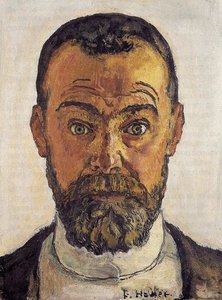
1853–1918, Switzerland
Ferdinand Hodler
The Architecture of Mortality Born in Bern, Switzerland, in 1853, Ferdinand Hodler’s early years were defined by a quiet, persistent grief. Before he reached adolescence, the tuberculosis that claimed his father and two younger brothers left a void in his household. This early encounter with loss became a recurring motif in his work, a shadow that would follow him from the modest beginnings of his apprenticeship to the heights of his professional career. He began his training as a decorative painter, assisting his stepfather with commercial sign-work, a practical education that instilled in him a precise command of line and form.
Also by Ferdinand Hodler
 Eiger, Monch and Jungfrau in Moonlight1908
 Woman in Ecstasy1911
 Sunset on Lake Geneva1915
 Study of two figures1897

Essays around Composition study
 Unveiling the Raw Emotion: The Top 25 Masterpieces by Francis BaconJourney through the raw emotion of Francis Bacon's most iconic works. From distorted figures to visceral portraits, explore 25 masterpieces…
 Giacomo Balla: Dynamism, Futurism & the Aesthetic of Speed – A Comprehensive ExplorationExplore the revolutionary art of Giacomo Balla, a key figure in Futurism. Discover his dynamic paintings capturing speed, light & movement.…
 Mastering Parallelism: The 25 Greatest Artworks by Ferdinand HodlerImmerse yourself in the rhythmic beauty of Ferdinand Hodler. Explore 25 iconic masterpieces of Swiss Symbolism and Parallelism, from emotiv…