Preview
 Send
Send Share
Share
 Details
 Guide
Guide

 Download
 Similars
 X-Ray
X-Ray Diaporama
 Stats
StatsMeditation
 Oil On Canvas
- WallArt
- Symbolism
 1893
1893- 19th Century
 48.0 x 65.0 cm
 Ohara Museum of Art
 Read More
Giclée / Art Print
Museum-quality giclée or canvas print with fast production and flexible finish options. ( Buy Hand Made Painting Switch to Digital Image)




P118B $10

P118H $10

P118W $10

P438Z $10

P508JH $12

P508YH $12

P805H $10

P805Z $10

P919BZ $10

P919G $10

P919XJ $10

P959ZH $10

P968JZ $12

W106C $8

W218G $10

W218JH $8

W218Y $10

W307PJ $10

W316G $10

W316PJ $8

W316Y $10

W398PJ $8

W4111J $10

W500HY $15

W500JH $15

W692G $12

W849H $8

W940BG $15

W953PJ $8




Pick from our preset sizes that match the artwork's original proportions.

Type the width and the height you need, to fit your frame or your wall. A print can only be cut, never made bigger than the picture, so a size with a different shape loses a part of the image. We send you a digital mockup to approve before we print anything. The picture shown on this page does not show the real cut — only the mockup does.
Worldwide Delivery () in 2 weeks instead of standard 4/5 weeks. (26 October)

Free Worldwide Express Shipping

High-Quality Linen Canvas

Full Shipping Insurance

Customs Tax Refund Guarantee

True Color Matching Guarantee

100-Day Return Policy (Defects Only)

100% Money-Back Guarantee

Bulk Discount Offer
 Glass option is only available in size under 110 CM

Meditation
Giclée / Art Print
Reproduction Size
-


Total Price
$ 81
The Soul in Stillness: A Journey into Carrière’s Meditation
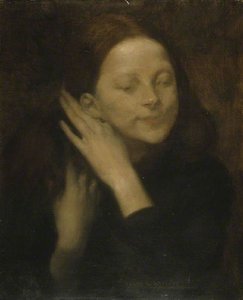
In the quiet corners of art history, few works possess the haunting, introspective power of Eugène Anatole Carrière’s 1893 masterpiece, Meditation. This oil on canvas is far more than a mere portrait; it is an invitation into the private sanctuary of the human psyche. At first glance, the viewer is met with the profound stillness of a young woman lost in thought, her presence commanding the space through a deliberate lack of movement. Carrière, a titan of the French Symbolist movement, eschews the fleeting light and vibrant energy of his Impressionist contemporaries to instead cultivate an atmosphere of eternal, somber reflection. The subject does not interact with the world outside the frame; rather, she exists in a state of profound interiority, making the painting a poignant testament to the beauty found within solitude and the weight of unspoken thoughts.
The technical brilliance of Meditation lies in Carrière’s masterful command over a restricted, almost monochromatic palette. Eschewing bright colors, the artist utilizes a sophisticated range of deep browns, velvety blacks, and subtle, earthy undertones of muted red and orange. This choice is not merely aesthetic but deeply psychological, serving to shroud the subject in a sense of mystery and melancholy. Through an ambitious layering process and the meticulous application of glazing techniques, Carrière achieves a luminous depth that seems to glow from within the canvas itself. The texture of the paint is remarkably tactile, creating a soft, skin-like quality in the figure’s face and a heavy, luxurious feel to her garments. His brushwork, while controlled, retains an organic fluidity that mirrors the natural contours of the human form, lending the piece a dreamlike, ethereal quality that borders on the supernatural.
Symbolism and the Echoes of the Subconscious
To understand Meditation is to understand the heart of Symbolism. During the fin-de-sięcle period, artists sought to represent ideas and emotions rather than the literal external world. In this work, every element serves a symbolic purpose. The woman’s downward gaze and slumped, vulnerable posture act as visual metaphors for grief, introspection, or perhaps an existential longing. The flattened composition—where the background dissolves into a hazy, indistinct void—strips away all worldly distractions, forcing the viewer to confront the subject's emotional state directly. There is no landscape to provide context, only the raw, unadulterated presence of feeling.
For the discerning collector or interior designer, this painting offers a profound sense of gravitas and emotional depth. It is a piece that does not merely decorate a wall but transforms the atmosphere of a room, bringing a sense of quiet sophistication and intellectual weight. Whether placed in a contemporary gallery setting or a classic study, Meditation acts as an anchor of tranquility. Its somber tones and rich textures provide a perfect counterpoint to modern minimalism or complement the ornate grandeur of traditional decor. Owning a high-quality reproduction of this work allows one to possess a fragment of the Symbolist soul, a permanent window into the profound beauty of the human spirit in repose.
Questions & Answers
Did "Meditation" stay in its artist's homeland?
No - the artwork is kept abroad. "Meditation" is held in Japan, while Eugène Anatole Carrière was born in France.
Can I examine "Meditation" in more detail?
The X-Ray page of "Meditation" by Eugène Anatole Carrière is an interactive viewer that lets you slide through eleven optical layers of the artwork's image, including an X-ray style view.
What does "Meditation" by Eugène Anatole Carrière bring to an interior?
The calm atmosphere of "Meditation" by Eugène Anatole Carrière matches its recommended space: a living room.
Artist Biography
**early life and training**
eugène anatole carrière, a renowned french symbolist artist, was born on january 16, 1849, in gournay-sur-marne, seine-saint-denis. he studied at the école des beaux-arts in paris and later under cabanel, laying the foundation for his future artistic endeavors.**artistic style and influences**
carrière's paintings are best known for their distinctive brown monochrome palette, which has been a subject of fascination for many art enthusiasts. his work was influenced by the art of peter paul rubens, which he was exposed to during his time as a prisoner in dresden. this influence is evident in the glowing colors of his early paintings. **the young mother (1879)**, one of carrière's earliest notable works, is now housed at the musée des beaux-arts de rouen. this piece marked the beginning of his domestic life themes, which would become a hallmark of his artistic style.**notable works and exhibitions**
* **the sick child (montargis)** * **the first communion (toulon)** * **portrait of louis-henri devillez (1887)**, a highly praised work showcasing carrière's skill in capturing the essence of his subjects. these works, among others, have been exhibited at the société nationale des beaux-arts, which carrière helped establish. his contributions to the art world extend beyond his paintings, as he also played an influential role as an art teacher at académie de la palette.**legacy and influence on modern art**
carrière's monochrome style has been seen in the works of pablo picasso, particularly during his blue period. this influence is a testament to carrière's lasting impact on modern art.- view more of carrière's works at OriginalUniqueArt.com/eugène anatole carrière
- explore the musée des beaux-arts de rouen, which houses some of carrière's early pieces, at discovering the musée des beaux-arts de carcassonne (france)
- learn more about symbolism and its influence on art at the symbolism art movement

Eugène Anatole Carrière
1849 - 1906 , France
Quick Facts
- Full Name: Eugène Anatole Carrière
- Nationality: French
- Date Of Birth: 1849
- Date Of Death: 1906
- Place Of Birth: Gournay-sur-Marne, France
- Notable Artworks:
- The Sick Child
- Young Mother
- First Communion
- Artistic Movement Or Style: Symbolism, Monochrome
- Artists Who Influenced This Artist: ['Rubens']
- Artists Or Movements Influenced By This Artist: ['Picasso (Blue Period)']
Related Articles

The Enduring Legacy of Oil on Canvas: Technique, History & Contemporary Practice
Explore the rich history & enduring techniques of oil painting on canvas. Discover the science behind its longevity, conservation practices, and contemporary relevance. Expert insights for art enthusiasts.

Oil on Canvas: A Historical & Technical Exploration of a Timeless Artistic Medium
Explore the rich history & enduring techniques of oil painting on canvas. Discover the science behind its longevity, conservation practices, and contemporary relevance. Expert insights for art enthusiasts.
Eugène Carrière: The 'Peintre d'Âme' & Symbolist Portraiture’s Intimate Vision
Explore the haunting world of Eugène Carrière, a pivotal French Symbolist artist known for his deeply intimate portraits & 'peinture d'âme'. Discover his life, style, and lasting influence on modern masters like Picasso. Shop high-quality reproductions at OriginalUniqueArt.

The Enduring Legacy of Oil on Canvas: Technique, History & Aesthetic Impact
Explore the rich history & techniques of oil painting – from Renaissance masters to Impressionism. Discover pigments, layering methods, and why this timeless medium endures. Expert insights for artists & art enthusiasts.

The Enduring Power of Painting: A Historical & Contemporary Exploration of Form and Emotion
Explore the rich history & enduring techniques of oil painting with OriginalUniqueArt. Discover masterpieces, learn about art collecting, and find authentic handmade reproductions crafted by skilled artists.