Switch to Print
 Read More







































 For artworks or reproductions larger than 105 cm (approximately 41 inches) on any side, the frame will be shipped as a kit, disassembled. This method ensures safe delivery and prevents damage during transport.


A Bold Expression of Isolation and Mystery
Ernst Ludwig Kirchner’s “The Painter Stirner with Cat” stands as a quintessential example of German Expressionism, capturing the turbulent spirit of its time—the early 1920s—and embodying the artist's profound engagement with themes of solitude and psychological introspection. Painted in 1913, before the looming shadow of World War I cast itself over Europe, this artwork isn’t merely a depiction; it’s an emotional distillation of Kirchner’s worldview.
Composition and Color Palette: A Fractured Reality
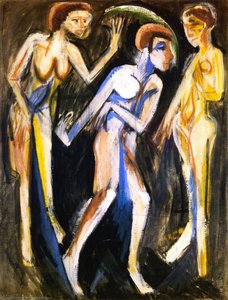
The painting's composition is deceptively simple—a vertical arrangement dominated by the central figure of Stirner, accompanied by his feline companion. Kirchner skillfully employs a jarring color palette characterized by intense reds, blues, and greens, creating an atmosphere rife with tension and unease. These hues clash dramatically, mirroring the inner turmoil suggested by the subject matter. The artist’s deliberate use of contrasting tones amplifies the emotional impact, drawing the viewer into a world where visual harmony is absent.
Stylistic Elements: Distortion and Bold Brushstrokes
Kirchner's stylistic choices are decisive—thick, expressive brushstrokes dominate the canvas surface, conveying a palpable sense of immediacy and raw emotion. Lines are deliberately distorted, emphasizing the fractured nature of perception and reflecting the psychological anxieties prevalent in Expressionist art. Forms are simplified and stylized, prioritizing emotional resonance over realistic representation. The artist’s technique is unapologetically visceral, mirroring the turbulent inner landscape he seeks to portray.
Symbolism: Cat as Companion and Darkness
The inclusion of a black cat—a recurring motif in Kirchner's oeuvre—adds layers of symbolic significance. Often interpreted as representing companionship or even darkness, the feline figure serves as an enigmatic counterpoint to Stirner’s solitary presence. Its gaze directs attention inward, prompting contemplation on themes of vulnerability and hidden anxieties. The cat embodies a quiet resilience amidst the chaos of the depicted environment.
Historical Context and Artistic Influence
"The Painter Stirner with Cat" aligns itself firmly within the broader context of Die Brücke—the Bridge group—a collective of German Expressionist artists who championed subjective experience as paramount to artistic endeavor. Kirchner’s work echoes the stylistic innovations pioneered by Munch and other contemporaries, demonstrating a shared commitment to conveying emotional intensity through distorted forms and vibrant color palettes. It remains a powerful testament to the expressive power of art during a period marked by social upheaval and psychological uncertainty.
Questions & Answers
What is "The painter Stirner with cat" made with, and in which style?
"The painter Stirner with cat" by Ernst Ludwig Kirchner combines the acrylic technique with the Expressionism style. Technique and movement describe the making and the style of the work.
Can I order an oil reproduction of "The painter Stirner with cat"?
"The painter Stirner with cat" is available as a hand-painted oil reproduction on linen canvas. The order can be placed on its Hand-Painted Reproduction page, with a choice of sizes.
What does "The painter Stirner with cat" by Ernst Ludwig Kirchner depict, and in what mood?
"The painter Stirner with cat" by Ernst Ludwig Kirchner depicts portrait, expressionism, cat, landscape, color palette, bold strokes, isolation, in a dramatic mood. Subject and atmosphere together describe the work.
More about this painting
 Preview
 Send
Send Share
Share
 Details
 Guide
Guide

 Download
 Similars
 X-Ray
X-Ray Diaporama
 Q&A
Q&A Stats
Stats