

 Preview
 Send
Send Share
Share
 Details

 Download
 Similars
 X-Ray
X-Ray Diaporama
 Stats
StatsProcession in the Mist


 Read More
Giclée / Art Print
Museum-quality giclée or canvas print with fast production and flexible finish options. ( Buy Hand Made Painting Switch to Digital Image)




P118B $10

P118H $10

P118W $10

P438Z $10

P508JH $12

P508YH $12

P805H $10

P805Z $10

P919BZ $10

P919G $10

P919XJ $10

P959ZH $10

P968JZ $12

W106C $8

W218G $10

W218JH $8

W218Y $10

W307PJ $10

W316G $10

W316PJ $8

W316Y $10

W398PJ $8

W4111J $10

W500HY $15

W500JH $15

W692G $12

W849H $8

W940BG $15

W953PJ $8




Pick from our preset sizes that match the artwork's original proportions.

You may enter your own dimensions to fit a specific frame or space. If your selected size does not match the original image's proportions, we will either crop the artwork or extend the image with a mirrored or solid-fill edge. A digital mockup will be sent for your approval before production begins.
Please note that the on-screen preview does not reflect the actual cropping or extension. Only the mockup will accurately show the final composition.
While custom sizes are available, we recommend selecting a dimension from the predefined list to preserve the original proportions.
Worldwide Delivery () in 2 weeks instead of standard 4/5 weeks. (19 September)

Free Worldwide Express Shipping

High-Quality Linen Canvas

Full Shipping Insurance

Customs Tax Refund Guarantee

True Color Matching Guarantee

100-Day Return Policy (Defects Only)

100% Money-Back Guarantee

Bulk Discount Offer
 Glass option is only available in size under 110 CM

Procession in the Mist
Giclée / Art Print
Reproduction Size
-


Total Price
$ 81
A Vision in Mist: Ernst Ferdinand Oehme’s “Procession in the Fog”
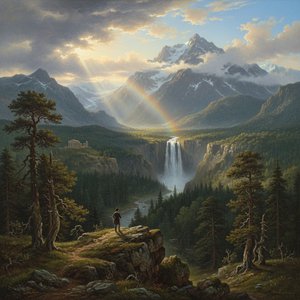
Ernst Ferdinand Oehme's "Procession in the Fog," painted in 1828, is not merely a landscape; it’s an immersion into a realm of profound mystery and spiritual yearning. This evocative work, now meticulously reproduced for discerning collectors, transports the viewer to a twilight world where the boundaries between reality and dream blur, offering a glimpse into the Romantic sensibility that defined early 19th-century German art. Oehme, a master of atmospheric perspective and subtle tonal shifts, crafted this piece with an almost palpable sense of solemnity, inviting contemplation on themes of faith, pilgrimage, and the human condition’s inherent uncertainties.
The Scene Unfolds: Composition and Technique
The painting immediately draws the eye down a receding path, delineated by strong linear perspective that guides us toward a distant church steeple. This central axis is flanked by towering trees, their branches reaching like supplicating arms into the swirling mist. Oehme’s technique is characterized by a remarkable restraint – he eschews dramatic contrasts in favor of a nuanced grayscale palette built upon subtle gradations of black, white, and gray. The application of paint is remarkably smooth, creating an almost velvety texture that contributes to the ethereal quality of the scene. Notice how the artist skillfully uses light and shadow not to define form with sharp edges, but rather to suggest volume and depth through atmospheric diffusion. The mist itself isn’t simply a backdrop; it's actively sculpted by Oehme’s brush, creating pockets of clarity and obscuring details in a way that heightens the sense of distance and mystery.
Symbolism Woven into the Mist
The pervasive fog is arguably the painting’s most potent symbol. It represents not just physical obscurity but also the uncertainties of life, the veil that separates us from understanding, and perhaps even a spiritual quest for enlightenment. The procession itself – a line of figures moving towards the steeple – speaks to themes of faith, pilgrimage, and the collective journey toward something greater than oneself. The church steeple, a traditional symbol of hope and salvation, pierces through the mist, offering a beacon in the darkness. It’s a powerful visual metaphor for guidance and spiritual direction, suggesting that even amidst confusion and doubt, there is always a path forward.
Romantic Roots and Artistic Context
“Procession in the Fog” firmly resides within the Romantic movement, an artistic and intellectual current that prioritized emotion, imagination, and the sublime. Artists like Oehme were deeply influenced by the writings of philosophers such as Immanuel Kant, who explored the concept of the “sublime”—experiences that evoke awe and a sense of our own insignificance in the face of nature’s grandeur. Oehme's work reflects this fascination with the power of landscape to inspire both terror and reverence. He was part of a circle of artists closely associated with Caspar David Friedrich, another key figure in German Romanticism, sharing a similar interest in capturing the emotional impact of natural settings. The painting’s somber mood and focus on spiritual themes align perfectly with the movement's exploration of human experience beyond the purely rational.
Today, “Procession in the Fog” continues to resonate with viewers through its haunting beauty and profound symbolism. Its meticulous reproduction allows you to bring this evocative masterpiece into your home or office, transforming any space into a sanctuary of contemplation and artistic inspiration.
Artist Biography
Joseph Wright of Derby: Illuminating the Industrial Age
Joseph Wright of Derby, a name synonymous with dramatic lighting and scenes of burgeoning industry in 18th-century England, was more than just a painter; he was a visual chronicler of his time. Born in Derby in 1734, Wright’s life unfolded against the backdrop of rapid social and economic change – the rise of the Industrial Revolution – and he masterfully captured this transformation through his evocative canvases. Initially trained under Hudson in London, Wright quickly returned to his native Derbyshire, establishing a studio that would become renowned for its unique style and subject matter. His career wasn’t one of grand commissions or courtly portraits; instead, he focused on documenting the lives and events unfolding around him, often with a keen eye for social commentary.Early Life and Artistic Training
Wright's early life remains somewhat shrouded in mystery, but it is known that he received his initial artistic training in London under Thomas Hudson, a prominent portraitist associated with the Royal Academy. This period provided him with a solid foundation in traditional techniques and subject matter. However, Wright’s true artistic voice began to emerge as he returned to Derby. He was influenced by Dutch masters, particularly their use of chiaroscuro – the dramatic contrast between light and dark – but he quickly developed his own distinctive style, characterized by dynamic compositions, meticulous detail, and a fascination with capturing fleeting moments of action and emotion. His early portraits demonstrated a skill in rendering character and expression, foreshadowing his later explorations into more complex themes.The Rise of the ‘Industrial Scenes’
Wright's most celebrated works are undoubtedly his “industrial scenes,” paintings that depict events related to the burgeoning industrial activity in the Midlands. These weren’t romanticized depictions of progress; rather, they offered a nuanced and often unsettling portrayal of the realities of factory life, mining operations, and scientific experimentation. Key amongst these is *An Experiment on a Bird in the Air Pump* (1768), arguably his most famous work. This painting, depicting a scientist subjecting a bird to observation within an air pump, brilliantly illustrates the burgeoning spirit of scientific inquiry alongside the potential for exploitation and suffering. The dramatic lighting, the intense expressions of the figures involved, and the claustrophobic setting all contribute to the painting’s powerful impact. Other notable works include *The Slaughtered Horse* (1785), a harrowing depiction of a horse being butchered after an accident in a mine, and *Mr. Shaw's Ballooning Party* (1786), which captures the excitement surrounding early hot air balloon expeditions.Influences and Artistic Style
Wright’s artistic style was remarkably eclectic, drawing inspiration from various sources. As mentioned earlier, he admired Dutch masters like Rembrandt and Vermeer for their masterful use of light and shadow. He also studied the works of contemporary engravers, which likely influenced his meticulous attention to detail and his ability to render complex scenes with precision. Furthermore, Wright’s work was profoundly shaped by the intellectual climate of his time, particularly the rise of Enlightenment ideals and the growing interest in science and industry. The Lunar Society of Birmingham – a group of scientists, philosophers, and industrialists who met regularly in Derby – served as a key source of inspiration for many of his paintings, offering him access to cutting-edge scientific discoveries and providing him with subjects that reflected the spirit of innovation. His use of tenebrism, combined with a keen eye for composition and an ability to capture the psychological intensity of his subjects, set him apart from his contemporaries.Legacy and Historical Significance
Joseph Wright of Derby’s contribution to British art is immense. He was one of the first English painters to achieve widespread recognition for his innovative approach to subject matter and technique. His paintings offer a unique window into the social, economic, and intellectual landscape of 18th-century England, documenting a period of profound transformation with remarkable sensitivity and insight. Wright’s work has been interpreted in various ways – as a celebration of progress, a critique of industrial exploitation, or simply as a record of everyday life. Regardless of one's interpretation, his paintings remain powerfully evocative and continue to resonate with audiences today. He is now recognized as a pivotal figure in the development of British art, paving the way for later generations of artists who sought to capture the complexities of modern life. His legacy endures not only through his remarkable paintings but also through their enduring relevance to our understanding of the Industrial Revolution and its impact on society.
ernst ferdinand oehme
1797 - 1855 , Germany
Quick Facts
- Artistic Movement Or Style: Romanticism, Neoclassicism
- Artists Or Movements Influenced By This Artist:
- Hudson School
- Romanticism
- Artists Who Influenced This Artist:
- Janys Zedres
- Rembrandt
- Date Of Birth: September 3, 1734
- Date Of Death: August 29, 1797
- Full Name: Joseph Wright of Derby
- Nationality: English
- Notable Artworks:
- An Experiment on a Bird in the Air Pump
- The Slaughtered Horse
- A Man Going to His Death
- Place Of Birth: Derby, England
Related Articles

Evocations of Place: A Historical Journey Through Landscape Art
Explore the rich history of landscape art with OriginalUniqueArt. Discover renowned artists, movements like Impressionism & Romanticism, and expert guidance for collecting timeless pieces. Find your perfect serene escape today!

John Constable's Masterpieces: Explore 25 Iconic Landscapes for Your Home
Journey through John Constable's 25 most celebrated landscapes. Explore Romanticism, Dedham Vale & his masterful use of light in iconic paintings like 'Hay Wain'. Find museum-quality art reproductions and elevate your home decor on OriginalUniqueArt.com.

Evocations of Place: A Historical Journey Through Landscape Art
Explore the rich history of landscape art with OriginalUniqueArt. Discover renowned artists, movements like Impressionism & tonalism, and expert guidance for collecting timeless pieces. Find your perfect serene escape today!

Romantic Landscapes: 10 Masterpieces for Your Home | OriginalUniqueArt
Journey through 10 Romantic landscape masterpieces by Friedrich, Turner & Cole. Explore emotional art, sublime nature scenes & iconic 19th-century paintings. Find museum-quality reproductions for your home at OriginalUniqueArt.com – discover the full collection online!
Evoking Nature's Sublime: A Comprehensive Exploration of 19th-Century Landscape Painting
Explore the captivating world of 19th-century landscape painting! Discover renowned artists like Friedrich & Monet, key movements, and find the perfect artwork to bring nature's serenity into your home. Expert insights at OriginalUniqueArt.


