German Expressionism
Irises (Emil Nolde)
Emil Nolde (1867–1956) made Irises. It belongs to the German Expressionism movement. It is made in oil.
- Oil

 Preview

 Hand Made Oil Painting
 Send
 Share
 Fact sheet


 Download
 Similars
 X-Ray
 Diaporama
 Q&A

 Stats
Irises, in brief
- Title
- Irises
- Artist
- Emil Nolde (1867–1956)
- Artist born in
- Nolde, Denmark
- Medium
- Oil
- Movement
- German Expressionism
- Period
- Modern
- Subject
- red flowers, floral painting, german art, expressionism style, nolde artwork, botanical still life
What does Irises depict?
The Depiction of Irises by Emil Nolde
In the painting titled Irises by Emil Nolde, the canvas presents a field-like setting populated by a dense arrangement of flora. The primary subject consists of a display of red flowers, with at least 13 distinct red blooms visible across the composition. These flowers vary in size and shape, appearing in different positions throughout the space. Some are situated near the top left corner, while others are placed toward the center and the right side of the frame.
The color palette relies on these red tones, which are interspersed with yellow accents. These yellow elements are distributed among the red flowers, creating a contrast in hue. The arrangement of the plants creates a sense of depth and dimension within the field. The flowers occupy various planes, from the foreground to the background, establishing a layered structure within the botanical scene.
Composition and Visual Elements
The arrangement of the flowers establishes a sense of depth and dimension across the canvas. At the top left corner, several blooms are situated near the edge, while other flowers are positioned towards the right side. A group of flowers occupies the center of the composition. These botanical forms vary in both size and shape, creating an uneven distribution of weight throughout the field-like setting.
The color palette relies on a combination of reds and yellows. These hues interact to create a lively atmosphere within the scene. The red flowers appear in various shades, and some yellow accents are interspersed among them. The placement of these colors across the different planes of the image contributes to the overall structure of the work.
High-resolution images of Irises
Emil Nolde, Irises. Public domain.
Questions on Irises, answered
What technique was used for "Irises" by Emil Nolde?
Emil Nolde used the oil technique for "Irises". The technique defines the material nature of the original work.
What subjects appear in "Irises" by Emil Nolde?
The themes present in "Irises" by Emil Nolde include red flowers, floral painting, german art, expressionism style, nolde artwork, botanical still life, vibrant colors. Together they summarize the artwork's subject matter.
Can the image of "Irises" by Emil Nolde be freely reproduced?
Regarding copyright, "Irises" is in the public domain - its copyright has expired.
Who created "Irises"?
The artist behind "Irises" is Emil Nolde. The work is catalogued under Emil Nolde's name.
What art movement does "Irises" by Emil Nolde belong to?
"Irises" by Emil Nolde belongs to the German Expressionism movement. This movement provides the stylistic context of the work.
Where does "Irises" fall in Emil Nolde's career?
Within Emil Nolde's career, "Irises" falls in the Early Modern. The phase helps compare it with the artist's other works.
Why is the copyright status of "Irises" what it is?
"Irises" by Emil Nolde is in the public domain - its copyright has expired. Copyright duration runs from the artist's death, which occurred in 1956.
How does "Irises" fit into Emil Nolde's themes and style?
"Irises" belongs to Emil Nolde's German Expressionism work, whose recorded themes include german expressionism, nolde's religious vision, rural landscapes", bold color palette, nature & spirituality, social commentary, iconic floral series, key corpus work.
Where does "Irises" stand among Emil Nolde's recurring subjects?
"Irises" depicts red flowers, floral painting, german art, expressionism style, nolde artwork, botanical still life, vibrant colors, while Emil Nolde's recorded themes are german expressionism, nolde's religious vision, rural landscapes", bold color palette, nature & spirituality, social commentary, iconic floral series, key corpus work. Comparing the two shows how the work relates to the artist's usual subjects.
About the artist, Emil Nolde
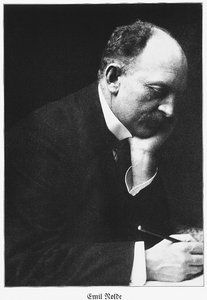
1867–1956, Denmark
Emil Nolde
The Life and Identity of Emile Nolde Born Hans Emil Hansen on 7 August 1867, the man who would become known as Emile Nolde grew up near the village of Nolde in the Duchy of Schleswig. His early years were shaped by the rural, agrarian life of his family. He eventually moved away from this path, choosing instead to work as a wood carver and furniture decorator. This tactile, physical labor preceded his shift toward painting and printmaking.
Also by Emil Nolde
 Sunset
 Sea with Red Sky
 Couple on the beach1903
 Masks1911
Essays around Irises
 Expressionism vs. New Objectivity: Emotion vs. Precision in German ArtMaster the tension between Expressionist emotion and New Objectivity precision. Explore the soul of German modern art now.
 Emil Nolde: The Top 25 Masterpieces of an Expressionist IconExplore 25 iconic Emil Nolde masterpieces. Discover the soul of Expressionism and find museum-quality art at OriginalUniqueArt.com.
 Impressionism vs. Expressionism: Capturing Light and EmotionMaster the technical differences between Impressionism and Expressionism. Discover the art of light and emotion now.