Switch to Print
 Read More







































 For artworks or reproductions larger than 105 cm (approximately 41 inches) on any side, the frame will be shipped as a kit, disassembled. This method ensures safe delivery and prevents damage during transport.


Elizabeth Adela Stanhope Forbes: A Pioneer Impressionist of the Newlyn School
Elizabeth Adela Stanhope Forbes (née Armstrong; 29 December 1859 – 16 March 1912) stands as a remarkable figure in British art history, particularly recognized for her contribution to the burgeoning Newlyn school movement. Born in Kingston, Ontario, Canada, Forbes embarked on an artistic journey that spanned continents—from London and Munich to New York and Brittany—leaving behind a legacy of captivating landscapes infused with Impressionistic sensibilities.
- Early Life & Education: Forbes’s formative years were marked by private schooling in Canada before she pursued formal art training at the South Kensington Art School (now Royal College of Art), accompanied by her mother. This privileged upbringing instilled a deep appreciation for artistic excellence and provided her with invaluable foundational knowledge.
- Continental Influences: Her travels to Munich solidified her connection with European artistic traditions, where she studied alongside prominent artists like J. Frank Currier and Frank Duveneck. These experiences exposed her to diverse stylistic approaches and broadened her artistic horizons.
The Brittany Period & Whistler’s Legacy
Forbes's artistic breakthrough occurred during her time in Pont-Aven, Brittany—a pivotal moment that irrevocably shaped her distinctive style. Inspired by the luminist ideals championed by James Abbott McNeill Whistler, Forbes embraced plein air painting, meticulously capturing the ethereal qualities of light and atmosphere. Whistler’s influence is palpable in Forbes's etchings, demonstrating a shared fascination with tonal harmonies and subtle nuances of color.
- Whistlerian Technique: Forbes adopted Whistler’s approach to etching—a technique characterized by delicate lines and tonal gradations—reflecting a commitment to capturing the essence of visual perception rather than striving for photographic realism.
- Symbolic Resonance: The Brittany landscape served as more than just a subject; it embodied Forbes's artistic philosophy – an unwavering dedication to observing and interpreting nature with sensitivity and precision.
Newlyn School Style & Artistic Development
Returning to Cornwall in 1885, Forbes established herself within the Newlyn school of painters—a collective dedicated to portraying coastal scenes with remarkable immediacy and emotional depth. Alongside Walter Sickert and Arthur Hacker, Forbes honed her craft, mastering the Impressionist technique of layering paint to build up form and texture while prioritizing mood over strict representation.
- Sickertian Influence: Walter Sickert’s realism—particularly his focus on capturing urban life—provided Forbes with a contrasting perspective that enriched her artistic repertoire.
- The Cornish Landscape: Forbes's paintings of Newlyn and its surrounding coastline exemplify the school’s commitment to portraying the beauty of the natural world with honesty and passion.
Concluding Remarks
Elizabeth Adela Stanhope Forbes’s artistic journey culminated in a profound exploration of Impressionism—a movement that championed subjective experience and celebrated the transformative power of light. Her enduring contribution to British art lies not only in her masterful depictions of landscapes but also in her unwavering belief that art should serve as a conduit for conveying emotion and capturing the fleeting beauty of everyday life.
Questions & Answers
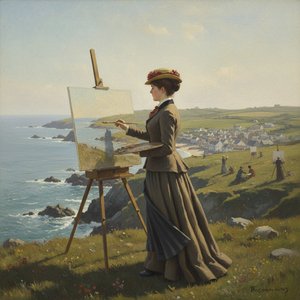
How do movement and era meet in "Midday Rest" by Elizabeth Adela Stanhope Forbes?
In "Midday Rest" by Elizabeth Adela Stanhope Forbes, the Impressionism movement meets the 19th-Century era.
What is the creation date of "Midday Rest" by Elizabeth Adela Stanhope Forbes?
"Midday Rest" by Elizabeth Adela Stanhope Forbes was created in 1904.
How does "Midday Rest" fit into Elizabeth Adela Stanhope Forbes's themes and style?
"Midday Rest" belongs to Elizabeth Adela Stanhope Forbes's Impressionism work, whose recorded themes include newlyn school, canadian landscape, genre scenes, whistler, sickert, french realism, victorian genre, daily life.
More about this painting
 Preview
 Send
Send Share
Share
 Details
 Guide
Guide

 Download
 Similars
 X-Ray
X-Ray Diaporama
 Q&A
Q&A Stats
Stats