Preview
 Send
Send Share
Share
 Details
 Guide
Guide

 Download
 Similars
 X-Ray
X-Ray Diaporama
 Q&A
Q&A Stats
StatsCatalog cover


 Read More
Giclée / Art Print
Museum-quality giclée or canvas print with fast production and flexible finish options. ( Buy Hand Made Painting Switch to Digital Image)




P118B $10

P118H $10

P118W $10

P438Z $10

P508JH $12

P508YH $12

P805H $10

P805Z $10

P919BZ $10

P919G $10

P919XJ $10

P959ZH $10

P968JZ $12

W106C $8

W218G $10

W218JH $8

W218Y $10

W307PJ $10

W316G $10

W316PJ $8

W316Y $10

W398PJ $8

W4111J $10

W500HY $15

W500JH $15

W692G $12

W849H $8

W940BG $15

W953PJ $8




Pick from our preset sizes that match the artwork's original proportions.

Type the width and the height you need, to fit your frame or your wall. A print can only be cut, never made bigger than the picture, so a size with a different shape loses a part of the image. We send you a digital mockup to approve before we print anything. The picture shown on this page does not show the real cut — only the mockup does.
Worldwide Delivery () in 2 weeks instead of standard 4/5 weeks. (3 November)

Free Worldwide Express Shipping

High-Quality Linen Canvas

Full Shipping Insurance

Customs Tax Refund Guarantee

True Color Matching Guarantee

100-Day Return Policy (Defects Only)

100% Money-Back Guarantee

Bulk Discount Offer
 Glass option is only available in size under 110 CM

Catalog cover
Giclée / Art Print
Reproduction Size
-


Total Price
$ 81
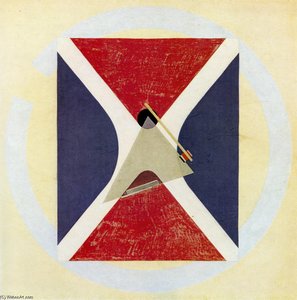
Catalog Cover: A Geometric Manifesto of Revolution
El Lissitzky’s ‘Catalog cover,’ produced in 1923, stands as a cornerstone of Constructivist design—a movement that sought to liberate art from representational illusion and forge it into the tool of social transformation. More than just an advertisement for a publication, this artwork embodies the core tenets of Constructivism: stark geometric abstraction, purposeful typography, and unwavering faith in technological progress.
- Composition & Form: The image presents a meticulously crafted arrangement dominated by large, overlapping rectangular letters – ‘EL’, ‘3’, and ‘Lissitzky’ – interwoven with vertical bars. These forms aren't merely decorative; they actively engage the viewer’s eye, creating an illusion of depth and dynamism within the monochrome palette. The absence of curves or organic shapes underscores Constructivism’s rejection of traditional artistic conventions.
- Typography & Language: Lissitzky skillfully utilizes sans-serif typeface to convey both visual impact and ideological commitment. Text in Cyrillic script—including “Schau der Arbeit” (“Look at Work”) and “Moskau”—further reinforces the artwork's central theme of labor and urban life, aligning with Constructivist ideals of industrial society and social reform.
- Technique & Material: The original painting was executed in oil or gouache on canvas—a deliberate choice reflecting Constructivism’s emphasis on materiality and craftsmanship. Photographic reproduction captures the smooth surface texture achieved through meticulous brushwork, highlighting Lissitzky's dedication to precision and artistic execution.
The artwork’s historical context is inextricably linked to Russia’s tumultuous years following the Bolshevik Revolution. Constructivism emerged as a reaction against Impressionism and Expressionism, rejecting subjective emotion in favor of objective representation—specifically geometric abstraction—as a means of communicating revolutionary ideas. Lissitzky envisioned art as an instrument for societal advancement, mirroring the broader ambitions of the Soviet state.
Beyond its formal qualities, ‘Catalog cover’ resonates with profound symbolic significance. The geometric forms represent stability and order amidst chaos – mirroring Constructivism's aspiration to rebuild society after the devastation of war. The bold lettering proclaims a manifesto of progress and defiance against artistic dogma. Lissitzky’s work continues to inspire designers and artists today, demonstrating the enduring power of abstraction to communicate complex concepts with clarity and conviction.
- Emotional Impact: Viewing ‘Catalog cover’ evokes a sense of intellectual stimulation and visual excitement. Its austere beauty speaks to the transformative potential of art—a belief that underpinned Lissitzky's entire artistic practice.
Questions & Answers
How is the mood of "Catalog cover" by El Lissitzky described?
"Catalog cover" has a minimalist atmosphere.
Where can I find artworks similar to "Catalog cover" by El Lissitzky?
Works similar to "Catalog cover" are listed on the artwork's Similars page.
Are the colors of "Catalog cover" by El Lissitzky vivid or muted?
"Catalog cover" by El Lissitzky is recorded with a muted saturation and a monochromatic intensity.
Artist Biography
A Revolutionary Vision: The Life and Art of El Lissitzky
El Lissitzky, born Lazar Markovich Lissitzky in 1890 in the small Russian town of Pochinok, emerged as a pivotal figure in the tumultuous landscape of early 20th-century art. His journey was one of constant reinvention, driven by a fervent belief in the power of art to shape society and reflect the dynamism of the modern world. From his initial training as an architect and engineer – pursuits hampered by restrictions placed upon Jewish students – Lissitzky’s path diverged towards artistic expression, initially through illustrations steeped in Jewish folklore. These early works, like his cover for ‘Chad Gadya’, reveal a nascent talent already grappling with narrative and visual storytelling, hinting at the profound cultural roots that would continue to inform his aesthetic. A move to Berlin and Darmstadt broadened his horizons, but it was upon returning to Russia that Lissitzky truly found his artistic voice, becoming inextricably linked with the revolutionary fervor sweeping through the nation.The Embrace of Abstraction: Suprematism and Proun
A defining moment arrived with his encounter with Kazimir Malevich and the embrace of Suprematism. This radical movement, dedicated to pure geometric abstraction, resonated deeply with Lissitzky’s desire to transcend representational art and tap into a universal visual language. He became a key member of UNovis, the Suprematist group established in Vitebsk, actively disseminating its principles through teaching and artistic production. However, Lissitzky didn't simply replicate Malevich’s style; he forged his own distinct path with the development of *Proun*. This unique series, born from a fusion of Suprematism and Constructivism, explored spatial relationships and geometric forms in dynamic compositions that often resembled architectural blueprints or exploded diagrams. Proun wasn't merely painting; it was an investigation into the very structure of space itself, a premonition of future architectural possibilities. These works, with their floating planes and intersecting lines, embodied Lissitzky’s belief in art as a force capable of constructing new realities. The influence of his engineering background is palpable here, lending a structural logic to the abstract forms.Art as Propaganda and Social Commentary
Lissitzky's artistic vision extended far beyond the canvas. He passionately believed that art should serve a social purpose, actively engaging with political ideologies and seeking ways to integrate design into everyday life. This conviction led him to become deeply involved in Soviet propaganda efforts, creating powerful posters and graphic designs intended to mobilize public support for the Bolshevik regime. His 1941 poster calling for tank construction stands as a testament to this commitment – a stark, impactful image reflecting the urgency of wartime. Beyond propaganda, Lissitzky revolutionized typography, exhibition design, and photomontage. He understood that effective communication required innovative visual strategies, and he fearlessly experimented with new techniques to convey his message. His photomontages, such as ‘The Constructor’ (1924), are particularly striking – self-portraits that blend photography with geometric abstraction, offering a complex commentary on identity and the role of the artist in society.A Cultural Ambassador: Spreading Constructivist Ideals
Lissitzky's influence transcended national borders. He served as a crucial cultural ambassador for Soviet art, disseminating Constructivist ideas throughout Western Europe, particularly in Germany. His innovative exhibition designs challenged traditional gallery spaces, creating immersive environments that actively engaged viewers. These exhibitions weren’t simply displays of artwork; they were carefully constructed experiences designed to provoke thought and inspire action. His work had a profound impact on the Bauhaus and De Stijl movements, influencing generations of artists and designers with its emphasis on geometric abstraction, functionalism, and social responsibility. He collaborated with figures like Kurt Schwitters and Theo van Doesburg, fostering a cross-cultural exchange that enriched the artistic landscape of the era.Legacy and Enduring Influence
El Lissitzky’s life was tragically cut short in 1941 in Moscow, but his legacy continues to resonate today. He bridged the gap between art and architecture, abstraction and social purpose, leaving behind a body of work that is both intellectually stimulating and visually captivating. The establishment of the Lissitzky Foundation in 2014 underscores the ongoing commitment to preserving his artistic heritage and preparing a comprehensive catalogue raisonné of his creations. His innovations in typography, exhibition design, and photomontage continue to inspire contemporary artists and designers, while his unwavering belief in the power of art as a force for social change remains profoundly relevant.- His work is held in numerous international collections
- Museums featuring his works include the Taganrog Art Museum and Novokuznetsk Art Museum.

El Lissitzky
1890 - 1941 , Russia
Quick Facts
- Artistic Movement Or Style:
- Suprematism
- Constructivism
- Proun
- Artists Or Movements Influenced By This Artist:
- Bauhaus
- De Stijl
- Artists Who Influenced This Artist: ['Kazimir Malevich']
- Full Name: Lazar Markovich Lissitzky
- Nationality: Russian and Soviet
- Notable Artworks:
- Chad Gadya cover
- The Constructor
- Beat the Whites with the Red Wedge
- Iron in Clouds
- Place Of Birth: Pochinki, Russia
- Date Of Birth: 1890
- Date Of Death: 1941
Related Articles
Beyond Form & Color: Geometric Abstraction's Enduring Legacy in Art History
Explore the captivating world of geometric abstraction! Discover its origins, key artists like Malevich & Mondrian, and why this movement remains highly valued by art collectors today. Expert insights at OriginalUniqueArt.

Geometric Abstraction's 10 Defining Masterpieces | Art for Your Home - OriginalUniqueArt
Explore 10 defining masterpieces of Geometric Abstraction! Discover Kandinsky, Mondrian & Malevich’s iconic works. Find museum-quality art reproductions and curated decor ideas to elevate your home at OriginalUniqueArt.com.

Beyond Form & Color: Geometric Abstraction's Evolution in 20th/21st Century Art
Explore the evolution of geometric abstraction from Cubism to contemporary art. Discover key artists like Malevich & Mondrian, investment insights, and expert collecting advice at OriginalUniqueArt.

Neo-Abstract Art: The High-Impact Evolution of Modern Visual Energy and Geometric Sophistication
Discover the power of Neo-Abstract art. Explore how bold geometric forms and high-impact visual energy are redefining modern design. Learn to curate sophisticated, high-energy spaces with the latest trends in contemporary abstraction and structural color.

Beyond Representation: Decoding the Language of Shape and Form in Geometric Abstraction
Master the complexities of Geometric Abstraction. Our expert guide explores the evolution from Cubist deconstruction to Bauhaus precision, decoding the power of shape and form. Perfect for art students seeking deep historical context and academic insight into modern masterpieces.