

 Preview
 Send
Send Share
Share
 Details
 Guide
Guide

 Download
 Similars
 X-Ray
X-Ray Diaporama
 Stats
StatsMad scientist

 Read More
The artwork displayed on this page is protected by copyright law, which means we cannot legally create or sell an identical reproduction. This protection is enforced under international agreements such as the Berne Convention and by national laws, including those outlined by the U.S. Copyright Law - Title 17.
As a respectful and legal alternative, we offer custom, hand-painted artworks inspired by the original. Our skilled and professional artists carefully study the original's style, mood, and artistic essence to create a new, unique piece that evokes the same feeling - while remaining an original creation in its own right.
This method fully complies with copyright regulations because it does not involve copying or duplicating the protected artwork. Instead, it is a creative reinterpretation - a new painting that is influenced by the original but not identical to it.
Hand Made Oil Reproduction
Hand-painted oil on canvas in your size and frame, made to order by our artists. ( Switch to Print Switch to Digital Image)




































Pick from our preset sizes that match the artwork's original proportions.

You may enter your own dimensions to fit a specific frame or space. If your selected size does not match the original image's proportions, we will either crop the artwork or extend the painting with additional hand-painted elements. A digital mockup will be sent for your approval before production begins.
Please note that the on-screen preview does not reflect the actual cropping or extension. Only the mockup will accurately show the final composition.
While custom sizes are available, we recommend selecting a dimension from the predefined list to preserve the original proportions.
After order, OriginalUniqueArt.com team will email client for instructions and provide a mockup preview
Worldwide Delivery () in 3/4 weeks instead of standard 5 weeks. (11 October). No compromise on quality.

Free Worldwide Express Shipping

High-Quality Linen Canvas

Full Shipping Insurance

Customs Tax Refund Guarantee

True Color Matching Guarantee

100-Day Return Policy (Defects Only)

100% Money-Back Guarantee

Bulk Discount Offer
 Glass option is only available in size under 110 CM

Mad scientist
Reproduction Medium
Reproduction Size
-


Total Price
$ 300
Mad Scientist by Edward Ruscha: A Pop Art Exploration
- Artist: edward joseph ruscha iv
- Birth Year: 1937
- Origin: United States of America
Edward Ruscha, a pivotal figure in the Pop Art movement, presents "Mad Scientist," a vibrant and intriguing work that encapsulates his signature style. Born in Omaha, Nebraska, Ruscha's artistic journey led him to Los Angeles where he honed his skills at the Chouinard Art Institute (now California Institute of the Arts). His exploration of American landscapes, typography, and vernacular language has cemented his place as an influential artist.
Subject Matter & Composition
"Mad Scientist" depicts a man seemingly immersed in scientific experimentation. The central figure, clad in a lab coat, playfully sports a beaker atop his head – a whimsical touch that immediately establishes the painting's quirky and unconventional nature. He is surrounded by an array of scientific paraphernalia: microscopes, test tubes, hinting at a chaotic yet fascinating laboratory setting. Ruscha’s composition isn’t about meticulous realism; instead, it prioritizes visual impact and a sense of playful absurdity.
Style & Technique
The painting firmly aligns with Pop Art principles. Ruscha employs bold colors—predominantly orange, blue, green, and yellow—to create a visually striking composition. The background features a colorful gradient that enhances the overall vibrancy and contributes to the piece's energetic atmosphere. Ruscha’s technique is characterized by its flatness and lack of traditional perspective, further emphasizing the Pop Art aesthetic which rejected academic artistic conventions in favor of imagery drawn from popular culture.
Historical Context & Symbolism
Emerging in the 1960s, Pop Art challenged the dominance of Abstract Expressionism. Artists like Ruscha sought to incorporate everyday objects and commercial imagery into their work, reflecting a shift towards consumerism and mass media. "Mad Scientist" can be interpreted as a commentary on the burgeoning scientific advancements of the era, perhaps with a touch of satirical humor regarding the perceived eccentricities often associated with scientists. The “mad” descriptor suggests a departure from conventional norms, embracing experimentation and unconventional thinking.
Emotional Impact & Appeal
"Mad Scientist" evokes a sense of playful chaos and quirky fascination. The vibrant colors and unusual imagery create an engaging visual experience that is both humorous and thought-provoking. The painting’s appeal lies in its ability to blend the familiar (the lab coat, scientific equipment) with the unexpected (the beaker as a hat), resulting in a work that is instantly memorable and endlessly intriguing. It's a piece that sparks curiosity and invites viewers to embrace the unconventional.
Questions & Answers
Which artist and which style stand behind "Mad scientist"?
Edward Joseph Ruscha Iv created "Mad scientist" within the Pop Art movement.
Who is the artist behind "Mad scientist"?
The artist behind "Mad scientist" is Edward Joseph Ruscha Iv. The work is catalogued under Edward Joseph Ruscha Iv's name.
Who sells hand-painted copies of "Mad scientist" by Edward Joseph Ruscha Iv?
You can order a hand-painted reproduction of "Mad scientist" by Edward Joseph Ruscha Iv directly on this page: a hand-painted oil reproduction on linen canvas, made to order.
Is there a factsheet about "Mad scientist" by Edward Joseph Ruscha Iv for students?
A Guide page is available for "Mad scientist" by Edward Joseph Ruscha Iv: a printable factsheet about the artwork, designed for students and classroom use.
Is "Mad scientist" free of copyright?
The copyright answer for "Mad scientist" by Edward Joseph Ruscha Iv: the work is still protected by copyright. This determines whether reproductions of the image may be freely made.
Is "Mad scientist" available as a fine art print?
To get a print of "Mad scientist" by Edward Joseph Ruscha Iv, simply order it on this page: a fine art print on cotton canvas or archival canvas paper.
Is "Mad scientist" more bright or more dark overall?
The recorded values for "Mad scientist" by Edward Joseph Ruscha Iv are: brilliant brightness, gentle luminance luminance.
Artist Biography
Edward Joseph Ruscha IV: A Pioneer of Pop Art
Early Life and Education
- Born on December 16, 1937, in Omaha, Nebraska, Edward Joseph Ruscha IV grew up in a Roman Catholic family.
- He showed an early interest in art, particularly cartooning, nurtured by his mother’s support.
- Ruscha moved to Los Angeles in 1956 and studied at the Chouinard Art Institute (now CalArts) from 1956-1960 under Robert Irwin and Emerson Woelffer.
- During his time at Chouinard, he co-edited the journal *Orb*, a precursor to alternative newspapers.
Artistic Development and Influences
- Ruscha’s artistic journey began in the early 1960s, aligning him with the Ferus Gallery group in Los Angeles.
- He was influenced by a diverse range of artists including Jasper Johns, John McLaughlin, H.C. Westermann, Arthur Dove, Alvin Lustig, and Marcel Duchamp.
- The work of Edward Hopper, particularly his painting *Gas* (1940), also resonated with Ruscha’s developing style.
- His early works explored the visual language of commercialism and everyday American life.
Key Themes and Style
- Ruscha is renowned for his incorporation of text and phrases into paintings, often presented in a flat, deadpan aesthetic.
- He frequently depicted commonplace subjects like gas stations, motels, and landscapes of Southern California.
- His photographic books, such as Every Building on the Sunset Strip (1966), are iconic examples of his conceptual approach to art.
- A key theme in Ruscha’s work is the exploration of vernacular language and the visual culture of Los Angeles.
Major Achievements and Notable Works
- Some of his most celebrated works include:
- Standard Station (1966): A quintessential representation of American roadside architecture.
- Large Trademark (1962): An early example of his word-based paintings.
- Hollywood (1982): Reflecting the iconic imagery of Los Angeles.
- Every Building on the Sunset Strip (1966): A groundbreaking photographic book documenting a stretch of Sunset Boulevard.
- Ruscha’s work challenged traditional notions of painting and photography, blurring the boundaries between art forms.
Historical Significance and Legacy
- Ruscha is considered a pivotal figure in the Pop Art movement, though his style often transcends easy categorization.
- His influence extends to contemporary artists working with language, photography, and conceptual art.
- He helped establish Los Angeles as a significant center for artistic innovation during the 1960s.
- Ruscha continues to live and work in Culver City, California, remaining an active and influential force in the art world.

Edward Joseph Ruscha Iv
1937 - , United States of America
Quick Facts
- Name: Edward Joseph Ruscha IV
- Movement: Pop Art
- Birth Date: December 16, 1937
- Birth Place: Omaha, Nebraska, United States
- Nationality: American
- Date Of Birth: 1937
- Influenced By:
- Jasper Johns
- John McLaughlin
- H.C. Westermann
- Arthur Dove
- Alvin Lustig
- Marcel Duchamp
- Edward Hopper
- Notable Works:
- Standard Station (1966)
- Large Trademark (1962)
- Hollywood (1982)
- Every Building on the Sunset Strip (1966)
- Place Of Birth: Omaha, United States of America
Related Articles

Abstract Expressionism's 10 Defining Masterpieces |
Explore 10 defining Abstract Expressionism masterpieces by Pollock, Rothko & de Kooning. Discover the stories behind these iconic paintings and find museum-quality art reproductions to elevate your home decor on .
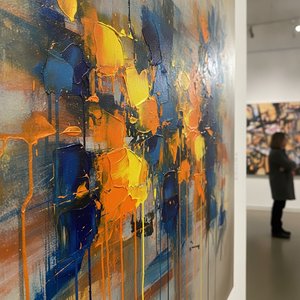
Beyond the Lines: Mastering the High-Impact World of Contemporary Abstraction
Master the high-impact world of contemporary abstraction. Discover how bold colors, textures, and modern movements like Abstract Expressionism can transform your space with premium, high-energy art curated for the design-conscious professional.

Kandinsky's Masterpieces: 25 Paintings That Define Abstract Art | OriginalUniqueArt
Journey through Wassily Kandinsky's 25 most iconic abstract paintings. Explore his revolutionary use of color, form & spiritual expressionism. Find museum-quality Kandinsky reproductions and elevate your home decor with OriginalUniqueArt.com. Discover all masterpieces on OriginalUniqueArt.com!
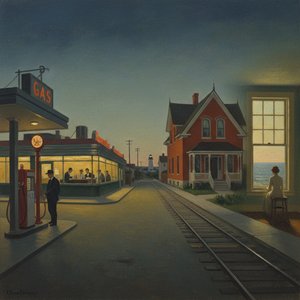
Edward Hopper's Masterpieces: 25 Iconic Paintings & Their Enduring Legacy | OriginalUniqueArt
Explore 25 iconic Edward Hopper paintings & their stories. Discover American realism, urban loneliness, and timeless beauty through his masterpieces. Find museum-quality art reproductions & curated decor ideas at OriginalUniqueArt.com.

Geometric Abstraction's 10 Defining Masterpieces | Art for Your Home - OriginalUniqueArt
Explore 10 defining masterpieces of Geometric Abstraction! Discover Kandinsky, Mondrian & Malevich’s iconic works. Find museum-quality art reproductions and curated decor ideas to elevate your home at OriginalUniqueArt.com.


