
 Preview
 Send
Send Share
Share
 Details
 Guide
Guide

 Download
 Similars
 X-Ray
X-Ray Diaporama
 Q&A
Q&A Stats
StatsTwo roses on a tablecloth


 Read More
Get a print-ready file that goes far beyond the web preview. Every digital image we sell comes from a high-resolution master in our stock database — usually 5,000 to 15,000 pixels wide — so you can print large, crop tightly, or reproduce fine detail with confidence.
No file leaves our studio untouched. A digital expert checks the colors against the original painting and corrects them if needed, then improves clarity and detail with professional retouching tools — always staying faithful to the artist's brushwork and style. The result is an image that looks like the painting, not like a filtered scan.
You approve before you're done: our expert sends the image by e-mail within 72 hours for your review. Not satisfied? Ask for improvements or corrections, or request a refund if the quality falls short.
This is the quality relied on by publishers, design studios, galleries and print shops.
Digital Image
Download a high-resolution file for personal display, printing, and creative projects. ( Switch to Print Buy Hand Made Painting)
Included in Every Digital Image Order
Expert Digital Delivery, Guaranteed
When you choose OriginalUniqueArt.com, you're not just getting an image - you're receiving a professionally enhanced digital artwork, crafted with precision and backed by a satisfaction guarantee. Here's everything that comes with your order, automatically:

Fast Email Delivery
Your high-resolution digital image file will be emailed to you within 72 hours of ordering - ready for immediate use.

AI-Enhanced Digital File
Your artwork is professionally optimized using advanced AI tools and manual editing, ensuring maximum detail, clarity, and color accuracy.

Free Lifetime Re-Delivery
Accidentally deleted or lost your file? No worries - we'll resend it to you anytime, free of charge.

No Import Fees - Ever
Enjoy your artwork instantly with zero customs, duties, or delivery fees - digital downloads are always tax-free.

Color Accuracy Guarantee
We ensure your digital image reflects the original colors as closely as possible using professional tools and color management.

100-Day Satisfaction Guarantee
If you're not satisfied with your digital image, we'll revise it or refund 100% within 100 days - no questions asked.

100% Money-Back Guarantee
Not satisfied? Get a full refund within 100 days of receiving your digital file - no questions asked.

Bulk Order Discounts
Buy 3 images, save 10% - Buy 5, save 15% - Buy 10+, save 20%. Great for creative projects, galleries, and agencies.
Two Roses on a Tablecloth
Édouard Manet’s “Two Roses on a Tablecloth” stands as an emblem of Impressionism's quiet revolution—a deceptively simple composition brimming with nuanced observation and emotional resonance. Created in 1883, this painting resides within the hallowed halls of the Museum of Modern Art (New York), inviting viewers to contemplate beauty born from fleeting moments and masterful artistic execution. ### The Composition The artwork’s core is undeniably its arrangement: two roses—one pristine white and fully blossomed, the other a delicate blush pink still clinging to bud—rest upon a linen tablecloth. Manet eschewed grand gestures or dramatic narratives; instead, he employed a diagonal placement of the roses that subtly injects dynamism into the scene. This deliberate movement contrasts with the stillness implied by the muted tones of the tablecloth and leaves, creating an interplay of visual tension. Crucially, Manet’s meticulous attention to light—captured through loose brushstrokes—illuminates the petals, casting soft shadows that accentuate their velvety texture and conveying a palpable sense of immediacy. ### Artistic Style Manet's rejection of academic conventions solidified his position as a pioneer of Impressionism. Unlike the polished surfaces and idealized forms favored by earlier artists, Manet embraced spontaneity and textural variation. His brushwork is characterized by visible strokes—a technique championed by Claude Monet and other Impressionists—that prioritize capturing the ephemeral qualities of light and color rather than striving for photographic realism. This stylistic choice reflects a broader artistic ethos that sought to depict the world as perceived by the senses, prioritizing emotion over intellectual precision. ### Historical Context By 1882, Édouard Manet had been battling syphilis for approximately ten years, experiencing debilitating symptoms including locomotive impairment, intense pain, and sensory disturbances. Despite these challenges, he produced some of his most poignant works during this period—pieces infused with an intimacy born from confronting personal vulnerability. The creation of “Two Roses” coincided with a time when Impressionists were actively rejecting the rigid formalism of the Salon, asserting instead their commitment to portraying everyday life with honesty and sensitivity. This artistic rebellion mirrored broader societal shifts toward valuing subjective experience and challenging established aesthetic hierarchies. ### Legacy “Two Roses on a Tablecloth” cemented Manet’s legacy as a transformative figure in art history—a precursor to movements like Cézanne's exploration of form and Picasso's groundbreaking innovations. Its influence extends beyond stylistic imitation; it instilled a fundamental belief that beauty could be found not only in grand spectacle but also in the quiet contemplation of ordinary subjects. For those seeking inspiration or desiring to adorn their homes with a piece of artistic heritage, reproductions of this masterpiece are available at OriginalUniqueArt.com – offering an unparalleled opportunity to experience the enduring power of Impressionist vision.Related Works:
- Édouard Manet: Woman with a Parrot
- Francis Bacon: Dog
- Georges Pierre Seurat: Portrait of Edmond-François Aman-Jean
For more information on still life painting and its history, visit Wikipedia's Still Life page.
Questions & Answers
Is "Two roses on a tablecloth" by Édouard Manet among the sought-after Impressionism artworks?
"Two roses on a tablecloth" is recorded as recognized among the Impressionism works in the catalog.
What color saturation does "Two roses on a tablecloth" by Édouard Manet have?
"Two roses on a tablecloth" by Édouard Manet is recorded with a subtle color saturation.
What does "Two roses on a tablecloth" share with the rest of Édouard Manet's output?
Within Édouard Manet's output, "Two roses on a tablecloth" sits in the Impressionism style, alongside the themes of rejection of academic style, everyday life observation, symbolic struggle, impressionist legacy, manet’s artistic vision.
Artist Biography
Early Life, Family and Training
Édouard Manet was born in Paris on January 23, 1832. He grew up in an affluent household, the eldest son of a man who held a position in the French Ministry of Justice. His father had envisioned a different path for him, one involving the navy or the law. The boy attempted to follow this direction, but he failed the entrance exams for the naval academy twice. This failure redirected his focus toward the studio. He eventually presented his father with a portfolio of paintings to prove his commitment to the arts, finally gaining the permission needed to study formally.
From 1850 to 1856, he trained in the studio of Thomas Couture. While he learned the technical foundations of academic painting there, his eyes often wandered toward the Louvre. He spent much of his time in those galleries, standing before the canvases of the Old Masters and copying their methods. He studied the way they handled light and form, absorbing the lessons of the past while preparing to find his own way. This period of intense study provided the technical grounding that would support his later departures from tradition.
Technique and Artistic Style
The surface of a canvas reveals a deliberate departure from the polished, invisible finish required by the Salon. Instead of smoothing away the evidence of the brush, there is a visible, energetic application of pigment known as facture. This approach prioritizes the physical reality of the paint itself. By using the alla prima or wet-on-wet technique, the colors are laid down while still fresh, capturing an immediate quality that avoids the slow, layered buildup of traditional academic methods. This method allows for a certain spontaneity in how light and atmosphere are recorded.
There is a noticeable flatness in the way forms are constructed. A loose handling of the paintbrush avoids the heavy modeling used to create deep, three-dimensional illusions. Instead, the pictorial space often feels compressed. This effect is heightened by the use of strong, contrasting tones. Rather than relying on gradual color scales to define shape, the work often uses stark shifts in value to suggest the fragmented, modern light of the city. This rejection of mathematical perspective and seamless blending creates a sense of immediacy, as if the image is being assembled directly before the eye.
The Scandal of Modern Subjects
The mid-1860s brought a series of confrontations with the public eye. In 1863, the Salon des Refusés provided a stage for works that the official juries had rejected. Among these was Le Déjeuner sur l'herbe, a painting that caused an immediate stir. It did not rely on the usual mythological or biblical excuses to present nudity; instead, it placed a nude woman in a picnic setting alongside two fully clothed men. This refusal to provide a historical or divine context left the viewer with nothing but the raw presence of contemporary life.
The tension only increased in 1865 with the exhibition of Olympia. This work was considered the most shocking piece in the Salon. It took the composition of Titian’s Venus of Urbino and stripped away the protective layer of myth, replacing a goddess with a contemporary prostitute. She did not look away or invite a gaze of admiration; she stared back with a directness that many found unsettling. Critics focused their anger on this lack of idealization and the bluntness of the subject matter.
Beyond the choice of subjects, the way the paint was applied drew heavy criticism. Many observers attacked the visible, energetic brushwork and the lack of a polished, seamless finish. They saw errors in perspective and a failure to follow the traditional rules of decorum. What some called incompetence, others recognized as a deliberate choice to show the reality of the paint on the canvas rather than a window into a dream.
Key Works and Major Paintings
In 1861, he produced The Spanish Singer, a work that earned him an honorable mention at the Salon. The painting shows a model in Andalusian costume, holding a guitar in a way that suggests the chords are being pressed by a left-handed player, even though the instrument is strung for a right-handed one. This small, deliberate error sits alongside a stereotypical Spanish still life placed near the model's feet.
His brushwork often addressed the immediate and the political. In 1867, he painted The Execution of the Emperor Maximilian of Mexico. Later, as his health began to decline in the late 1870s, his focus shifted toward smaller, more intimate subjects. By 1882, he had completed A Bar at the Folies-Bergère, a painting that captures the atmosphere of a modern café with a sense of psychological ambiguity. Near the end of his life, around 1883, he turned his attention to still lifes, such as Two roses on a tablecloth.
- The Spanish Singer (1861)
- The Execution of the Emperor Maximilian of Mexico (1867)
- A Bar at the Folies-Bergère (1882)
- Two roses on a tablecloth (about 1883)
Circle, Rivals and Influences
His brushwork carries the weight of the masters he studied in the Louvre. He looked toward the dramatic light of Caravaggio and the fluid, dark tones of Velázquez to find a way forward. From Goya, he took a certain directness that bypassed the need for polished, academic finishes. These were not mere studies; they were the tools he used to dismantle the expectations of the Salon. He preferred the presence of a single, strong color over the gradual blending of tones.
In the cafes and intellectual circles of Paris, he moved among the very people who would redefine the era. He shared spaces and ideas with Claude Monet and Edgar Degas, men who were also pushing against the boundaries of what a painting could be. His personal life was equally intertwined with the avant-garde; his sister-in-law was the artist Berthe Morisot. While he often sought the approval of the official institutions, his true peers were those working in the shadows of the established academies.
He found an early, vocal defender in a writer who saw the future in his controversial canvases. This supporter published a glowing account of his work, helping to frame his place in a changing art world. Even when the public reacted with hostility to his modern subjects, this support provided a necessary counterweight to the critics who found his style unfinished or his themes improper. He remained a figure caught between the old world of the Academy and the new, restless energy of the streets.
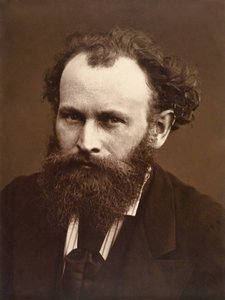
Édouard Manet
1832 - 1883 , France
Quick Facts
- Artistic Movement Or Style: Realism, Impressionism, Avant-garde
- Artists Or Movements Influenced By This Artist:
- Impressionism
- Avant-garde
- Claude Monet
- Berthe Morisot
- Edgar Degas
- Gauguin
- Artists Who Influenced This Artist:
- Caravaggio
- Diego Velázquez
- Francisco Goya
- Titian
- Raphael
- Frans Hals
- Peter Paul Rubens
- Full Name: Édouard Manet
- Nationality: French
- Notable Artworks:
- Olympia
- Le Déjeuner sur l'herbe
- A Bar at the Folies-Bergère
- Place Of Birth: Paris, France
- Date Of Birth: 1832
- Date Of Death: 1883