Preview
 Send
Send Share
Share
 Details
 Guide
Guide

 Download
 Similars
 X-Ray
X-Ray Diaporama
 Q&A
Q&A Stats
StatsThe Old Musician

- 187.0 x 248.0 cm


 Read More
Giclée / Art Print
Museum-quality giclée or canvas print with fast production and flexible finish options. ( Buy Hand Made Painting Switch to Digital Image)




P118B $10

P118H $10

P118W $10

P438Z $10

P508JH $12

P508YH $12

P805H $10

P805Z $10

P919BZ $10

P919G $10

P919XJ $10

P959ZH $10

P968JZ $12

W106C $8

W218G $10

W218JH $8

W218Y $10

W307PJ $10

W316G $10

W316PJ $8

W316Y $10

W398PJ $8

W4111J $10

W500HY $15

W500JH $15

W692G $12

W849H $8

W940BG $15

W953PJ $8




Pick from our preset sizes that match the artwork's original proportions.

Type the width and the height you need, to fit your frame or your wall. A print can only be cut, never made bigger than the picture, so a size with a different shape loses a part of the image. We send you a digital mockup to approve before we print anything. The picture shown on this page does not show the real cut — only the mockup does.
Worldwide Delivery () in 2 weeks instead of standard 4/5 weeks. (9 November)

Free Worldwide Express Shipping

High-Quality Linen Canvas

Full Shipping Insurance

Customs Tax Refund Guarantee

True Color Matching Guarantee

100-Day Return Policy (Defects Only)

100% Money-Back Guarantee

Bulk Discount Offer
 Glass option is only available in size under 110 CM

The Old Musician
Giclée / Art Print
Reproduction Size
-


Total Price
$ 81
The Old Musician: A Glimpse into Parisian Life by Édouard Manet
Édouard Manet's The Old Musician, painted in 1862, is more than just a depiction of street performers; it’s a pivotal work that bridges Realism and the burgeoning Impressionist movement. This large-scale oil on canvas (187 x 248 cm), now residing at the National Gallery of Art in Washington D.C., offers a fascinating window into mid-19th century Parisian society, capturing a moment of quiet contemplation amidst urban change.
Subject and Composition: A Gathering on the Margins
The painting portrays a group of seven figures – an elderly musician, a young girl cradling a baby, two children, a man in a top hat, and a figure partially obscured by shadow. These individuals are not idealized; they represent the everyday people inhabiting the fringes of Parisian life. The central figure, Jean Lagrène, a local gypsy band leader who also worked as an organ grinder and model, is depicted poised to play his violin. The composition isn't a narrative scene in the traditional sense; rather, it presents a snapshot – a collection of individuals seemingly unaware of each other, existing within the same space but disconnected.
Influences and Artistic Style: Realism with Spanish Flair
Manet’s artistic approach in The Old Musician is deeply rooted in Realism, influenced by Gustave Courbet's commitment to depicting contemporary life without romantic embellishment. However, the painting also reveals a significant influence from Spanish art, particularly the works of Diego Velázquez and Louis Le Nain. Manet admired their ability to capture the dignity and humanity of ordinary people. This is evident in the figures’ poses and attire, which echo those found in Spanish portraiture. The use of flattened perspective and bold brushstrokes further distinguishes Manet's style from the academic conventions of his time, foreshadowing the techniques that would later define Impressionism.
Symbolism and Historical Context: Urban Transformation and Modernity
Beyond its surface depiction, The Old Musician carries layers of symbolic meaning. The painting was created during a period of rapid urban transformation in Paris under Baron Haussmann's redevelopment plan. The slum depicted in the painting was slated for demolition to make way for new boulevards, suggesting that these figures represent a disappearing world – a community displaced by progress. The inclusion of recognizable characters like Colardet, the rag-picker and ironmonger, adds another layer of social commentary. Manet’s deliberate neutrality in portraying these individuals—neither glorifying nor condemning them—reflects his commitment to capturing the complexities of modern life. The recurring motif of the man in the top hat, also appearing in The Absinthe Drinker, creates a sense of continuity and reinforces the idea of observing familiar faces within a changing urban landscape.
Emotional Impact: A Moment of Quiet Reflection
Despite its realism, The Old Musician evokes a profound sense of quiet contemplation. The figures’ impassive expressions and disconnected postures create an atmosphere of melancholy and detachment. Manet's masterful use of light and shadow further enhances this mood, drawing the viewer into the scene and inviting them to reflect on the lives of these marginalized individuals. The painting is not merely a portrait; it’s a poignant meditation on the human condition—a timeless exploration of solitude, resilience, and the fleeting nature of existence.
Questions & Answers
What feeling do the colors of "The Old Musician" by Édouard Manet create?
In "The Old Musician", earthy colors accompany a reflective feeling.
What explains the copyright situation of "The Old Musician" by Édouard Manet?
"The Old Musician" by Édouard Manet is in the public domain - its copyright has expired. Copyright duration runs from the artist's death, which occurred in 1883.
How popular is "The Old Musician" within Realism?
Within the Realism movement, "The Old Musician" has a recognized popularity level.
Artist Biography
The Architect of Modernity
To look at a canvas by Édouard Manet is to witness the precise moment when the polished illusions of the past collapsed under the weight of contemporary reality. He did not seek to decorate the walls of the bourgeoisie; he sought to confront them. While his contemporaries often retreated into mythological safety, Manet forced the viewer to acknowledge the grit and the glare of 19th-century Paris. His work functions as a blunt instrument that dismantled the academic hierarchy of subjects. He stripped away the comfortable distance provided by historical allegory, replacing it with the unsettling directness of a woman staring back from a modern street or a café.
The impact of his technique remains visible in every brushstroke that prioritizes the physical reality of paint over the illusion of depth. He rejected the seamless, invisible finish demanded by the Salon, opting instead for facture—a visible, energetic application of pigment. By using stark contrasts and a flattened pictorial space, he reminded anyone looking at his work that they were observing a constructed image on a flat surface. This was not an error in perspective; it was a deliberate rejection of the window-like transparency that had dominated Western art since the Renaissance.
A Rebellion Rooted in Tradition
Manet’s radicalism was not born from ignorance of the past, but from a deep, analytical study of it. His time spent copying Old Masters in the Louvre provided him with a technical foundation that he would later use to subvert tradition. He drew heavily from the bold compositions and light manipulation found in the works of Caravaggio and Velázquez. From the Spanish masters, he learned how to utilize black as a positive color and how to employ fluid brushwork to suggest form without excessive detail. This was not an imitation of the past, but a dissection of it.
His early life in Paris suggested a path far removed from the studio. Born into a comfortable family, his father initially pushed for a career in the navy or law. After failing his entrance exams for the naval academy, Manet turned toward the arts under the instruction of Thomas Couture. This tension between his bourgeois origins and his revolutionary output created a unique friction in his work. He possessed the social standing to navigate Parisian intellectual circles, yet he used that access to promote an aesthetic that many found vulgar or incompetent.
The Scandal of the Real
The mid-1860s provided the stage for Manet’s most significant confrontations with the public. The 1863 Salon des Refusés became a site of intense controversy, largely due to his inclusion in the exhibition of rejected works. His painting Le Déjeuner sur l'herbe shocked audiences not merely because of its nudity, but because of its lack of mythological context. The figures were undeniably modern, stripped of the divine or the ancient, leaving only the raw presence of contemporary Parisians. This refusal to idealize his subjects was met with widespread condemnation from critics who found his realism too blunt.
This pattern of provocation continued with Olympia in 1865. By reimagining Titian’s Venus of Urbino through the lens of a contemporary prostitute, Manet stripped away the protective layer of myth. The subject did not invite a gaze of admiration for a goddess; she demanded recognition of a person. This period of his career established the fundamental shift from Realism toward the beginnings of Impressionism. His influence on the movement was structural rather than purely stylistic:
- He championed the use of alla prima painting, or wet-on-wet technique, to capture immediate atmospheric effects.
- He introduced a flattened perspective that challenged the mathematical precision of academic composition.
- He utilized strong, contrasting tones to create a sense of modern, fragmented light.
The Enduring Verdict
Manet’s career was cut short by his death in 1883, yet the trajectory of art had already been irrevocably altered. He acted as the essential bridge between the heavy, grounded themes of Realism and the fleeting, light-focused explorations of the Impressionists. While he never fully adopted the label of an Impressionist and continued to seek recognition from the official Salon, his methods provided the vocabulary for the avant-garde. He proved that the artist's duty was not to provide a beautiful escape, but to document the complexities and contradictions of the era.
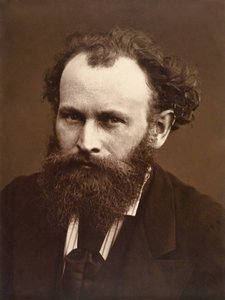
Édouard Manet
1832 - 1883 , France
Quick Facts
- Full Name: Édouard Manet
- Nationality: French
- Date Of Birth: 1832
- Date Of Death: 1883
- Place Of Birth: Paris, France
- Notable Artworks:
- Le Déjeuner sur l'herbe
- Olympia
- A Bar at the Folies-Bergère
- Artistic Movement Or Style: Realism, Impressionism
- Artists Who Influenced This Artist:
- Caravaggio
- Diego Velázquez
- Gustave Courbet
- Artists Or Movements Influenced By This Artist:
- Claude Monet
- Pierre-Auguste Renoir
- Edgar Degas
- Impressionism
Related Articles

Romantic Realism's Finest: 10 Masterpieces for Your Home | OriginalUniqueArt
Explore 10 defining masterpieces of Romantic Realism! Discover Courbet, Millet & Daumier's powerful paintings—capturing emotion and social realities. Find museum-quality reproductions for your home at OriginalUniqueArt.com.
Realism's Masters: 10 Artworks That Capture Life's Essence | OriginalUniqueArt
Explore 10 iconic realism artworks by Courbet, Millet & more! Discover the stories behind these masterpieces of 19th-century painting. Find museum-quality art reproductions and elevate your home decor with OriginalUniqueArt.com.

Impressionistic Realism's Finest: 10 Masterpieces for Your Home | OriginalUniqueArt
Journey through Impressionistic Realism with 10 iconic masterpieces by Monet, Renoir & Van Gogh. Explore art history, techniques & find museum-quality reproductions for your home at OriginalUniqueArt.com. Discover all masterpieces online!

25 Masterpieces by Édouard Manet: The Revolutionary Architect of Modern Art
Explore 25 iconic Édouard Manet masterpieces that defined modern art. Discover the full collection online at OriginalUniqueArt.com.
Édouard Manet: Pioneering Modernism & Challenging Artistic Conventions
Explore the life & art of Édouard Manet, a pivotal figure bridging Realism and Impressionism. Discover his revolutionary techniques, controversial masterpieces like 'Olympia,' and lasting impact on modern art history.