Early Life, Family and Artistic Training
Diego Rivera emerged from a family of modest means in Guanajuato, Mexico, born on December 8, 1886. His early environment was marked by a significant loss when his twin brother, Carlos, died at the age of two. Despite this, his talent manifested almost immediately. By the age of three, Rivera was already drawing, a drive that his parents, María del Pilar Barrientos and Diego Rivera Acosta, recognized and supported. This early impulse was not a passing phase but the beginning of a disciplined technical pursuit.
His formal education began in earnest at the Academy of San Carlos in Mexico City. At age ten, he entered this institution to undergo rigorous training in traditional methods. This period of study provided the structural foundation necessary for the large-scale works that would later define his career. He did not rely on raw instinct alone; his development was rooted in the formal academic discipline of the Mexican capital.
Artistic Development in Europe
Rivera’s time in Europe was a period of technical acquisition and ideological sharpening. In 1907, a government scholarship sent him to the continent, beginning with studies in Madrid, Spain. Under the instruction of Eduardo Chicharro, he engaged with established academic traditions. This was not a period of mere imitation; it was a necessary grounding before his move to Paris, France. In the Montparnasse community, he integrated into a circle of international artists, absorbing the avant-garde shifts that were redefining modernism. This exposure provided the visual vocabulary he would later apply to the monumental scales of his Mexican commissions.
His technical evolution continued through a focused study of frescoes in Italy between 1920 and 1921. This specific training in wall painting was essential for the large-scale works that would define his career. His political engagement was equally active; when the Soviet poet Vladimir Mayakovsky visited Mexico in 1925, Rivera acted as his personal guide. These years in Europe and his subsequent travels established the intersection of formal technique and social conviction that characterizes his entire body of work.
The Mexican Mural Renaissance
Rivera’s return to Mexico in 1921 marked a decisive shift from European experimentation toward a localized, politically charged agenda. He did not merely return to his roots; he actively integrated himself into the country's social upheaval by joining the local Communist Party. This political alignment transformed his practice from individual expression into a tool for public narrative. He became a central figure in the Mexican Mural Movement, a movement that sought to use large-scale public art to communicate history and social change to a broad audience.
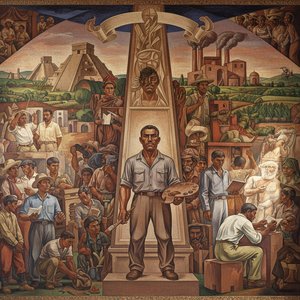
His work during this period focused on the dignity of the Mexican working class and the realities of their struggles. He moved away from the private gallery space to occupy the walls of public buildings, ensuring his imagery reached the people it depicted. This was a calculated effort to use art as a vehicle for social commentary, focusing on the lives of ordinary citizens rather than the elite. His murals functioned as visual records of a nation attempting to redefine itself through its indigenous roots and revolutionary spirit.
- Creation (1922)
- Song of the Earth (1923–1927)
- Political Vision of the Mexican People (1923–1928)
Technique and Artistic Style
Rivera’s visual language was not a mere aesthetic choice; it was a calculated synthesis of disparate influences. He fused the structural deconstruction of Cubism and the color theories of Post-Impressionism with the deep-seated traditions of Mexican folklore. This was not a superficial borrowing. His style relied on a massive collection of nearly sixty thousand pre-Columbian artifacts, which provided the foundational imagery for his compositions. The result was a method of seeing that prioritized large, flat shapes and strong, decisive lines. He avoided delicate nuances in favor of a bold and colorful approach that demanded immediate recognition.
The scale of his work required specific technical mastery. He moved beyond the limitations of the easel, utilizing large frescoes and large-scale mosaics to command public spaces. His compositions often utilized a rhythmic sense of arrangement to organize complex historical narratives. By stripping away unnecessary detail, he achieved a monumental clarity. This directness allowed his work to function as a visual record of social and historical shifts, making the art inseparable from the political and cultural identity of Mexico.
Major Commissions and Patrons
Rivera’s career was defined by a capacity to secure large-scale public work that bypassed traditional gallery constraints. His reach extended from the political centers of Mexico to the industrial heart of the United States. In Mexico, he accepted a commission from the American ambassador to paint murals in the Palace of Cortés in Cuernavaca. This project demonstrated his ability to navigate diplomatic and institutional channels to secure space for his monumental narratives. His work was never confined to a single medium or a single nation; he moved between the demands of state-sponsored public art and the specific needs of private collectors.
The Detroit Institute of Arts provided a significant platform for his industrial themes through the commission of the Detroit Industry Murals. This project required him to translate the mechanical complexity of the automotive era into a permanent visual language. Beyond these massive public efforts, his professional network included influential figures like Albert M. Bender, who commissioned a portrait of Frida Kahlo. Rivera also exerted influence through the written word, serving as a contributor and editor of the English-language journal Mexican Folkways between 1925 and 1937. This period of editorial work allowed him to shape how Mexican culture was perceived by an international audience.
- Detroit Industry Murals
- Palace of Cortés murals
Key Works and Masterpieces
Rivera’s command of scale and medium is best understood through his early experimentation with texture and permanence. His first significant mural, Creation, utilized the encaustic technique to establish a visual language that prioritized substance over mere decoration. This early focus on material weight transitioned into the monumental scale of his later public works, where he moved from the intimate application of wax to the expansive demands of fresco. His ability to manipulate these mediums allowed him to transform massive surfaces into historical narratives that demanded physical engagement from the viewer.
The Detroit Industry Murals, completed during the shadows of the Great Depression, represent a peak in his ability to synthesize industrial grit with social commentary. Specifically, the Detroit Industry: East Wall in the Detroit Institute of Arts functions as a massive fresco that captures the rhythmic, mechanical pulse of labor. These works do not merely depict machinery; they translate the energy of the assembly line into a permanent, public record. Similarly, Dream of a Sunday Afternoon in the Alameda Park operates as a monumental work that compresses historical figures and collective memory into a single, dense visual field. His output was never about simple representation; it was about the physical occupation of space.
- Creation (1922)
- Detroit Industry: East Wall (1933)
- Dream of a Sunday Afternoon in the Alameda Park (1948)
Personal Life and Relationships
Rivera’s private life was as complex and layered as his public murals. His first significant marriage occurred in 1911 to Angelina Beloff, an artist from the pre-Revolutionary Russian Empire. This union was marked by personal tragedy; they had a son named Diego who died young between 1916 and 1918. This loss remains a heavy, concrete fact of his early adulthood, a period of profound personal upheaval that preceded his return to Mexico.
His domestic history continued to shift as his political and artistic identity solidified. In June 1922, he married Guadalupe Marín. This marriage eventually ended in divorce, leading to his next high-profile union. In August 1929, Rivera married Frida Kahlo. Their relationship was a central fixture of his life, characterized by intense passion and frequent turbulence. This connection between two prominent artists became a defining element of his personal narrative, often discussed alongside his political convictions.
Legacy and Global Influence
Rivera remains a central figure in the history of post-revolutionary Mexico. His work established the mural movement as a dominant force in both Mexican and international art. By utilizing large-scale frescoes to address social themes, he transformed the medium into a tool for political and historical narrative. His approach remains a primary example of social realism, where the visual language is inseparable from the struggle of the working class and indigenous identity.
The impact of his style extends beyond the borders of Mexico. His ability to fuse modernist innovations with pre-Columbian imagery created a visual framework that influenced how nations express their own histories through public art. He did not merely paint walls; he redefined the function of the mural, moving it from decorative application to a medium of social commentary. This shift forced a global reconsideration of how art interacts with the public sphere and the state.
- Detroit Industry Murals (1933)
- Dreams of a Sunday in the Alameda
- Creation (1922)
Where to See the Works Today
To witness the scale of Rivera's vision, one must travel to the Detroit Institute of Arts. Here, the Detroit Industry Murals occupy a central place, capturing the mechanical pulse of labor and the grit of the industrial era. These frescoes remain a primary site for observing how he translated heavy machinery and human effort into a public narrative.
In Mexico City, his presence is felt through several major institutions. The Museo Mural Diego Rivera preserves his monumental output, specifically housing the mural "Dream of a Sunday Afternoon in the Alameda Park." Nearby, the Museo Dolores Olmedo holds "Día de Muertos en Janitzio," a work that anchors the museum's collection. These sites offer a direct encounter with the artist's commitment to public and historical storytelling.
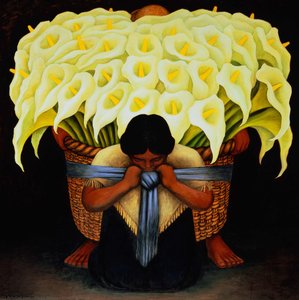
Beyond these Mexican hubs, his influence extends into major international collections. The San Francisco Museum of Modern Art holds "The Flower Carrier," a piece that demonstrates his ability to focus on the dignity of everyday life. His work is distributed across these specific locations, ensuring his visual language remains accessible to those studying the intersection of art and social history.

 Switch to Print
 Read More







































 For artworks or reproductions larger than 105 cm (approximately 41 inches) on any side, the frame will be shipped as a kit, disassembled. This method ensures safe delivery and prevents damage during transport.


 Preview
 Send
Send Share
Share
 Details
 Guide
Guide

 Download
 Similars
 X-Ray
X-Ray Diaporama
 Q&A
Q&A Stats
Stats