Hudson River School
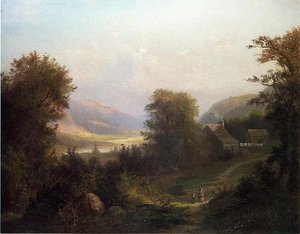
Landscape (David Johnson)
David Johnson (1827–1908) made Landscape. It belongs to the Hudson River School movement.

 Preview

 Hand Made Oil Painting
 Send
 Share
 Fact sheet


 Download
 Similars
 X-Ray
 Diaporama
 Q&A

 Stats
Landscape, in brief
- Title
- Landscape
- Artist
- David Johnson (1827–1908)
- Artist born in
- New York City, United States
- Movement
- Hudson River School
- Subject
- forests, landscape
High-resolution images of Landscape
David Johnson, Landscape. Public domain.
Questions on Landscape, answered
What is "Landscape" about?
The themes present in "Landscape" by David Johnson include forests, landscape. Together they summarize the artwork's subject matter.
Is "Landscape" by David Johnson in the public domain?
"Landscape" by David Johnson is in the public domain - its copyright has expired. This status governs how the image of the work may be reproduced.
Who created "Landscape"?
The artist behind "Landscape" is David Johnson. The work is catalogued under David Johnson's name.
Which artistic current is "Landscape" by David Johnson part of?
"Landscape" by David Johnson belongs to the Hudson River School movement. This movement provides the stylistic context of the work.
Is "Landscape" by David Johnson in the public domain, and why?
"Landscape" by David Johnson is in the public domain - its copyright has expired. Copyright terms are measured from the artist's death, and David Johnson died in 1908.
About the artist, David Johnson

1827–1908, United States
David Johnson
David Johnson: Weaver of Northeastern Light David Johnson, born in New York City in 1827, wasn’t a name etched into the public consciousness during his lifetime, yet his contributions to American landscape painting are profoundly significant. He belonged to the second generation of the Hudson River School, a movement that sought to capture the sublime beauty and spirit of America's natural world – a legacy he inherited and subtly reshaped over a remarkably productive career spanning nearly five decades. Unlike some of his more flamboyant contemporaries, Johnson’s approach was characterized by quiet observation, meticulous detail, and an almost meditative quality, earning him recognition as a master of Luminism, a style emphasizing subtle tonal variations and atmospheric effects to evoke mood and atmosphere rather than dramatic spectacle. Johnson's early artistic journey began with limited formal training.
Also by David Johnson
 Hudson River Scene1863
 Edwin Forrest1871
 On the Waywayanda, Orange County, New York1877
 A View on Lake George1876
Essays around Landscape
 David Johnson: A Luminist Master of the Hudson River School & BeyondExplore the captivating landscapes of David Johnson, a key figure in the Hudson River School & Luminism movement. Discover his artistic evo…
 The Sublime Frontier: Examining the Legacy of the Hudson River School's American LandscapesExplore the epic legacy of Hudson River School landscapes and the sublime. Discover America's romantic art history now.
 The Hudson River School: A Definitive Guide to America's Romantic Landscape TraditionExplore the profound legacy of the Hudson River School. Discover how masters like Thomas Cole captured the American sublime through Romanti…