

 Preview
 Send
Send Share
Share
 Details
 Guide
Guide

 Download
 Similars
 X-Ray
X-Ray Diaporama
 Stats
StatsHorizontal Tektonik
 Acrylic On Canvas
- WallArt
- Suprematist Tektonik
 1977
1977 244.0 x 177.0 cm
 Serpentine Galleries
 Read More
The artwork displayed on this page is protected by copyright law, which means we cannot legally create or sell an identical reproduction. This protection is enforced under international agreements such as the Berne Convention and by national laws, including those outlined by the U.S. Copyright Law - Title 17.
This method fully complies with copyright regulations because it does not involve copying or duplicating the protected artwork. Instead, it is a creative reinterpretation - a new painting that is influenced by the original but not identical to it.
Giclée / Art Print
Museum-quality giclée or canvas print with fast production and flexible finish options. ( Buy Hand Made Painting Switch to Digital Image)




P118B $10

P118H $10

P118W $10

P438Z $10

P508JH $12

P508YH $12

P805H $10

P805Z $10

P919BZ $10

P919G $10

P919XJ $10

P959ZH $10

P968JZ $12

W106C $8

W218G $10

W218JH $8

W218Y $10

W307PJ $10

W316G $10

W316PJ $8

W316Y $10

W398PJ $8

W4111J $10

W500HY $15

W500JH $15

W692G $12

W849H $8

W940BG $15

W953PJ $8




Pick from our preset sizes that match the artwork's original proportions.

Type the width and the height you need, to fit your frame or your wall. A print can only be cut, never made bigger than the picture, so a size with a different shape loses a part of the image. We send you a digital mockup to approve before we print anything. The picture shown on this page does not show the real cut — only the mockup does.
Worldwide Delivery () in 2 weeks instead of standard 4/5 weeks. (26 October)

Free Worldwide Express Shipping

High-Quality Linen Canvas

Full Shipping Insurance

Customs Tax Refund Guarantee

True Color Matching Guarantee

100-Day Return Policy (Defects Only)

100% Money-Back Guarantee

Bulk Discount Offer
 Glass option is only available in size under 110 CM

Horizontal Tektonik
Giclée / Art Print
Reproduction Size
-


Total Price
$ 81
A Dance of Circles and Shadows: Zaha Hadid’s Horizontal Tektonik
Zaha Hadid’s Horizontal Tektonik isn't merely a painting; it’s an architectural proposition rendered in vibrant acrylic on canvas, a testament to the Iraqi-British visionary’s radical approach to design. Completed in 1977 during her studies at the Architectural Association School of Architecture in London, this work represents a pivotal moment in Hadid’s evolution – a bridge between her burgeoning mathematical understanding and her increasingly intuitive grasp of spatial dynamics. The piece immediately captivates with its dynamic composition: a central, commanding circle dominates the canvas, radiating outwards into a complex network of smaller circles, each subtly offset and interwoven. These aren't static forms; they possess an inherent movement, suggesting both construction and dissolution, order and chaos – mirroring the very essence of Hadid’s architectural philosophy.
The painting draws heavily from the work of Kazimir Malevich, specifically his ‘arkhitektons,’ abstract geometric forms that he believed could serve as the basis for architecture. Hadid’s interpretation takes this concept to a new level, transforming Malevich's static diagrams into a pulsating, almost liquid structure. The influence is evident in the painting’s fractured perspective and its deliberate disruption of traditional spatial conventions. It’s a bold departure from representational art, prioritizing process and potential over precise depiction. The use of color – primarily blues, greens, and blacks – further enhances this sense of dynamism, creating an atmosphere of both mystery and excitement.
Decoding the Geometry: Structure and Symbolism
Technically, Horizontal Tektonik is a masterful exercise in controlled abstraction. Hadid’s meticulous layering of circles creates a complex interplay of positive and negative space, generating a sense of depth that defies the flatness of the canvas. The varying sizes and positions of the circles suggest a hierarchical structure – the central circle acting as a nucleus around which all other elements orbit. This geometric arrangement isn't arbitrary; it’s rooted in Hadid’s fascination with mathematical principles and her belief that architecture should be informed by logic and precision.
Symbolically, the painting can be interpreted as an exploration of urban transformation and the inherent tension between tradition and innovation. The circles represent both the established structures of London – alluded to by the North Bank’s Brutalist architecture – and the potential for new forms to emerge within that context. The ‘mutation’ factor, a concept central to Hadid's thinking, is embodied in the painting’s dynamic composition; it suggests a process of constant change and adaptation, mirroring the ever-evolving nature of the city itself. The work also subtly references Suprematism, with its emphasis on pure geometric forms and its rejection of representational imagery.
A Legacy Forged in Innovation
Horizontal Tektonik wasn’t merely a student project; it was a declaration of intent. It foreshadowed Hadid's future career as one of the most influential architects of her generation, known for her daring designs and her ability to seamlessly blend form and function. The painting’s influence can be seen in her subsequent works, such as the Rosenthal Center for Contemporary Art in Cincinnati and the Guangzhou Opera House. It demonstrates a key element of Hadid's approach: using abstract forms to explore complex spatial relationships and to create buildings that are both visually striking and structurally innovative.
Today, Horizontal Tektonik stands as a powerful reminder of Hadid’s early vision – a testament to her belief in the transformative power of architecture. It's a work that continues to inspire architects, artists, and designers around the world, inviting viewers to contemplate the relationship between geometry, space, and human experience. Reproductions of this captivating artwork offer a unique opportunity to bring a piece of Hadid’s revolutionary thinking into your home or office – a conversation starter and a symbol of enduring creativity.
Questions & Answers
What stage of Dame Zaha Mohammad Hadid's development does "Horizontal Tektonik" represent?
"Horizontal Tektonik" represents the Early Period of Dame Zaha Mohammad Hadid.
What medium is "Horizontal Tektonik" by Dame Zaha Mohammad Hadid executed in?
Dame Zaha Mohammad Hadid used the acrylic on canvas technique for "Horizontal Tektonik". The technique defines the material nature of the original work.
What emotional tone accompanies the Suprematist Tektonik style of "Horizontal Tektonik"?
The mysterious emotion of "Horizontal Tektonik" accompanies its Suprematist Tektonik style.
Artist Biography
A Revolutionary Vision: The Life and Legacy of Zaha Hadid
Born in Baghdad, Iraq, in 1950, Dame Zaha Mohammad Hadid emerged as one of the most significant architectural forces of our time. Her journey began not within the traditional confines of artistic upbringing, but amidst a stimulating intellectual environment; her father, Muhammad al-Hajj Husayn Hadid, was a successful industrialist and politician, while her mother, Wajiha al-Sabunji, nurtured a passion for art. This unique blend of pragmatism and creativity would profoundly shape young Zaha’s worldview. Initially pursuing mathematics at the American University of Beirut, she soon discovered that her true calling lay in the realm of spatial design, leading her to London in 1972 and enrollment at the Architectural Association School of Architecture. It was here, under the tutelage of influential figures like Rem Koolhaas, Elia Zenghelis, and Bernard Tschumi, that Hadid’s radical architectural thinking began to take form. These mentors encouraged a questioning of established norms, fostering an environment where experimentation and innovation thrived—a foundation upon which she would build her extraordinary career.Deconstructing Conventions: Style and Influences
Zaha Hadid didn't simply design buildings; she sculpted experiences. Widely celebrated as a pioneer of deconstructivism, her work boldly rejected the rigid geometries and conventional forms that had long defined architectural practice. Instead, she embraced fragmentation, dynamic curves, and a sense of fluid movement, creating structures that seemed to defy gravity itself. Her designs weren’t merely functional spaces; they were artistic statements—powerful expressions of form and energy. The influence of early 20th-century avant-garde movements, particularly Suprematism and the work of Kazimir Malevich, is readily apparent in her early explorations. In fact, her graduation project, “Malevich’s Tektonik,” served as a powerful demonstration of her commitment to abstract principles and non-rectilinear forms. But Hadid wasn't solely an imitator; she synthesized these influences with her own unique vision, liberating architectural geometry and imbuing it with a new expressive identity. Crucially, painting and drawing were not merely preparatory tools for Hadid—they were integral to the design process itself, allowing her to explore spatial concepts and visualize complex forms before they materialized in concrete and steel.Landmark Creations: A Global Impact
Hadid established her own practice in London in 1980, but recognition didn’t come easily. Her early designs were often considered too radical, too challenging for the prevailing architectural climate. However, she persevered, and gradually, her innovative approach began to gain traction. The Hong Kong Peak Club (1983) was an early showcase of her emerging style, hinting at the breathtaking structures that would follow. Over the ensuing decades, Hadid’s firm completed a series of landmark projects that redefined urban landscapes around the globe. These included the fluid and dynamic London Aquatics Centre for the 2012 Olympics, a testament to her ability to create spaces that inspire movement and athleticism; the Broad Art Museum in Michigan, USA, with its striking pleated stainless steel facade; MAXXI – National Museum of 21st Century Arts in Rome, Italy, a complex interplay of volumes and voids; the Guangzhou Opera House in China, resembling two smooth pebbles on the Pearl River; and the Heydar Aliyev Center in Baku, Azerbaijan, a breathtaking wave-like structure that embodies her signature curvilinear aesthetic. These projects weren’t just buildings—they were cultural icons, pushing the boundaries of architectural possibility.Recognition and Enduring Influence
The accolades bestowed upon Zaha Hadid throughout her career are a testament to her extraordinary talent and lasting impact. She received numerous awards, culminating in the Pritzker Architecture Prize in 2004—the highest honor in architecture—making her the first woman to receive this prestigious recognition individually. Further honors included the Stirling Prize (awarded twice, in 2010 and 2011), and, posthumously, the Royal Gold Medal from the Royal Institute of British Architects in 2016, again a historic first for a woman. Beyond her architectural achievements, Hadid broke down barriers as a female architect in a historically male-dominated field, becoming an inspiration to countless aspiring designers. Her legacy extends beyond the physical structures she created; it lies in her transformative influence on architectural thought and practice. Even after her untimely death in 2016, Zaha Hadid Architects continues to operate, carrying forward her vision and principles with unwavering dedication. Her exploration of artistic mediums beyond architecture—such as works like “Tatlin Tower and Tectonic”—demonstrates a unique synergy between design expertise and artistic expression. Zaha Hadid’s buildings stand as enduring monuments to her innovative spirit, shaping the built environment for generations to come.Beyond Buildings: A Lasting Artistic Legacy
While celebrated primarily for her architectural achievements, Zaha Hadid's creative vision extended far beyond the realm of building design. She consistently explored artistic mediums such as painting and product design, viewing them not as separate disciplines but as interconnected expressions of her unique aesthetic sensibility. Her paintings, often characterized by dynamic compositions and abstract forms, served as conceptual explorations that directly informed her architectural projects. These works weren’t simply sketches or representations; they were integral to the development of her ideas, allowing her to experiment with spatial relationships and visual textures before translating them into three-dimensional structures.- Early Paintings: Her early paintings, like “Orange Explosion on White,” demonstrate a fascination with fragmented forms and vibrant colors, foreshadowing the deconstructivist principles that would define her architectural style.
- Design Objects: Hadid also ventured into product design, creating furniture, lighting fixtures, and other objects that echoed the fluid lines and sculptural qualities of her buildings. The Chanel Mobile Art Pavilion in Tokyo is a prime example of this cross-disciplinary approach, showcasing her ability to translate architectural concepts into a portable, immersive environment.
- Conceptual Explorations: Works like “Interpretation of Tatlin” reveal her engagement with historical avant-garde movements and her desire to reinterpret modernist principles in a contemporary context.
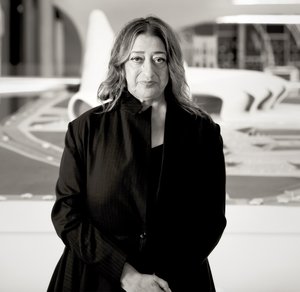
Dame Zaha Mohammad Hadid
1950 - 2016 , Iraq
Quick Facts
- Full Name: Zaha Mohammad Hadid
- Nationality: Iraqi-British
- Date Of Birth: 1950
- Date Of Death: 2016
- Place Of Birth: Baghdad, Iraq
- Notable Artworks:
- London Aquatics Centre
- MAXXI Museum
- Guangzhou Opera House
- Interpretation of Tatlin
- Artistic Movement Or Style: Deconstructivism
- Artists Who Influenced This Artist:
- Kazimir Malevich
- Rem Koolhaas
- Artists Or Movements Influenced By This Artist: Modern Architecture
Related Articles

Kandinsky's Masterpieces: 25 Paintings That Define Abstract Art | OriginalUniqueArt
Journey through Wassily Kandinsky's 25 most iconic abstract paintings. Explore his revolutionary use of color, form & spiritual expressionism. Find museum-quality Kandinsky reproductions and elevate your home decor with OriginalUniqueArt.com. Discover all masterpieces on OriginalUniqueArt.com!

Abstract Expressionism's 10 Defining Masterpieces |
Explore 10 defining Abstract Expressionism masterpieces by Pollock, Rothko & de Kooning. Discover the stories behind these iconic paintings and find museum-quality art reproductions to elevate your home decor on .

Geometric Abstraction's 10 Defining Masterpieces | Art for Your Home - OriginalUniqueArt
Explore 10 defining masterpieces of Geometric Abstraction! Discover Kandinsky, Mondrian & Malevich’s iconic works. Find museum-quality art reproductions and curated decor ideas to elevate your home at OriginalUniqueArt.com.
Kazimir Malevich: 25 Masterpieces of Suprematism & Abstract Art | OriginalUniqueArt
Explore 25 iconic artworks by Kazimir Malevich, pioneer of Suprematism & abstract art. Discover the stories behind 'Black Square' and more! Find museum-quality prints & elevate your home decor with OriginalUniqueArt.com.
Beyond the Lines: Mastering the High-Impact World of Contemporary Abstraction
Master the high-impact world of contemporary abstraction. Discover how bold colors, textures, and modern movements like Abstract Expressionism can transform your space with premium, high-energy art curated for the design-conscious professional.


