

 Preview
 Send
Send Share
Share
 Details
 Guide
Guide

 Download
 Similars
 X-Ray
X-Ray Diaporama
 Stats
StatsLandscape with Nymphs
 Oil On Canvas
- WallArt
- Baroque
 1650
1650- Early Modern
 22.0 x 29.0 cm
 Wallraf-Richartz-Museum
 Read More
Hand Made Oil Reproduction
Hand-painted oil on canvas in your size and frame, made to order by our artists. ( Switch to Print Switch to Digital Image)




P118B $10

P118H $10

P118W $10

P438Z $10

P508JH $12

P508YH $12

P805H $10

P805Z $10

P919BZ $10

P919G $10

P919XJ $10

P959ZH $10

P968JZ $12

W106C $8

W218G $10

W218JH $8

W218Y $10

W307PJ $10

W316G $10

W316PJ $8

W316Y $10

W398PJ $8

W4111J $10

W500HY $15

W500JH $15

W692G $12

W849H $8

W940BG $15

W953PJ $8




Pick from our preset sizes that match the artwork's original proportions.

Type the width and the height you need, to fit your frame or your wall. This is hand-painted, so for a size with a different shape the artist can paint a bit more around the picture, or cut a bit — you choose. We send you a digital mockup to approve before the painting starts. The picture shown on this page does not show the real result — only the mockup does.
After order, OriginalUniqueArt.com team will email client for instructions and provide a mockup preview
Worldwide Delivery () in 3/4 weeks instead of standard 5 weeks. (27 October). No compromise on quality.

Free Worldwide Express Shipping

High-Quality Linen Canvas

Full Shipping Insurance

Customs Tax Refund Guarantee

True Color Matching Guarantee

100-Day Return Policy (Defects Only)

100% Money-Back Guarantee

Bulk Discount Offer
 Glass option is only available in size under 110 CM

Landscape with Nymphs
Reproduction Medium
Reproduction Size
-


Total Price
$ 300
A Vision of Pastoral Serenity: Exploring the Landscape with Nymphs
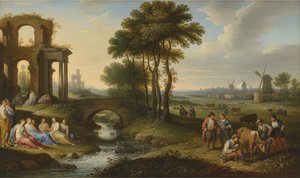
To gaze upon this depiction of a landscape with nymphs is to step through a veil into an idealized moment plucked from classical mythology. The scene unfolds as a breathtaking tableau of natural beauty, where human figures seem utterly at ease within the embrace of nature. At its heart lie two primary figures: one reclining gracefully on the left, embodying repose, while a standing male figure accompanies her on the right. They are enveloped by an exquisite outdoor setting, suggesting a secluded haven far from the clamor of the everyday world. Scattered throughout this picturesque vista are other figures, some appearing intimately close in the foreground, others receding into the soft distance, adding depth and narrative complexity to the composition.
The Allure of Myth and Landscape Tradition
This work channels the enduring fascination with pastoral life, a theme that captivated artists for centuries. The presence of nymphs—mythological spirits intrinsically linked to nature—elevates the scene beyond mere portraiture; it becomes an allegory of natural harmony. Cornelis van Poelenburch, whose mastery is evident here, was deeply influenced by his travels through Italy. His style often imbued Dutch landscapes with a distinctly Romanate flavor, transforming local scenery into something grander, more mythologically resonant. The inclusion of the animal near the center-right anchors the scene in tangible reality while the nymphs suggest an eternal, timeless state of grace.
Mastery in Technique and Atmosphere
Van Poelenburch’s technique allows the viewer to feel the very air of this 1650 piece. The handling of light across the varied textures—the soft drapery of the figures, the lush foliage, the distant hazy hills—speaks to a highly skilled hand. While the composition is populated with life and activity, the overall atmosphere remains profoundly serene and peaceful. This careful balance between narrative detail and tranquil mood is what gives the painting its enduring emotional pull. It invites contemplation, suggesting that true joy can be found in quiet communion with beautiful surroundings.
Bringing Arcadia Home: Decorating with Timeless Myth
For those seeking to infuse a space with an air of cultivated elegance or classical romance, this reproduction offers unparalleled depth. The subject matter—the idyllic gathering of nymphs—resonates beautifully in drawing rooms, studies, or any area meant for quiet contemplation. Its scale (22 x 29 cm) makes it a perfect focal point without overwhelming a mantelpiece or gallery wall. Owning a piece echoing Van Poelenburch’s vision is not merely decorating; it is curating an atmosphere—a breath of idealized Arcadia for your modern sanctuary.
Questions & Answers
Does the copyright of "Landscape with Nymphs" by Cornelis Van Poelenburch allow reproductions?
The original "Landscape with Nymphs" is at the Wallraf-Richartz-Museum, and the work is in the public domain - its copyright has expired.
Where does "Landscape with Nymphs" stand among Cornelis Van Poelenburch's recurring subjects?
"Landscape with Nymphs" depicts landscape, nymphs, mythology, outdoor scene, figures, pastoral, italianate, while Cornelis Van Poelenburch's recorded themes are roman influence on landscape, mythological figures enjoying nature, small scale italianate scenes, nymphs bathing in arcadia. Comparing the two shows how the work relates to the artist's usual subjects.
What kind of colors does "Landscape with Nymphs" use?
The colors of "Landscape with Nymphs" form an earthy palette. This classification describes the dominant color families.
Artist Biography
early life and training
cornelis van poelenburgh, a prominent dutch landscape painter, was born in utrecht, netherlands in 1594. he initially trained with abraham bloemaert, a renowned artist of the time. this foundational training laid the groundwork for van poelenburch's future success.artistic career and influences
van poelenburch's travels to rome in the early 17th century significantly influenced his work, making him a leading representative of the first generation of dutch landscape painters active in italy. his small-scale paintings, often featuring italianate landscapes with small figures enacting biblical or mythological scenes, showcased his unique style. notable works:- satyrs spying on nymphs (after 1627), a characteristic example of van poelenburch's work, featuring archaic landscapes with figures bathing. (view on OriginalUniqueArt)
- council of the gods (c. 1630), a painting showcasing van poelenburch's idealized hilly landscape and roman-inspired goddesses, now housed in the mauritshuis (the hague, netherlands). (view on OriginalUniqueArt)
legacy and later life
van poelenburch's work was highly regarded by his contemporaries, including the grand duke of tuscany and the dutch stadholder. he later returned to utrecht, where he passed away in 1667, just a few years after his old teacher abraham bloemaert. key points:- born in utrecht, netherlands in 1594
- trained with abraham bloemaert
- influenced by his time in rome
- known for small-scale italianate landscapes with figures
- died in utrecht in 1667 view cornelis van poelenburch's artworks on OriginalUniqueArt learn more about cornelis van poelenburgh on wikipedia

Cornelis Van Poelenburch
1594 - 1667 , Netherlands
Quick Facts
- Full Name: Cornelis van Poelenburgh
- Nationality: Dutch
- Date Of Birth: 1594
- Date Of Death: 1667
- Place Of Birth: Utrecht, Netherlands
- Notable Artworks:
- Satyrs spying on nymphs
- Council of the gods
- Artistic Movement Or Style: Dutch Landscape, Romanate
- Artists Who Influenced This Artist: ['Abraham Bloemaert']
- Artists Or Movements Influenced By This Artist: ['Claude Lorraine']
Related Articles

Golden Light & Dutch Skies: The Timeless Magic of Dutch Golden Age Landscapes
Discover the breathtaking beauty of Dutch Golden Age landscapes. Explore the mastery of light, chiaroscuro, and 17th-century realism through an expert art history lens, celebrating the enduring legacy of the Dutch Masters for discerning collectors and art lovers.

Dutch Baroque Masters: 10 Paintings That Shaped an Era | OriginalUniqueArt
Journey through the Golden Age with our guide to the Top 10 Dutch Baroque masterpieces! Explore iconic paintings by Rembrandt, Vermeer & Frans Hals. Find museum-quality art reproductions and elevate your home decor at OriginalUniqueArt.com.
Cornelis van Poelenburch: Bridging Mannerism & the Dutch Baroque Landscape
Discover Cornelis van Poelenburch, a pivotal Dutch Baroque landscape painter bridging Mannerism & Italianate styles. Explore his life, key works, and lasting influence on 17th-century art with OriginalUniqueArt.

Golden Light & Dutch Skies: Bringing the Magic of Dutch Golden Age Landscapes into Your Home
Transform your home with the breathtaking light of Dutch Golden Age landscapes. Discover how hand-painted oil reproductions of masterworks like Ruisdael and Vermeer bring timeless elegance, atmosphere, and soulful texture to modern interiors. Elevate your space with museum-quality art.

Golden Age Reflections: Dutch Baroque Painting & Cultural Innovation
Explore the Dutch Golden Age of painting! Discover key artists like Vermeer & ter Borch, their innovative techniques, and the rich cultural context behind these Baroque masterpieces. Learn about collecting & appreciating this iconic art period.


