Preview
 Send
Send Share
Share
 Details

 Download
 Similars
 X-Ray
X-Ray Diaporama
 Stats
StatsAlaïa Fashion Drawing


 Read More
Giclée / Art Print
Museum-quality giclée or canvas print with fast production and flexible finish options. ( Buy Hand Made Painting Switch to Digital Image)




P118B $10

P118H $10

P118W $10

P438Z $10

P508JH $12

P508YH $12

P805H $10

P805Z $10

P919BZ $10

P919G $10

P919XJ $10

P959ZH $10

P968JZ $12

W106C $8

W218G $10

W218JH $8

W218Y $10

W307PJ $10

W316G $10

W316PJ $8

W316Y $10

W398PJ $8

W4111J $10

W500HY $15

W500JH $15

W692G $12

W849H $8

W940BG $15

W953PJ $8




Pick from our preset sizes that match the artwork's original proportions.

You may enter your own dimensions to fit a specific frame or space. If your selected size does not match the original image's proportions, we will either crop the artwork or extend the image with a mirrored or solid-fill edge. A digital mockup will be sent for your approval before production begins.
Please note that the on-screen preview does not reflect the actual cropping or extension. Only the mockup will accurately show the final composition.
While custom sizes are available, we recommend selecting a dimension from the predefined list to preserve the original proportions.
Worldwide Delivery () in 2 weeks instead of standard 4/5 weeks. (14 September)

Free Worldwide Express Shipping

High-Quality Linen Canvas

Full Shipping Insurance

Customs Tax Refund Guarantee

True Color Matching Guarantee

100-Day Return Policy (Defects Only)

100% Money-Back Guarantee

Bulk Discount Offer
 Glass option is only available in size under 110 CM

Alaïa Fashion Drawing
Giclée / Art Print
Reproduction Size
-


Total Price
$ 81
A Stark Silhouette: Exploring the Minimalist Vision of Claude Parent’s Alaïa Fashion Drawing
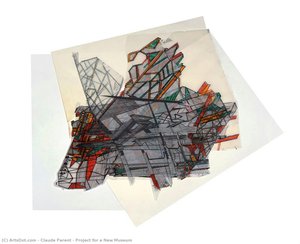
Claude Parent, a figure both revered and controversial within 20th-century architecture, possessed an uncanny ability to distill complex ideas into strikingly reductive forms. His 2016 fashion drawing, depicting a long dress inspired by Alaïa designs, isn’t merely a sketch; it's a concentrated distillation of his core philosophies – a visual manifesto embodying the architect’s radical approach to space and perception. This piece, rendered in stark black and white on tracing paper, transcends its subject matter to become a powerful meditation on form, line, and the very nature of representation.
Parent's work was deeply rooted in a rejection of Modernist dogma. He famously articulated his “Oblique Function,” challenging the dominance of right angles and static geometry. Instead, he envisioned architecture that responded dynamically to human movement, creating spaces that were fluid, unpredictable, and inherently engaging. This concept permeates this drawing, evident in the deliberate asymmetry and the unsettlingly precise lines that bisect the figure, suggesting a fractured, almost diagrammatic approach to design. The two vertical lines aren’t simply compositional elements; they act as visual anchors, establishing a grid-like structure within the otherwise ambiguous form.
Deconstructing Elegance: Line, Form, and the Absence of Texture
The drawing's strength lies in its ruthless simplicity. There is no attempt at realistic depiction; instead, Parent focuses entirely on the essential elements of shape and line. The elongated silhouette of the dress dominates the composition, rendered with a series of carefully placed lines that suggest layers of fabric and construction. These lines aren’t smooth or flowing; they are crisp, angular, and deliberately assertive, contributing to the overall sense of controlled precision. Crucially, there is an almost complete absence of texture – the surfaces appear flat and devoid of detail. This deliberate flattening reinforces the drawing's conceptual focus, stripping away any superfluous information and forcing the viewer to engage with the underlying structure.
The limited color palette—black and white—further amplifies this effect. The stark contrast creates a dramatic visual impact, directing all attention towards the interplay of lines and shapes. It’s reminiscent of graphic design or architectural diagrams, elevating the drawing beyond a simple fashion illustration into something more akin to an intellectual exercise. This reductionist approach mirrors Parent's broader philosophical stance – a belief that by stripping away the unnecessary, one can arrive at a deeper understanding of fundamental principles.
Echoes of Alaïa and a Legacy of Discomfort
The inspiration for this drawing clearly stems from the work of Azzedine Alaïa, whose designs are characterized by their elegant silhouettes, dramatic draping, and a subtle sense of asymmetry. However, Parent doesn’t simply reproduce Alaïa's aesthetic; he deconstructs it, transforming it into something entirely his own. The sharp lines and geometric precision contrast sharply with the flowing curves of Alaïa’s garments, creating a visual tension that is both unsettling and compelling.
Born in 1923 and passing away in 2016, Claude Parent was a pivotal figure in post-war architecture. His work often provoked controversy, challenging established norms and pushing the boundaries of architectural thought. This fashion drawing serves as a microcosm of his broader artistic vision – a testament to his belief that beauty could be found not in ornamentation or conventional forms, but in the precise articulation of fundamental principles. It’s a piece that demands contemplation, inviting viewers to question their assumptions about representation and the very nature of design.
Artist Biography
A Maverick of the Oblique: The Revolutionary Vision of Claude Parent
Claude Parent, born in Neuilly-sur-Seine, France, in 1923 and passing away in 2016, was not merely an architect; he was a philosophical provocateur who fundamentally challenged the very foundations of Modernist architectural thought. He dared to question the dominance of right angles and static forms, envisioning instead a dynamic architecture responsive to the human body in motion – a vision embodied in his groundbreaking concept of the ‘Oblique Function.’ Parent’s journey began with formal training, an apprenticeship under Ionel Schein from 1949 to 1955 providing him with technical grounding. However, this period also ignited within him a desire for liberation from conventional norms, a yearning that led him to the avant-garde Espace group in 1951 alongside artists André Bloc and Félix del Marle, exposing him to radical new ideas about space and form. This early exposure proved pivotal, shaping his trajectory toward architectural rebellion.The Birth of the Oblique Function
By the mid-1950s, Parent had begun to forge a path distinctly his own. Rejecting the rigid orthogonality that defined much of Modernist architecture, he developed the ‘Oblique Function,’ a principle prioritizing movement and dynamism over static stability. This wasn’t simply an aesthetic choice; it was a philosophical statement about how humans interact with space. Parent believed buildings should not impose themselves upon the body but rather accommodate and even encourage natural human movement. He envisioned tilting and shifting volumes, creating discontinuous spaces that disrupted traditional notions of floor and wall, fostering a sense of disorientation and prompting new ways of experiencing architecture. This radical approach wasn’t born in isolation; it was deeply intertwined with his intellectual partnership with philosopher Paul Virilio. Together, they formed the Architecture Principe group in 1963, exploring the implications of speed, technology, and movement on architectural space – a collaboration that would yield some of Parent's most iconic works.Landmark Projects & Provocative Collaborations
The collaboration with Virilio culminated in what is arguably their most celebrated achievement: the Église Sainte-Bernadette-du-Banlay in Nevers (1966). This concrete church, a striking monument to the Oblique Function, features a dramatically sloping floor and an unconventional form that challenges conventional religious architecture. It’s not merely a building; it's an experience – a space designed to disorient and provoke contemplation. Beyond this landmark project, Parent consistently applied his principles to other works. The Maison Drusch (1963) stands as an early example of the oblique function in residential design, while projects like the Sens supermarket (1970), built with raw concrete, demonstrated his ability to translate these ideas into commercial spaces. Parent’s versatility extended beyond architecture; he curated the French pavilion at the 1970 Venice Art Biennale, transforming it into an oblique space and inviting artists to engage with this unconventional environment. He even ventured into fashion illustration, creating striking designs for Azzedine Alaïa, showcasing his adaptability and artistic range.A Lasting Legacy of Disruption
Though his partnership with Virilio dissolved in 1968, Parent continued to refine and implement the Oblique Function throughout his career. He remained a tireless advocate for challenging established norms, creating spaces that were both intellectually stimulating and experientially engaging. His work had a profound influence on the development of Deconstructivism and continues to resonate with contemporary architects and designers who seek to break free from conventional constraints. Parent’s legacy isn't solely defined by his built projects; it also lies in his theoretical contributions, his provocative manifesto-drawings that expanded the boundaries of architectural discourse, and his unwavering commitment to questioning the status quo. He demonstrated that architecture could be more than just shelter – it could be a catalyst for thought, a challenge to perception, and a reflection of the dynamic nature of human existence. His work remains a testament to the power of architecture to shape our understanding of the world around us.Exploring Claude Parent’s Work
- Alaïa Fashion Drawing: Discover minimalist fashion drawings, showcasing elegant lines and bold contrast. A unique graphic design reflecting Alaïa's silhouette.
- Église Sainte-Bernadette-du-Banlay (1966): A landmark project embodying the Oblique Function and its impact on spatial experience – a concrete church with a dramatically sloping floor.
- Maison Drusch (1963): An early residential example of Parent’s oblique principles, demonstrating his innovative approach to domestic space.

Claude Parent
1923 - 2016 , France
Quick Facts
- Artistic Movement Or Style: Oblique Architecture
- Artists Or Movements Influenced By This Artist:
- Deconstructivism
- Paul Virilio
- Artists Who Influenced This Artist:
- Ionel Schein
- André Bloc
- Félix del Marle
- Date Of Birth: 1923-02-26
- Date Of Death: 2016-02-27
- Full Name: Claude Parent
- Nationality: French
- Notable Artworks:
- Église Sainte-Bernadette-du-Banlay
- Maison Drusch
- Alaïa Fashion Drawing
- Place Of Birth: Neuilly-sur-Seine, France
Related Articles
The Nuances of Graphite: Exploring Emotional Depth & Technical Mastery in Pencil Drawing
Explore the captivating world of graphite drawing! Discover its rich history, master essential techniques like chiaroscuro, and learn how artists evoke emotion through this timeless medium. Expert insights for art enthusiasts.

Timeless Elegance: Unveiling the Chic Allure and Artistic Legacy of Black Dress Artworks
Immerse yourself in the timeless allure of black dress artworks. Explore a curated collection of fine art reproductions and bespoke oil paintings that blend fashion history with modern elegance. Discover how OriginalUniqueArt.com transforms memories into exquisite, hand-painted masterpieces.
Monet's Masterpieces: 25 Iconic Artworks to Transform Your Home
Journey through 25 iconic Claude Monet masterpieces! Explore Impressionism’s beauty, from Water Lilies to Rouen Cathedral. Discover stunning art reproductions & curated decor ideas – explore the full collection online at OriginalUniqueArt.com.
Minimalist Masterpieces: 10 Artworks for Serene Home Decor | OriginalUniqueArt
Find serenity with 10 minimalist masterpieces! Explore Agnes Martin, Rothko & more. Discover the stories behind iconic abstract art, neutral palettes & calming designs. Museum-quality reproductions at OriginalUniqueArt.com – elevate your home decor today!

Dark Masterpieces: 10 Iconic Paintings Dominated by Black Tones |
Explore 10 iconic paintings dominated by black tones, from Rembrandt’s chiaroscuro to Goya's dark expressions. Discover the stories behind these masterpieces & find museum-quality art reproductions for your home at .