Text size

() ·

A painting made for you, by hand

Still-life

Hand Made Oil Reproduction

Hand-painted oil on canvas in your size and frame, made to order by our artists. ( Switch to Print Switch to Digital Image)

Collectible Description

Explore Clara Peeters’ opulent 1611 Still-life! A Dutch Golden Age masterpiece featuring lavish flowers, jewels & symbolic details. Oil on canvas showcases meticulous realism & dramatic lighting. Perfect for art collectors.

Artist Biography

Clara Peeters (1594-after 1657) was a pioneering Flemish still life painter of the Dutch Golden Age. Known for detailed 'breakfast pieces,' luxurious banquet scenes, and unique cheese depictions, she's the earliest significant woman artist in this ge

from ·

Chapter 1

How large should it be?

Slide to change the size; the picture on the left shows the frame at its real width. The proportions of the original are kept.

Standard
custom
CM
INCH

Pick from our preset sizes that match the artwork's original proportions.

width
height

Type the width and the height you need, to fit your frame or your wall. This is hand-painted, so for a size with a different shape the artist can paint a bit more around the picture, or cut a bit — you choose. We send you a digital mockup to approve before the painting starts. The picture shown on this page does not show the real result — only the mockup does.

Chapter 2

How should it arrive?

Choose the edges of the stretched canvas

Choose your frame

Corner sample of the WhiteWrap canvas edge finish, stretched on solid wood bars
White $1
Corner sample of the BlurSideWrap canvas edge finish, stretched on solid wood bars
Blurside $1
Corner sample of the ExtendedWrap canvas edge finish, stretched on solid wood bars
Extended $1
Corner sample of the P118B picture frame: moulded polystyrene, 5 cm wide and 3 cm thick
P118B $10
Corner sample of the P118H picture frame: moulded polystyrene, 5 cm wide and 3 cm thick
P118H $10
Corner sample of the P118W picture frame: moulded polystyrene, 5 cm wide and 3 cm thick
P118W $10
Corner sample of the P438Z picture frame: moulded polystyrene, 5.5 cm wide and 3.5 cm thick
P438Z $10
Corner sample of the P508JH picture frame: moulded polystyrene, 7 cm wide and 3.5 cm thick
P508JH $12
Corner sample of the P508YH picture frame: moulded polystyrene, 7 cm wide and 3.5 cm thick
P508YH $12
Corner sample of the P805H picture frame: moulded polystyrene, 5 cm wide and 3.5 cm thick
P805H $10
Corner sample of the P805Z picture frame: moulded polystyrene, 5 cm wide and 3.5 cm thick
P805Z $10
Corner sample of the P919BZ picture frame: moulded polystyrene, 7 cm wide and 3.5 cm thick
P919BZ $10
Corner sample of the P919G picture frame: moulded polystyrene, 7 cm wide and 3.5 cm thick
P919G $10
Corner sample of the P919XJ picture frame: moulded polystyrene, 7 cm wide and 3.5 cm thick
P919XJ $10
Corner sample of the P959ZH picture frame: moulded polystyrene, 5 cm wide and 3 cm thick
P959ZH $10
Corner sample of the P968JZ picture frame: moulded polystyrene, 6 cm wide and 4 cm thick
P968JZ $12
Corner sample of the W106C picture frame: solid wood, 5 cm wide and 3 cm thick
W106C $8
Corner sample of the W218G picture frame: solid wood, 5 cm wide and 3 cm thick
W218G $10
Corner sample of the W218JH picture frame: solid wood, 5 cm wide and 3 cm thick
W218JH $8
Corner sample of the W218Y picture frame: solid wood, 5 cm wide and 3 cm thick
W218Y $10
Corner sample of the W307PJ picture frame: solid wood, 6 cm wide and 3 cm thick
W307PJ $10
Corner sample of the W316G picture frame: solid wood, 6 cm wide and 3 cm thick
W316G $10
Corner sample of the W316PJ picture frame: solid wood, 6 cm wide and 3 cm thick
W316PJ $8
Corner sample of the W316Y picture frame: solid wood, 6 cm wide and 3 cm thick
W316Y $10
Corner sample of the W398PJ picture frame: solid wood, 5 cm wide and 3 cm thick
W398PJ $8
Corner sample of the W4111J picture frame: solid wood, 6.5 cm wide and 3.5 cm thick
W4111J $10
Corner sample of the W500HY picture frame: solid wood, 7 cm wide and 5 cm thick
W500HY $15
Corner sample of the W500JH picture frame: solid wood, 7 cm wide and 5 cm thick
W500JH $15
Corner sample of the W692G picture frame: solid wood, 8 cm wide and 4 cm thick
W692G $12
Corner sample of the W849H picture frame: solid wood, 5 cm wide and 3 cm thick
W849H $8
Corner sample of the W940BG picture frame: solid wood, 7.5 cm wide and 4.5 cm thick
W940BG $15
Corner sample of the W953PJ picture frame: solid wood, 6 cm wide and 3.5 cm thick
W953PJ $8
Corner sample of the H24-GOLD picture frame: carved wood with gesso, 10 cm wide and 6 cm thick
H24-GOLD $30
Corner sample of the H24-SILVER picture frame: carved wood with gesso, 10 cm wide and 6 cm thick
H24-SILVER $30
Corner sample of the H36-GOLD picture frame: carved wood with gesso, 15 cm wide and 6.5 cm thick
H36-GOLD $45
Corner sample of the H36-SILVER picture frame: carved wood with gesso, 15 cm wide and 6.5 cm thick
H36-SILVER $45
Frame preview
Framed

Moulding: . Overall size with the frame: .

Chapter 3

Who paints it, and should anything change?

Examples of what can be changed: Replace face with customer photo; Add pet (e.g., replace cat with dog); Include hidden message in background; Change background landscape or elements.
After order, OriginalUniqueArt.com team will email client for instructions and provide a mockup preview

Worldwide Delivery () in 3/4 weeks instead of standard 5 weeks. (8 November). No compromise on quality.

Chapter 4

The finishing touches

A nameplate, as in a museum?

Engraved Bronze Plaque Details

This elegant plaque features the artist's name and the title of the artwork, finely engraved for a timeless presentation.

It is made from bronze with a refined, elegant finish. The text is precisely laser-engraved for a sharp and permanent result. Measuring 9x2 cm, the plaque is compact yet easy to read. It's built to be durable and scratch-resistant, offering a professional, museum-quality look. Mounting is simple thanks to the included adhesive backing.

Transparent Acrylic Plaque Details

The plaque includes essential engraved details such as the artist's name, the title of the artwork, the date it was created, the type of media used-like oil on canvas or watercolor-a brief description of the piece, and a QR code that links to the complete artwork information.

It is crafted from clear acrylic, offering a sleek, modern appearance. The text is UV-engraved in black to ensure strong visual contrast. With a size of 10x15 cm, it ensures optimal readability. It comes equipped with two metal hooks for secure wall mounting. The plaque is designed to be weather-resistant, making it suitable for various environments, and it includes interactive features that work seamlessly with smartphone scanning.

Black Acrylic Plaque Details

This elegant plaque includes engraved information such as the artist's name, the title of the artwork, the date it was created, the type of media used (like oil on canvas or watercolor), a short description of the artwork, and a QR code for quick access to more information.

The plaque itself is made from refined black acrylic with a premium finish. The text is laser-engraved in white for high contrast and readability. Its size is 10x15 cm, designed to be easy to read. It comes with two metal hooks for professional mounting. The design is sleek and fits any interior style. It is also weather-resistant and durable, with built-in digital integration for mobile compatibility.

A protective varnish?

When do you need it?

Chapter 5

Your painting, as you ordered it

Still-life

Reproduction Medium

Reproduction Size

-

Elite Senior Artist

More detail, finesse, and extra production time

-

Reproduction Frame

-

-

For artworks or reproductions larger than 105 cm (approximately 41 inches) on any side, the frame will be shipped as a kit, disassembled. This method ensures safe delivery and prevents damage during transport.

Professional assembly required - this is not a DIY product.
The kit must be assembled and the canvas stretched by an experienced professional framer, using wood glue (not supplied), a canvas stretching plier and clamps to hold the bars square while the glue dries. Incorrect assembly or uneven canvas tension can permanently damage the artwork and is not covered by our warranty.

  • All solid wood bars are included, precisely cut to size.

  • Assembled with the screws provided, plus wood glue for the corner joints, which is not supplied and must be sourced by your framer.

  • Professional tools are required and not included: a canvas stretching plier (tensioner) and clamps to hold the bars square while the glue dries.

Important:
The corner joints require wood glue, the bars must be held with clamps until the glue is fully dry, and tightening the canvas on the assembled frame requires a canvas stretching plier. None of these are included in the kit. Please arrange an experienced professional framer before ordering this size.

Nameplate

-

-

Protective Varnish

Glossy Varnish (enhances colors, protects against light/moisture)

-

Customize My Artwork

Examples of what can be changed: Replace face with customer photo; Add pet (e.g., replace cat with dog); Include hidden message in background; Change background landscape or elements.

-

Urgent

Worldwide Delivery () in 3/4 weeks instead of standard 5 weeks. (8 November). No compromise on quality.

-

Express Shipping

Worldwide Delivery () in 5 weeks. (15 November).

Included

Total Price

$ 300

Total Price $ 300

Glass option is only available in size under 110 CM

Included with every order

  • Free Worldwide Express Shipping
  • High-Quality Linen Canvas
  • Full Shipping Insurance
  • Customs Tax Refund Guarantee
  • True Color Matching Guarantee
  • 100-Day Return Policy (Defects Only)
  • 100% Money-Back Guarantee
  • Bulk Discount Offer

A Glimpse of Opulence: Still Life by Clara Peeters

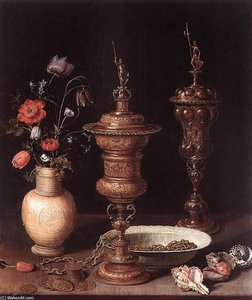
The year is 1611. Within the dimly lit interiors of a wealthy Flemish household, a tableau vivant unfolds – a still life painting by the remarkably talented Clara Peeters. This isn’t merely a depiction of objects; it's an invitation into a world of abundance, carefully constructed to evoke both pleasure and contemplation. The artwork, measuring 52 x 73 cm, immediately captivates with its meticulous detail and dramatic interplay of light and shadow, hallmarks of the Dutch Golden Age masters. Peeters’ skill lies not just in her technical prowess but also in her ability to imbue a simple arrangement of food, drink, and decorative objects with profound symbolic weight.

At the heart of this composition sits a magnificent silver bowl overflowing with glistening cherries – a potent symbol of fertility, prosperity, and even mortality. The vibrant orange of the roses, juxtaposed against the delicate green foliage, creates a visual feast for the eye, while the yellow daffodils add bursts of cheerful color. A small, ornate fountain beside the bowl hints at the pleasures of leisure and the flow of life itself. But it’s not just about beauty; Peeters masterfully employs perspective to create an illusion of depth, drawing the viewer into this meticulously rendered world. The flattened perspective, a common technique of the era, doesn't diminish the richness but rather enhances the sense of layering and complexity.

The Painter and Her Time

Clara Peeters (1594-after 1657) stands as an extraordinary figure in seventeenth-century Flemish art – one of the earliest recognized female painters operating within the burgeoning Dutch Golden Age. Despite the significant societal barriers faced by women at the time, she persevered to establish a remarkable career, leaving behind an oeuvre characterized by unparalleled detail, innovative compositional strategies, and a deep fascination with capturing the textures and nuances of everyday life, particularly the delights of food and drink. Her work reflects a period of immense wealth and artistic innovation in the Netherlands, where still-life painting was rapidly gaining prominence as a genre.

Born in Antwerp around 1587 (the exact date remains debated), Peeters’ training is shrouded in some mystery. Unlike many male artists who benefited from guild membership and formal apprenticeships, her path to artistic mastery appears less documented. Some scholars believe she may have been the daughter of a painter, possibly Hans van Essen or Jan van der Beeck, receiving her skills through familial influence rather than traditional channels. Regardless of her precise training, Peeters quickly established herself as a skilled practitioner, producing a significant body of work that continues to fascinate and inspire.

Symbolism and Technique

Peeters’ still lifes are far more than simple arrangements; they are carefully constructed narratives laden with symbolism. The inclusion of objects like the snake coiled around a plate – a recurring motif in Dutch art – often represents mortality and the transience of earthly pleasures. The glass goblet, the pipe, and the scattered jewels all contribute to this complex tapestry of meaning, suggesting both indulgence and the fleeting nature of wealth. Her mastery of technique is equally remarkable. Peeters employed meticulous brushwork and glazing techniques, layering thin washes of oil paint to create a rich, textured surface. The sharp lines defining shapes – predominantly organic forms like flowers and fruits alongside geometric elements such as bowls and goblets – demonstrate her keen eye for detail and control.

The use of light is particularly striking. Directional lighting casts strong shadows that emphasize the textures of velvet, jewels, and petals, lending a dramatic intensity to the scene. This careful manipulation of light and shadow not only enhances the visual appeal but also contributes to the overall sense of depth and realism. The materials appear convincingly rendered – the sheen of the silver, the delicate texture of the rose petals, the smooth surface of the fruit – all testament to Peeters’ exceptional skill and attention to detail.

A Legacy of Innovation

Clara Peeters' work represents a pivotal moment in art history. She was one of the first women to achieve significant recognition as a professional still-life painter during the Dutch Golden Age, challenging societal norms and establishing herself as a skilled and innovative artist. Her legacy continues to be studied and celebrated today, offering valuable insights into the artistic practices and cultural values of seventeenth-century Flanders. Reproductions of her works, such as this stunning 1611 still life, provide a tangible connection to this remarkable period of artistic achievement.

Questions & Answers

Is "Still-life" a famous Dutch Golden Age artwork?

"Still-life" is recorded as recognized among the Dutch Golden Age works in the catalog.

Where in Clara Peeters's career does "Still-life" fall, given its date?

The 1611 date places "Still-life" in the Mature Period of Clara Peeters's development.

What feeling does "Still-life" by Clara Peeters convey?

The recorded mood of "Still-life" by Clara Peeters is elegant, and its emotional tone is nostalgic.

More about this painting

Preview AR preview Switch to Print Switch to Digital Image Send
Details Guide Add to favorites Download Similars X-Ray Diaporama Q&A Stats

In numbers

  • 1611the year it was painted
  • 29frames to choose from
  • standard sizes, in its own proportions
  • 5weeks to paint and deliver it
Clara Peeters

Clara Peeters

1594 - 1657, Belgium

Quick facts about Clara Peeters

  • Full Name: Clara Peeters
  • Nationality: Flemish
  • Date Of Birth: 1594
  • Date Of Death: 1657
  • Place Of Birth: Antwerp, Belgium
  • Notable Artworks:
    • Still Life with Fish, Sea Food and Flowers
    • Still Life with Cheeses, Artichoke, and Cherries
  • Artistic Movement Or Style: Dutch Golden Age
  • Artists Who Influenced This Artist: ['Osias Beert']
  • Artists Or Movements Influenced By This Artist: ['Judith Leyster']

Artist Biography

Clara Peeters: Pioneer of Dutch Still Life

Clara Peeters (1594-after 1657) stands as a singular figure in seventeenth-century Flemish art—one of the earliest recognized female painters operating within the burgeoning Dutch Golden Age. Despite societal constraints that severely limited women’s access to artistic training and guild membership, Peeters carved out a remarkable career, leaving behind an oeuvre characterized by meticulous detail, innovative compositional strategies, and a fascination with capturing the textures and nuances of everyday life—particularly food. Her legacy continues to inspire scholars and artists alike as they grapple with questions surrounding her identity, training, and the elusive nature of her artistic output.
  • Early Life & Family
  • Training & Artistic Style
  • Notable Works & Oeuvre Size
  • Influence & Legacy
  • Ongoing Debate: Attribution & Authenticity

Early Life & Family

Born in Antwerp around 1587—the exact date remains debated by historians—Clara Peeters descended from a family steeped in artistic tradition. Records indicate that her father, Jean Peeters, was himself a painter, suggesting an environment conducive to fostering creative pursuits. The baptismal records confirm her birth within the Church of St. Walburga, Antwerp, cementing her place within the city’s vibrant artistic community. Further documentation reveals her marriage to Henricus Joosen in 1639—also at St. Walburga—establishing a domestic life alongside her husband and contributing to the growing family lineage of Peeters.

Training & Artistic Style

The precise circumstances surrounding Peeters’s artistic education remain shrouded in mystery, largely due to the limitations imposed upon women during this period. Unlike many male artists who benefited from formal guild apprenticeships—a cornerstone of Flemish artistic development—Peeters’s name does not appear in guild records, fueling speculation that she may have been educated privately or by a familial mentor. However, her distinctive style—characterized by exceptional technical polish and compositional sophistication—strongly suggests training within the Antwerp tradition, where artists prioritized meticulous detail and careful finish. Scholars believe Peeters was likely influenced by Osias Beert, a fellow Antwerp painter who pioneered still life techniques during his apprenticeship.

Notable Works & Oeuvre Size

Peeters’s artistic output is remarkably concentrated within the period between 1607 and 1621—a span during which she produced eighteen paintings before her eighteenth birthday. These early works exemplify her mastery of technique and demonstrate a profound understanding of visual representation, capturing scenes of food—particularly cheeses—with unparalleled realism. Beyond these seminal pieces, estimates suggest that Peeters’s oeuvre encompasses approximately seventy-six additional canvases—though definitive attribution remains challenging due to the prevalence of copies bearing her signature by various hands. Her penchant for depicting opulent banquet settings and meticulously rendered objects—including decorative knives adorned with nude figures—established her as a pivotal figure in shaping the traditions of Dutch “breakfast pieces” (“ontbijtjes”) and “banquet pieces” (“banketje”).

Influence & Legacy

Clara Peeters’s contribution to art history extends beyond her individual paintings. She represents a crucial milestone in recognizing women's artistic capabilities during the Dutch Golden Age—the earliest significant female painter of this era. Her work challenged prevailing societal norms and paved the way for future generations of female artists. Moreover, Peeters’s stylistic innovations—particularly her focus on capturing textures and subtleties—influenced subsequent painters and solidified her position as a pioneer in still life genre.

Ongoing Debate: Attribution & Authenticity

Despite the undeniable quality of Peeters' surviving works—primarily dated between 1607 and 1621—scholarly debate persists regarding their authorship. Two paintings bearing the signature “CP”—considered anonymous by the RKD—have been subjected to intense scrutiny, prompting questions about whether they truly represent Peeters’s hand. Furthermore, the loss of a painting purportedly attributed to Peeters in 1657 adds another layer of complexity to the discussion surrounding her artistic output. The pervasive presence of copies created by unidentified artists underscores the difficulty in definitively establishing Peeters' oeuvre size and cementing her place within art history.

Quick Facts

  • Influences:
    • Bruegel
    • Beert
  • Medium: Oil on canvas
  • Movement: Dutch Golden Age
  • Artist: Clara Peeters
  • Year: 1611

Art Quiz

There is only one correct answer for each question.

Question 1:
What is the primary subject matter depicted in this still-life painting?
Question 2:
The lighting in the painting is characterized by:
Question 3:
Which of the following best describes the artistic style evident in this painting?
Question 4:
What symbolic meaning is often associated with the objects depicted in Dutch still lifes like this one?
Question 5:
Clara Peeters is notable for being: