Preview
 Send
Send Share
Share
 Details
 Guide
Guide

 Download
 Similars
 X-Ray
X-Ray Diaporama
 Stats
StatsBarack Obama by Chuck Close


 Read More
The artwork displayed on this page is protected by copyright law, which means we cannot legally create or sell an identical reproduction. This protection is enforced under international agreements such as the Berne Convention and by national laws, including those outlined by the U.S. Copyright Law - Title 17.
As a respectful and legal alternative, we offer custom, hand-painted artworks inspired by the original. Our skilled and professional artists carefully study the original's style, mood, and artistic essence to create a new, unique piece that evokes the same feeling - while remaining an original creation in its own right.
This method fully complies with copyright regulations because it does not involve copying or duplicating the protected artwork. Instead, it is a creative reinterpretation - a new painting that is influenced by the original but not identical to it.
Hand Made Oil Reproduction
Hand-painted oil on canvas in your size and frame, made to order by our artists. ( Switch to Print Switch to Digital Image)




P118B $10

P118H $10

P118W $10

P438Z $10

P508JH $12

P508YH $12

P805H $10

P805Z $10

P919BZ $10

P919G $10

P919XJ $10

P959ZH $10

P968JZ $12

W106C $8

W218G $10

W218JH $8

W218Y $10

W307PJ $10

W316G $10

W316PJ $8

W316Y $10

W398PJ $8

W4111J $10

W500HY $15

W500JH $15

W692G $12

W849H $8

W940BG $15

W953PJ $8




Pick from our preset sizes that match the artwork's original proportions.

Type the width and the height you need, to fit your frame or your wall. This is hand-painted, so for a size with a different shape the artist can paint a bit more around the picture, or cut a bit — you choose. We send you a digital mockup to approve before the painting starts. The picture shown on this page does not show the real result — only the mockup does.
After order, OriginalUniqueArt.com team will email client for instructions and provide a mockup preview
Worldwide Delivery () in 3/4 weeks instead of standard 5 weeks. (23 October). No compromise on quality.

Free Worldwide Express Shipping

High-Quality Linen Canvas

Full Shipping Insurance

Customs Tax Refund Guarantee

True Color Matching Guarantee

100-Day Return Policy (Defects Only)

100% Money-Back Guarantee

Bulk Discount Offer
 Glass option is only available in size under 110 CM

Barack Obama by Chuck Close
Reproduction Medium
Reproduction Size
-


Total Price
$ 300
Barack Obama by Chuck Close: A Portrait of Resilience and Reflection
Chuck Close’s “Barack Obama” is more than just a photograph; it's a testament to the artist’s groundbreaking approach to portraiture and a poignant exploration of identity. Created in 2013, this diptych—featuring two black and white prints—captures Obama’s gaze with remarkable detail and immediacy, embodying Close’s signature style: monumental hyperrealism achieved through a meticulous grid system. The artwork speaks volumes about the artist's dedication to overcoming personal challenges and his profound understanding of human expression.- The Grid System Technique: Close revolutionized portraiture by abandoning traditional painting methods after suffering paralysis in 1988. Instead, he adopted a technique where he meticulously recreated a photograph onto canvas using a grid of colored squares—a method that allowed him to maintain artistic control and overcome physical limitations. This innovative approach became synonymous with his oeuvre.
- Photographic Realism: The prints themselves are exemplary of photographic realism. Close painstakingly transferred the image from a Polaroid camera, capturing Obama’s facial features and expression with astonishing accuracy. Lines are sharply defined, outlining Obama's contours and conveying a sense of solidity and presence.
- Historical Context: “Barack Obama” emerged during a pivotal moment in American history—the election of Barack Obama as the first African American president in 2008. The photograph reflects optimism and confidence, mirroring the broader aspirations for progress and unity that characterized the era.
- Symbolism & Emotion: Close’s deliberate framing—centering Obama within a rectangular frame—emphasizes his gaze and invites contemplation. The subtle graininess of the photographic process lends texture to the image, creating a tactile impression that enhances its emotional impact. It's a portrait not merely of a figure but of an idea – resilience, determination, and unwavering focus.
Detailed Analysis: Composition and Texture
The diptych format contributes significantly to the artwork’s visual narrative. Each print is meticulously composed with Obama positioned centrally within a rectangular frame, maximizing impact and conveying a sense of balance. The artist's careful attention to detail—particularly in delineating Obama’s facial features—is evident throughout the piece. Furthermore, Close skillfully utilizes texture through the photographic process itself. The grainy surface of the prints mimics the imperfections inherent in traditional printing techniques, adding depth and realism to the image. This textural element reinforces the artwork’s emotional resonance, inviting viewers to engage with its materiality alongside its visual content.Beyond Technique: Artistic Vision and Legacy
Chuck Close's unwavering commitment to pushing artistic boundaries—particularly his pioneering use of grid painting—established him as a visionary figure in contemporary art. His exploration of face blindness (prosopagnosia) fueled his artistic practice, prompting him to seek new ways to represent human identity. “Barack Obama” exemplifies this dedication to innovation and serves as a powerful reminder of Close’s enduring influence on portraiture and visual culture. It stands as an iconic image capturing the spirit of a transformative moment in American history—a testament to both artistic mastery and profound human empathy.Considerations for Reproduction & Display
Reproductions of “Barack Obama” by Chuck Close offer exceptional quality, faithfully recreating the artist’s meticulous technique and capturing the essence of his vision. Framing this artwork in a neutral setting—such as a gallery or home interior—allows its striking composition and textural detail to shine through, enhancing its aesthetic appeal and conveying its historical significance. Its enduring presence within the art world underscores Close's legacy as one of the most influential portrait artists of our time.Questions & Answers
Where can I find artworks similar to "Barack Obama by Chuck Close" by Chuck Close?
Artworks similar to "Barack Obama by Chuck Close" by Chuck Close are gathered on the artwork's Similars page.
Can I preview "Barack Obama by Chuck Close" by Chuck Close before ordering?
To preview a reproduction of "Barack Obama by Chuck Close" by Chuck Close, open the artwork's Preview page.
Did "Barack Obama by Chuck Close" stay in its artist's homeland?
No - the artwork is kept abroad. "Barack Obama by Chuck Close" is held in United Kingdom, while Chuck Close was born in United States of America.
Artist Biography
A Life Etched in Detail: The World of Chuck Close
Charles Thomas Close, born July 5, 1940, in Monroe, Washington, and who passed away on August 19, 2021, in Oceanside, New York, was a monumental figure in the landscape of contemporary art. His journey, marked by both profound artistic innovation and personal adversity, redefined portraiture for generations. From an early age, Close faced significant challenges – a neuromuscular condition coupled with dyslexia created obstacles that shaped his unique perspective. These difficulties fostered a deep observation of the world around him, a quality that would become central to his artistic practice. His childhood was further impacted by family tragedy; the loss of his father and his mother’s illness instilled in him a resilience that mirrored the meticulous dedication he later brought to his art. Early exposure to Jackson Pollock's drip paintings at the Seattle Art Museum proved pivotal, igniting within him a passion for pushing artistic boundaries. He pursued formal education at the University of Washington, earning a B.A. in 1962, and continued honing his skills at Yale University, receiving both a BFA (1963) and an MFA (1964). A Fulbright scholarship then propelled him to Vienna’s Akademie der Bildenden Künste, broadening his artistic horizons before he returned to the United States.From Abstraction to Hyperrealism: The Evolution of a Style
Close's artistic trajectory began with explorations in Abstract Expressionism, but it was during the late 1960s that he embarked on the path that would define his career – photorealism. Rejecting the gestural freedom of abstraction, Close turned to photography as his primary source material. He didn’t aim to merely copy a photograph; instead, he developed an intricate process of translation. Utilizing a grid system, he meticulously transferred photographic images onto enormous canvases, breaking down the image into manageable squares and replicating each detail with painstaking accuracy using acrylic paints and airbrush techniques. This method wasn't about flawless reproduction but rather about revealing the underlying structure of perception itself. His early portraits were monumental in scale, confronting viewers with an almost overwhelming level of detail. He didn’t shy away from imperfections – bloodshot eyes, broken capillaries, pores, and wrinkles were all rendered with unflinching honesty. This emphasis on the flaws of human features wasn't a critique of beauty standards but rather an exploration of the inherent limitations of both photography and representation. He explored various media throughout his career, including fingerprint patterns and color printing processes, always seeking new ways to deconstruct and rebuild the image.Innovation in the Face of Adversity: A Legacy Forged Through Resilience
The 1970s witnessed Close’s ascent to prominence as a leading figure in photorealism. His large-scale portraits garnered widespread recognition, establishing him as an artist who dared to challenge conventional notions of portraiture. His “fingerprint series” demonstrated a remarkable innovative approach to texture and abstraction; using his own fingerprints to create subtle gradations of gray, he transformed the personal into the universal. However, in 1988, Close’s life took another dramatic turn when he suffered a spinal artery occlusion, resulting in paralysis from the neck down. This devastating event could have ended his career, but instead, it spurred him to adapt and innovate further. He continued to paint, developing new techniques that allowed him to work with limited mobility – even painting with his mouth. This unwavering dedication to his craft is a testament to his artistic spirit and resilience. His work has been exhibited extensively worldwide and resides in prestigious museum collections such as the Art Institute of Chicago, the Museum of Modern Art (New York), and the Tate Gallery (London).Influences and Lasting Impact: A Transformation of Portraiture
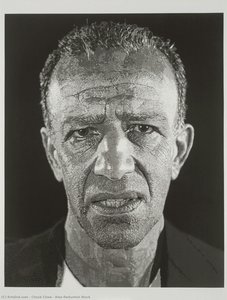
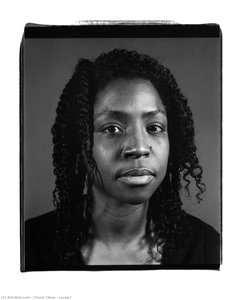
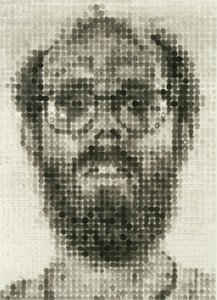
Chuck Close’s artistic lineage is complex. While initially inspired by Pollock's expressive freedom, he ultimately forged his own path, influenced by a desire to objectively observe and meticulously recreate reality. He challenged the traditional understanding of portraiture, moving away from idealized representations towards a more analytical and objective approach. His work questioned the very nature of seeing and representation, forcing viewers to confront the mechanics of perception. Close’s exploration of scale, detail, and process profoundly impacted the development of photorealism and contemporary art as a whole. He demonstrated that photography wasn't simply a tool for capturing reality but also a medium for artistic interpretation and transformation. His influence extends beyond painting; his techniques have resonated with artists working in various disciplines, from sculpture to digital media. Notable works like the striking black-and-white diptych of Barack Obama, the monumental self-portrait *Big Self-Portrait*, the pixelated detail of *Self-Portrait Spitbite White on Black*, and powerful portraits such as *Mark* (Richard Serra) and *Nat* stand as enduring testaments to his artistic vision. Chuck Close’s legacy is not merely one of technical mastery but also of unwavering perseverance, demonstrating that art can flourish even in the face of profound adversity.A Continuing Dialogue: Chuck Close's Enduring Relevance
- Photorealism Pioneer: Close remains a central figure in the history of photorealism, inspiring generations of artists to explore the boundaries between photography and painting.
- Technical Innovation: His grid system and innovative use of materials continue to be studied and emulated by artists today.
- Resilience and Adaptation: His ability to overcome physical challenges and continue creating art serves as a powerful example of the human spirit’s capacity for adaptation.
- Exploration of Identity & Perception: His portraits delve into themes of identity, perception, and representation, prompting viewers to question their own understanding of reality.

Chuck Close
1940 - , United States of America
Quick Facts
- Full Name: Chuck Close
- Nationality: American
- Date Of Birth: 1940
- Date Of Death: August 19, 2021
- Place Of Birth: Monroe, United States of America
- Notable Artworks:
- Barack Obama diptych
- Big Self-Portrait
- Mark
- Nat
- Lorna I
- Artistic Movement Or Style: Photorealism, Hyperrealism
- Artists Who Influenced This Artist: ['Jackson Pollock']
- Artists Or Movements Influenced By This Artist:
- Photorealism
- Contemporary art
Related Articles

White on Canvas: 10 Masterpieces & Timeless Elegance for Your Home Decor
Explore 10 iconic white paintings by Monet, Whistler & Rothko! Discover the stories behind these serene masterpieces and their impact on art history. Find museum-quality reproductions for your home decor at .

Grant Wood & American Regionalism: Identity, Myth & the Rural Landscape
Explore the world of Grant Wood & American Regionalism with OriginalUniqueArt. Discover the symbolism behind 'American Gothic', recurring themes, and the movement's lasting impact on art history. High-quality reproductions available.

Monochrome Visions: Exploring the Aesthetic & Historical Significance of Black & White Photography
Explore the rich history & artistic power of black and white photography. From early techniques to iconic masters like Ansel Adams, discover why monochrome continues to captivate art lovers today. Expert insights for collectors.

Dark Masterpieces: 10 Iconic Paintings Dominated by Black Tones |
Explore 10 iconic paintings dominated by black tones, from Rembrandt’s chiaroscuro to Goya's dark expressions. Discover the stories behind these masterpieces & find museum-quality art reproductions for your home at .
Shadow & Soul: Why Black & White Photography Remains the Ultimate Power Move in Modern Art
Discover why black & white photography remains a powerful force in contemporary art. Explore the impact of light, shadow, and texture through a visual journey of monochrome mastery and learn how to elevate your space with timeless grayscale aesthetics.