Preview
 Send
Send Share
Share
 Details
 Guide
Guide

 Download
 Similars
 X-Ray
X-Ray Diaporama
 Stats
StatsCoogee Bay


 Read More
Giclée / Art Print
Museum-quality giclée or canvas print with fast production and flexible finish options. ( Buy Hand Made Painting Switch to Digital Image)




P118B $10

P118H $10

P118W $10

P438Z $10

P508JH $12

P508YH $12

P805H $10

P805Z $10

P919BZ $10

P919G $10

P919XJ $10

P959ZH $10

P968JZ $12

W106C $8

W218G $10

W218JH $8

W218Y $10

W307PJ $10

W316G $10

W316PJ $8

W316Y $10

W398PJ $8

W4111J $10

W500HY $15

W500JH $15

W692G $12

W849H $8

W940BG $15

W953PJ $8




Pick from our preset sizes that match the artwork's original proportions.

Type the width and the height you need, to fit your frame or your wall. A print can only be cut, never made bigger than the picture, so a size with a different shape loses a part of the image. We send you a digital mockup to approve before we print anything. The picture shown on this page does not show the real cut — only the mockup does.
Worldwide Delivery () in 2 weeks instead of standard 4/5 weeks. (27 October)

Free Worldwide Express Shipping

High-Quality Linen Canvas

Full Shipping Insurance

Customs Tax Refund Guarantee

True Color Matching Guarantee

100-Day Return Policy (Defects Only)

100% Money-Back Guarantee

Bulk Discount Offer
 Glass option is only available in size under 110 CM

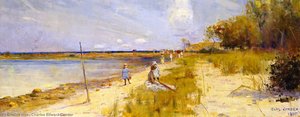
Coogee Bay
Giclée / Art Print
Reproduction Size
-


Total Price
$ 81
Coogee Bay: A Snapshot of Impressionistic Australia
Charles Edward Conder’s “Coogee Bay,” painted in 1888, stands as a quintessential example of the Heidelberg School movement—a group of Australian artists who championed plein air painting and sought to capture the essence of the bush landscape with vibrant color palettes and loose brushstrokes. This serene depiction captures not just a coastal vista but also a particular mood: one of leisure, tranquility, and connection to nature.
- Subject Matter: The canvas portrays Coogee Beach in New South Wales during Easter 1888. We see several figures enjoying the sunlit shore—men wading into the water, women relaxing under umbrellas—creating a dynamic yet peaceful tableau.
- Style & Technique: Conder employed Impressionistic techniques, prioritizing light and color over meticulous detail. Thick impasto brushstrokes dominate the surface, conveying texture and capturing the shimmering reflections of sunlight on the water’s surface. The artist skillfully blended hues to achieve atmospheric perspective, subtly suggesting depth and distance.
- Historical Context: Heidelberg School artists were deeply influenced by French Impressionism, particularly Monet and Renoir. They rejected academic conventions in favor of a more spontaneous approach, aiming to depict the Australian landscape as it appeared to their eyes—a bold departure from prevailing artistic trends at the time.
The painting’s composition is carefully considered. The horizon line divides the scene into upper and lower registers, emphasizing the expansive sky and the calmer waters below. Conder's use of color – predominantly blues and greens – evokes feelings of serenity and freshness, mirroring the idyllic setting depicted. Notice how he captures the dappled sunlight filtering through the trees—a hallmark of Impressionistic observation.
- Symbolism: Beyond its visual beauty, “Coogee Bay” speaks to a broader theme of Australian identity. The beach represents both physical space and cultural heritage, symbolizing freedom, recreation, and connection to the natural world.
- NGV Reproduction: Currently housed at the National Gallery of Victoria (NGV), this artwork exemplifies the Heidelberg School’s commitment to capturing fleeting moments of beauty. Its acquisition in 1979 underscores its significance as a cornerstone of Australian art history.
“Coogee Bay” continues to resonate with viewers today, offering a glimpse into a bygone era and reminding us of the enduring power of Impressionistic vision. It’s a testament to Conder's ability to transform observation into evocative artistic expression—a skill that ensures this masterpiece retains its allure for generations to come.
Questions & Answers
How do I preview a reproduction of "Coogee Bay" by Charles Edward Conder?
To preview a reproduction of "Coogee Bay" by Charles Edward Conder, open the artwork's Preview page.
What is the recommended use of a print of "Coogee Bay"?
The suggested use for "Coogee Bay" by Charles Edward Conder is accent. It can serve other purposes as well.
Can I examine "Coogee Bay" in more detail?
"Coogee Bay" can be examined layer by layer on the artwork's X-Ray page, a viewer inspired by a conservator's light bench with eleven optical readings of the image.
Artist Biography
early life and artistic journey
charles edward conder, a british-born painter, lithographer, and designer, left an indelible mark on the art world. born in tottenham, middlesex, on october 24, 1868, conder's early life was marked by his mother's passing in india when he was just four years old.artistic career in australia
in 1884, at 16, conder moved to sydney, australia, working for his uncle as a land surveyor. however, he soon discovered his true passion lay in drawing the landscape rather than surveying it. by 1886, he had become an artist for the illustrated sydney news, alongside notable artists like albert henry fullwood and frank mahony.the heidelberg school and notable works
conder's masterpiece, departure of the orient – circular quay (1888), showcased his newfound mastery of form and brushwork. this dockside scene, depicting the bustling harbour at sydney cove, was quickly purchased by the art gallery of new south wales, making it conder's first work to enter a public collection.- a holiday at mentone (1888), a fun-loving painting showcasing men and women relaxing on the beach, is another notable example of conder's work.
- conder's association with g. p. nerli, an itinerant italian painter, significantly influenced his development as an artist.
- his contributions to the 9 by 5 impression exhibition in melbourne, alongside tom roberts and arthur streeton, solidified his position within the heidelberg school movement.
legacy and later life
conder's later years were plagued by poor health, including paralysis and a bout of delirium tremens. despite this, he continued to paint, leaving behind a legacy as a key figure in the heidelberg school. his art was better received in england than in paris, with his portrait being painted by henri de toulouse-lautrec in 1892. view conder's works at the art gallery of new south wales or explore more about the heidelberg school on OriginalUniqueArt's charles edward conder page.- discover more about conder's life and works on wikipedia's charles conder page.
- explore OriginalUniqueArt's collection of conder's paintings, including a holiday at mentone (1888) and departure of the orient – circular quay (1888), on OriginalUniqueArt's website.
conclusion
charles edward conder's impact on australian impressionism is undeniable. his legacy, marked by his captivating paintings and association with the heidelberg school, continues to inspire art enthusiasts worldwide.
Charles Edward Conder
1868 - 1909 , United Kingdom
Quick Facts
- Full Name: Charles Edward Conder
- Nationality: British
- Date Of Birth: 1868
- Date Of Death: 1909
- Place Of Birth: Tottenham, United Kingdom
- Notable Artworks:
- Departure of the Orient – Circular Quay
- A holiday at Mentone
- Under The Southern Sun
- Artistic Movement Or Style: Heidelberg School
- Artists Who Influenced This Artist:
- Alfred Daplyn
- Victor Mann
- Julian Ashton
Related Articles

Impressionistic Landscapes: 10 Masterpieces That Changed Art & Decor
Journey into the heart of Impressionism! Explore 10 masterpieces by Monet, Renoir & Degas that revolutionized landscape art. Discover their stories, techniques & find museum-quality reproductions to elevate your home decor on OriginalUniqueArt.com.

Cézanne's Masterpieces: 25 Iconic Artworks to Transform Your Space
Journey through 25 iconic artworks by Paul Cézanne – a master of Impressionism and Post-Impressionism. Explore his landscapes, still lifes, and the stories behind these timeless masterpieces. Discover museum-quality reproductions & curated decor at OriginalUniqueArt.com.

Evocations of Place: A Historical Journey Through Landscape Art
Explore the rich history of landscape art with OriginalUniqueArt. Discover renowned artists, movements like Impressionism & tonalism, and expert guidance for collecting timeless pieces. Find your perfect serene escape today!
Grahame Sydney: Evoking Otago's Soul Through Light & Landscape
Explore the captivating landscapes of Sir Grahame Sydney, a leading New Zealand artist renowned for his magic realism & evocative depictions of Otago's beauty. Discover key works and delve into his artistic legacy.

Evocations of Place: A Historical Journey Through Landscape Art
Explore the rich history of landscape art with OriginalUniqueArt. Discover renowned artists, movements like Impressionism & Romanticism, and expert guidance for collecting timeless pieces. Find your perfect serene escape today!