- Home

- Oil Painting Reproduction
- Caspar David Friedrich
- Moonrise over the sea Sun

 Buy print
 Send
Send Share
Share
 Details

 Download
 Similars
 X-Ray
X-Ray Diaporama
Moonrise over the sea Sun

 Read More
Hand Made Oil Reproduction
Hand-painted oil on canvas in your size and frame, made to order by our artists.




P118B $10

P118H $10

P118W $10

P438Z $10

P508JH $12

P508YH $12

P805H $10

P805Z $10

P919BZ $10

P919G $10

P919XJ $10

P959ZH $10

P968JZ $12

W106C $8

W218G $10

W218JH $8

W218Y $10

W307PJ $10

W316G $10

W316PJ $8

W316Y $10

W398PJ $8

W4111J $10

W500HY $15

W500JH $15

W692G $12

W849H $8

W940BG $15

W953PJ $8




Pick from our preset sizes that match the artwork's original proportions.

You may enter your own dimensions to fit a specific frame or space. If your selected size does not match the original image's proportions, we will either crop the artwork or extend the painting with additional hand-painted elements. A digital mockup will be sent for your approval before production begins.
Please note that the on-screen preview does not reflect the actual cropping or extension. Only the mockup will accurately show the final composition.
While custom sizes are available, we recommend selecting a dimension from the predefined list to preserve the original proportions.
After order, OriginalUniqueArt.com team will email client for instructions and provide a mockup preview
Worldwide Delivery () in 3/4 weeks instead of standard 5 weeks. (16 July). No compromise on quality.

Free Worldwide Express Shipping

High-Quality Linen Canvas

Full Shipping Insurance

Customs Tax Refund Guarantee

True Color Matching Guarantee

60-Day Return Policy (Defects Only)

100% Money-Back Guarantee

Bulk Discount Offer
 Glass option is only available in size under 110 CM

Moonrise over the sea Sun
Reproduction Medium
Reproduction Size
-


Total Price
-
Artwork Description
A Meditation on Solitude and Transcendence: Exploring Caspar David Friedrich’s Moonrise Over the Sea
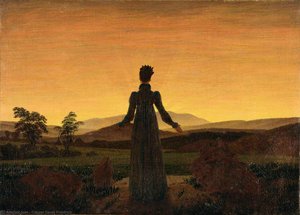
The painting "Moonrise Over the Sea," completed in 1822 by Caspar David Friedrich, stands as a cornerstone of Romantic landscape art—a testament to the profound influence of emotion and imagination upon artistic representation. More than just a depiction of a coastal scene at twilight, it embodies a complex philosophical inquiry into humanity’s relationship with nature and the sublime, concepts that captivated artists and intellectuals across Europe during the early 19th century. Friedrich himself famously stated that he wished to portray “the spirit of loneliness,” capturing not merely physical isolation but an inner state of contemplation deeply attuned to the rhythms of the natural world. Friedrich’s distinctive style—characterized by meticulous detail combined with a hazy atmospheric perspective—is instantly recognizable. He eschewed academic conventions favoring instead a technique rooted in observation and psychological intuition. The artist employed oil paints on canvas, applying thin glazes to build up tonal gradations that convey the ethereal quality of moonlight filtering through clouds. This layering process is particularly evident in the depiction of the sea itself, where ripples of light shimmer across the surface, creating an illusion of depth and movement without resorting to traditional linear perspective. The artist’s careful attention to texture—particularly visible in the rocky outcrop dominating the foreground—adds to the painting's tactile richness and reinforces its connection to the tangible world. Historically, Friedrich’s work emerged from a period marked by intellectual ferment and spiritual crisis following the Napoleonic Wars. Romanticism rejected Enlightenment rationalism, prioritizing feeling and intuition as pathways to understanding truth. Artists like Friedrich sought inspiration in folklore, mythology, and biblical narratives—drawing upon these sources to express universal themes of longing, loss, and redemption. “Moonrise Over the Sea” reflects this broader cultural preoccupation with confronting mortality and glimpsing glimpses of eternity. The solitary figure standing on the promontory is positioned deliberately against the vast expanse of the sea and sky, symbolizing humanity’s insignificance in comparison to the grandeur of creation—yet simultaneously affirming our capacity for spiritual awareness and inner peace. The painting's symbolism resonates deeply with Romantic ideals. The moon itself represents enlightenment and contemplation, guiding the viewer toward a higher understanding of existence. Its silvery glow illuminates the desolate landscape, suggesting that beauty can be found even in darkness and solitude. The rocky outcrop serves as an anchor—a grounding element amidst the turbulent emotions conveyed by the scene—representing resilience and steadfastness in the face of adversity. Furthermore, Friedrich’s deliberate omission of human figures—beyond the solitary observer—emphasizes the primacy of nature as a source of spiritual inspiration. Ultimately, “Moonrise Over the Sea” transcends its visual description to evoke an emotional response that lingers long after viewing. It invites contemplation on themes of existential uncertainty and the yearning for transcendence—a poignant reminder of our shared vulnerability and our innate desire to connect with something larger than ourselves. Its enduring appeal lies in its ability to capture a moment of profound stillness—a glimpse into the inner landscape where beauty, solitude, and spiritual awareness converge—making it an invaluable contribution to the canon of Romantic art and a timeless emblem of human experience.Artist Biography
A Solitary Vision: The Life and Art of Caspar David Friedrich
Born in the Baltic port city of Greifswald in 1774, Caspar David Friedrich’s life was steeped in a melancholic atmosphere that would profoundly shape his artistic vision. His early years were marked by loss – the deaths of his mother and siblings cast a long shadow, fostering a sensitivity to mortality and transience that became central themes in his work. Initially educated by his older brother Christian in drawing, Friedrich’s formal training began at the University of Leipzig, where he pursued both art and theology, though neither degree was completed. This dual interest – a fascination with the visual world alongside a deep spiritual questioning – would prove crucial to his development as an artist. Further studies in Copenhagen honed his technical skills, exposing him to landscape painting traditions that would serve as a foundation for his unique style, yet it was not imitation he sought but rather expression—a means of conveying inner emotional states through the language of nature.The Birth of Romantic Landscape
Friedrich’s artistic journey wasn't merely about depicting scenery; it was about imbuing landscapes with profound symbolic meaning. He moved away from the meticulous detail favored by earlier artists, embracing a more personal and expressive approach. His paintings are characterized by an emphasis on the sublime – evoking feelings of awe, terror, and spiritual connection in the face of nature’s grandeur. The use of *Rückenfiguren*, figures seen from behind, became a signature element, inviting viewers to step into the scene and share in the contemplative experience. Natural elements like ancient trees, towering mountains, swirling fog, and crumbling ruins weren't simply picturesque details; they were potent symbols representing life’s cycles, spiritual longing, and the weight of history. His palette, often muted with blues, grays, and browns, further enhanced the mood of introspection and solemnity that pervades his work. He pioneered a way to depict landscapes not as mere views but as reflections of the human soul—a revolutionary concept for its time.Iconic Works and Enduring Themes
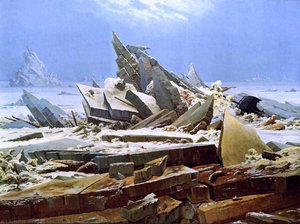
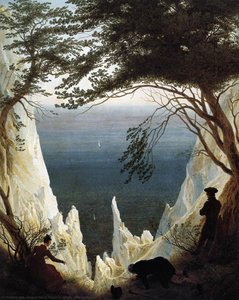
Several paintings stand out as defining examples of Friedrich’s artistic achievement. "The Abbey in the Oakwood" (1809-1810), a haunting image of a ruined churchyard enveloped by bare trees, speaks powerfully to themes of mortality and spiritual decay. Perhaps his most famous work, "Wanderer above the Sea of Fog" (c. 1818), encapsulates the Romantic ideal of the individual confronting the vastness and mystery of existence. The figure, silhouetted against a swirling sea of mist, embodies both human aspiration and insignificance. "Chalk Cliffs on Rügen" (1818) demonstrates his mastery of atmospheric effects and subtly conveys a sense of national identity—a growing concern in the fragmented political landscape of early 19th-century Germany. Even more dramatic is "The Sea of Ice" (1824), a chilling depiction of an Arctic wasteland, representing nature’s immense power and indifference to human fate. Recurring throughout his oeuvre are themes of nature as a manifestation of the divine, the fragility of humanity in the face of cosmic forces, melancholy, solitude, spiritual yearning, and a burgeoning sense of German nationalism.Legacy and Rediscovery
Friedrich’s influences were diverse, ranging from Dutch Golden Age landscape painting – particularly the works of Jacob van Ruisdael – to the philosophical writings of Immanuel Kant, which explored the limits of human perception and the power of subjective experience. His own personal experiences with loss and spirituality also played a crucial role in shaping his artistic vision. While celebrated during his lifetime, Friedrich’s popularity waned as artistic tastes shifted. However, he experienced a significant rediscovery in the late 20th century, becoming widely recognized as one of the most important figures in German Romanticism. His emphasis on subjective experience and emotional expression paved the way for later movements like Symbolism and Surrealism, influencing generations of artists who sought to explore the inner world through visual means. He remains a pivotal figure whose work continues to resonate with audiences today, reminding us of the profound connection between humanity and the natural world, and the enduring power of art to evoke contemplation and spiritual awakening.Historical Significance
Caspar David Friedrich’s art captured the very spirit of the Romantic era—a period defined by a rejection of Enlightenment rationalism in favor of emotion, imagination, and individualism. His landscapes served as powerful symbols of German national identity during a time of political fragmentation, fostering a sense of shared cultural heritage. Though he died in Dresden in 1840, his legacy extends far beyond the confines of 19th-century Germany. He didn’t simply paint what he saw; he painted what he *felt*, and it is this emotional honesty that continues to captivate and inspire. His work stands as a testament to the enduring power of art to explore the deepest questions of human existence, reminding us of our place within the vastness of nature and the mysteries of the universe.
Caspar David Friedrich
1774 - 1840 , Germany
Quick Facts
- Artistic Movement Or Style: Romanticism
- Artists Or Movements Influenced By This Artist:
- Symbolists
- Surrealists
- Artists Who Influenced This Artist:
- Dutch Masters
- J.C. Dahl
- Date Of Birth: September 5, 1774
- Date Of Death: May 7, 1840
- Full Name: Caspar David Friedrich
- Nationality: German
- Notable Artworks:
- Abbey in the Oakwood
- Wanderer above the Sea...
- Chalk Cliffs on Rügen
- The Sea of Ice
- Place Of Birth: Greifswald, Germany
Related Articles
Evoking Emotion & Transcendence: Romantic Landscape Painting (18th-19th Century)
Explore the emotional depth of Romantic landscape painting (18th-19th century). Discover key artists like Friedrich & Cole, and the concepts of the sublime. Expert insights for art lovers & collectors.

Johan Christian Dahl: Pioneering Norwegian Romantic Landscape Painting
Explore the life & art of Johan Christian Dahl, Norway's first great Romantic painter. Discover his iconic landscapes, cultural impact, and lasting legacy with OriginalUniqueArt.
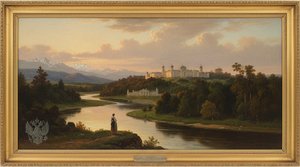
Alexei Harlamoff: A Study in Russian Romantic Landscape Painting & Imperial Patronage
Explore the captivating world of Alexei Harlamoff, a master of Russian Romantic painting. Discover his life, Imperial patronage, signature style & enduring legacy with OriginalUniqueArt.
Golden Hours: Sunset Motifs in Western Art History
Explore the captivating history of sunset motifs in Western art! Discover iconic paintings by Monet, Van Gogh & Kuindzhi. Learn about Romanticism, Impressionism & collecting these timeless masterpieces. Expert insights at OriginalUniqueArt.
The Sublime and the Picturesque: Exploring Emotion & Nature in Romantic Landscape Painting
Explore the emotional power of Romantic landscape painting! Discover the sublime & picturesque aesthetics, key artists like Friedrich & Cole, and lasting influence on art history. Find your perfect piece at OriginalUniqueArt.