Preview
 Send
Send Share
Share
 Details
 Guide
Guide

 Download
 Similars
 X-Ray
X-Ray Diaporama
 Stats
StatsUntitled


 Read More
Hand Made Oil Reproduction
Hand-painted oil on canvas in your size and frame, made to order by our artists. ( Switch to Print Switch to Digital Image)




P118B $10

P118H $10

P118W $10

P438Z $10

P508JH $12

P508YH $12

P805H $10

P805Z $10

P919BZ $10

P919G $10

P919XJ $10

P959ZH $10

P968JZ $12

W106C $8

W218G $10

W218JH $8

W218Y $10

W307PJ $10

W316G $10

W316PJ $8

W316Y $10

W398PJ $8

W4111J $10

W500HY $15

W500JH $15

W692G $12

W849H $8

W940BG $15

W953PJ $8




Pick from our preset sizes that match the artwork's original proportions.

You may enter your own dimensions to fit a specific frame or space. If your selected size does not match the original image's proportions, we will either crop the artwork or extend the painting with additional hand-painted elements. A digital mockup will be sent for your approval before production begins.
Please note that the on-screen preview does not reflect the actual cropping or extension. Only the mockup will accurately show the final composition.
While custom sizes are available, we recommend selecting a dimension from the predefined list to preserve the original proportions.
After order, OriginalUniqueArt.com team will email client for instructions and provide a mockup preview
Worldwide Delivery () in 3/4 weeks instead of standard 5 weeks. (25 September). No compromise on quality.

Free Worldwide Express Shipping

High-Quality Linen Canvas

Full Shipping Insurance

Customs Tax Refund Guarantee

True Color Matching Guarantee

100-Day Return Policy (Defects Only)

100% Money-Back Guarantee

Bulk Discount Offer
 Glass option is only available in size under 110 CM

Untitled
Reproduction Medium
Reproduction Size
-


Total Price
$ 300
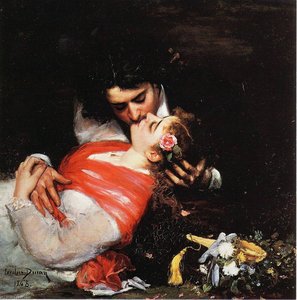
Untitled: A Study in Elegant Form
Carolus Duran’s “Untitled,” painted circa 1900, embodies the spirit of late nineteenth-century Parisian society—a realm meticulously documented by artists like Duran who sought to capture the refined tastes and sensibilities of their time. This captivating portrait exemplifies Duran's signature style: a masterful blend of academic tradition with Impressionistic nuance, resulting in an image brimming with understated beauty and psychological depth. The artwork’s muted palette – dominated by creams, pale greens, and subtle pinks – immediately establishes a tranquil atmosphere, mirroring the contemplative gaze of the subject.- Subject Matter: Duran skillfully portrays a woman seated gracefully, her hands clasped delicately near her chest. This pose speaks volumes about inner composure and introspection, aligning with the broader artistic preoccupation of the era with exploring human emotion and psychological states.
- Style & Technique: Duran’s approach transcends mere representation; he achieves an ethereal quality through loose brushwork and layering—a technique borrowed from Impressionism but firmly rooted in academic principles. The artist skillfully utilizes impasto, creating visible textural surfaces that imbue the painting with dynamism and luminosity.
- Historical Context: Painted during the Third Republic, “Untitled” reflects the burgeoning bourgeois culture of Paris – a society obsessed with social status and artistic patronage. Duran’s work aligns perfectly with the prevailing aesthetic sensibilities of the period, demonstrating an awareness of both formal conventions and psychological realism.
Composition & Color Palette: Echoes of Velázquez
The composition prioritizes simplicity, focusing intently on the female figure while minimizing extraneous details—a deliberate choice reminiscent of Diego Velázquez’s masterful use of perspective and tonal gradation. Duran skillfully employs color to heighten emotional impact; the earthy hues – particularly the creamy skin tones – convey warmth and serenity. Subtle variations in value create depth without resorting to dramatic contrasts, mirroring Velázquez's ability to capture light and shadow with remarkable precision. The artist’s careful consideration of color contributes significantly to the painting’s overall mood—one of quiet contemplation and understated elegance.- Color Harmony: Duran achieves a harmonious balance between warm and cool tones, creating visual interest while maintaining an air of sophistication.
- Brushwork & Texture: The artist's brushstrokes are visible throughout the canvas, adding textural richness and enhancing the painting’s luminous quality—a technique that underscores Duran’s commitment to capturing the essence of form rather than striving for photographic accuracy.
Symbolism & Emotional Resonance
Beyond its formal beauty, “Untitled” carries symbolic weight, reflecting the broader artistic exploration of femininity and vulnerability during this period. The woman's posture—seated with hands clasped—suggests a moment of profound reflection, inviting viewers to contemplate themes of inner peace and emotional sensitivity. Duran’s masterful rendering captures not only physical likeness but also psychological nuance—a testament to his ability to convey complex emotions through visual language. This artwork continues to resonate with audiences today as an exemplar of refined artistic expression and timeless beauty.- Psychological Depth: Duran's portrayal delves into the subtleties of human emotion, capturing a state of quiet contemplation that transcends mere appearance.
- Legacy: Duran’s influence extends beyond his own oeuvre; he mentored John Singer Sargent and championed Impressionistic techniques—solidifying his place as a pivotal figure in the history of art.
Materials & Reproduction Considerations
Likely executed on canvas using oil paints, “Untitled” exemplifies Duran's dedication to traditional artistic methods. Reproductions aim to faithfully recreate this original artwork’s luminous quality and textural richness—a challenge that requires meticulous attention to detail and skillful pigment manipulation. Selecting a high-quality reproduction ensures that you experience the enduring beauty of Duran’s masterpiece in your own home.Artist Biography
Carolus-Duran: Life and Legacy
Early Life and Education
- Born: Charles Auguste Émile Durand on July 4, 1837, in Lille, France.
- His early artistic training began with lessons from local sculptor Augustin-Phidias Cadet de Beaupré at the Académie de Lille.
- He furthered his education under François Souchon, a student of Jacques-Louis David, focusing on painting techniques.
- In 1853, he moved to Paris and adopted the name “Carolus-Duran,” marking a pivotal moment in his artistic identity.
Artistic Development and Influences
- Initially influenced by the Realism of Gustave Courbet, Carolus-Duran’s style evolved significantly after a scholarship allowed him to travel to Rome and Spain (1862-1866).
- Diego Velázquez became a crucial influence during his time in Spain. He admired Velázquez's mastery of light, color, and psychological insight.
- He moved away from the stark realism of Courbet towards a more refined and elegant style, characterized by sophisticated brushwork and attention to detail.
Career and Notable Works
- Carolus-Duran gained recognition for his portraits of wealthy members of Third Republic France’s high society. He captured their elegance and status with remarkable skill.
- Notable works include:
- Lady with a Glove (1869) – exemplifies his refined portrait style.
- Mrs. William Astor (1890) – a striking depiction of a prominent socialite.
- After the Swimming (1899) – showcases his ability to capture movement and atmosphere.
- The Artist's Daughter, Marie-Anne (1874) - A more intimate portrait demonstrating a softer side of his style.
- He also painted portraits that contrasted with his usual subjects, such as his gardener, employing looser strokes and earth tones.
Teaching and Legacy
- Carolus-Duran was a highly respected teacher. His studio on the Boulevard du Montparnasse became a center for artistic training.
- Among his most famous pupils were:
- John Singer Sargent
- Irving Ramsey Wiles
- Kenyon Cox
- He served on juries at the Expositions Universelles in 1889 and 1900, demonstrating his standing within the art world.
- In 1890, he co-founded the second Société Nationale des Beaux-Arts and was elected to the Académie des Beaux-Arts in 1904.
Honors and Final Years
- He received numerous honors throughout his career, including being named a Knight of the Légion d'honneur (1872) and progressing through its ranks to Grand Officer (1900).
- Carolus-Duran was a frequent visitor to Fréjus, where he owned a villa. After his death in 1917, the resort named a plaza and beach in his honor.
- Historical Significance: Carolus-Duran bridged the gap between Realism and Impressionism, influencing a generation of artists with his elegant style and technical skill. His emphasis on capturing personality and social status made him a significant figure in 19th-century French art.

carolus-duran (charles-auguste-emile durand)
1837 - 1917
Quick Facts
- Birth Date: 1837
- Birth Place: Lille, France
- Death Date: 1917
- Influenced:
- John Singer Sargent
- Irving Ramsey Wiles
- Kenyon Cox
- Influenced By: Gustave Courbet, Diego Velázquez
- Movement: Realism, Portraiture
- Name: Carolus-Duran
- Nationality: French
- Notable Works:
- Lady with a Glove
- Mrs. William Astor
- After the Swimming
- The Artist's Daughter, Marie-Anne
Related Articles
The Timeless Charm of Oil on Board: Reimagining Texture and Light through the Impressionist Lens
Discover the profound intimacy of oil on panel. Explore how Impressionist masters used rigid supports to capture light, texture, and impasto depth through exquisite, handmade oil reproductions for discerning collectors.

The Enduring Power of Painting: A Historical & Contemporary Exploration of Form and Emotion
Explore the rich history & enduring techniques of oil painting with OriginalUniqueArt. Discover masterpieces, learn about art collecting, and find authentic handmade reproductions crafted by skilled artists.

The Enduring Legacy of Oil on Canvas: Technique, History & Aesthetic Impact
Explore the rich history & techniques of oil painting – from Renaissance masters to Impressionism. Discover pigments, layering methods, and why this timeless medium endures. Expert insights for artists & art enthusiasts.

Oil on Canvas: A Historical & Technical Exploration of a Timeless Artistic Medium
Explore the rich history & enduring techniques of oil painting on canvas. Discover the science behind its longevity, conservation practices, and contemporary relevance. Expert insights for art enthusiasts.
Carolus-Duran: Bridging Academic Tradition & Modern Sensibility in 19th-Century Portraiture
Explore the life & art of Carolus-Duran, a pivotal 19th-century French painter bridging academic tradition and modern sensibility. Discover his influence on Sargent & the rise of Impressionism.