Switch to Print
 Read More







































 For artworks or reproductions larger than 105 cm (approximately 41 inches) on any side, the frame will be shipped as a kit, disassembled. This method ensures safe delivery and prevents damage during transport.


A Renaissance Dialogue of Faith and Wisdom
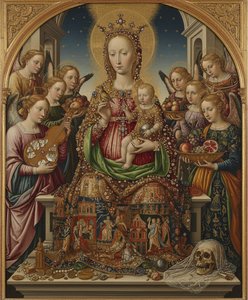
Carlo Crivelli’s “St. Jerome and St. Augustine,” painted around 1490, isn't merely a depiction of two revered figures; it’s a carefully constructed tableau of intellectual and spiritual contemplation, steeped in the late Gothic sensibilities of Renaissance Venice. The painting immediately draws the eye with its rich palette – deep reds and browns dominate, creating an atmosphere of solemnity and introspection, punctuated by the shimmering gold of the background and the vibrant hues of the garments. Crivelli masterfully employs a technique that balances meticulous detail with a sense of ethereal beauty, characteristic of his style which he developed after leaving Venice.
The composition is strikingly intimate, framing the two saints within a shallow space that invites close observation. Jerome, identifiable by his lion skin and quill pen, sits in deep thought, seemingly lost in prayer or contemplation. His posture exudes quiet intensity, while Augustine, clad in the robes of a bishop, gestures with an open book – a potent symbol of knowledge and divine revelation. The miniature architectural model at Augustine’s feet isn't simply decorative; it represents the power and authority of the papacy, subtly reinforcing the theme of earthly and spiritual governance. The inclusion of the lion, a recurring motif in Crivelli’s work, adds an element of primal instinct and strength to the scene, grounding the intellectual pursuits of the saints within the realm of human experience.
Craftsmanship and Venetian Influence
Crivelli's mastery lies not only in his subject matter but also in his technical execution. The painting is executed in tempera on wood, a medium favored by artists during this period for its luminosity and ability to achieve fine detail. Notice the layering of glazes – thin washes of color applied over dry layers – that create depth and richness in the fabrics and textures. The artist’s attention to detail is remarkable; from the intricate folds of the robes to the delicate rendering of Jerome's beard, every element contributes to a sense of realism and immediacy. The use of *trompe-l'oeil* techniques—the illusion of three-dimensionality—is particularly evident in the miniature building, which seems to leap out from the surface of the panel.
Crivelli’s Venetian training is undeniable, yet he forged a distinct style that set him apart from his contemporaries. While influenced by the meticulous realism of artists like Squarcione and the decorative elegance of Vivarini, Crivelli infused his work with a greater sense of emotional intensity and psychological depth. This painting exemplifies this shift – it’s not just a portrait of two saints; it's an exploration of their inner lives and the profound questions they grappled with.
Symbolism and Spiritual Resonance
Beyond the immediate depiction of Jerome and Augustine, the painting is laden with symbolic meaning. Jerome, traditionally associated with writing and contemplation, represents the pursuit of wisdom through scripture. Augustine, a pivotal figure in Christian theology, embodies faith, reason, and the struggle to reconcile divine revelation with human experience. The presence of the lion symbolizes strength and vigilance, while the open book signifies the importance of knowledge and learning. The overall composition suggests a dialogue between these two figures – a conversation between intellect and spirituality, earthly authority and divine grace.
Considered within the context of 1490s Venice, a city grappling with political upheaval and religious reform, “St. Jerome and St. Augustine” offers a poignant reflection on the challenges of navigating faith and reason in a turbulent world. It’s a testament to Crivelli's skill as an artist and his ability to capture the complexities of human experience within a framework of profound spiritual significance. Reproductions of this work continue to resonate with viewers today, offering a glimpse into the artistic and intellectual currents of the Renaissance.
Questions & Answers
Is "St Jerome and St Augustine (detail)" one of Carlo Crivelli's most popular works?
"St Jerome and St Augustine (detail)" by Carlo Crivelli has a recognized popularity level. This classification reflects how widely the work is recognized.
What technique was used for "St Jerome and St Augustine (detail)" by Carlo Crivelli?
The medium of "St Jerome and St Augustine (detail)" by Carlo Crivelli is oil. Reproductions aim to render the appearance of this technique.
Which room is "St Jerome and St Augustine (detail)" by Carlo Crivelli recommended for?
"St Jerome and St Augustine (detail)" by Carlo Crivelli is recommended for a living room. This suggestion is based on the work's subject, colors and mood.
More about this painting
 Preview
 Send
Send Share
Share
 Details
 Guide
Guide

 Download
 Similars
 X-Ray
X-Ray Diaporama
 Q&A
Q&A Stats
Stats