 Read More


 For artworks or reproductions larger than 105 cm (approximately 41 inches) on any side, the frame will be shipped as a kit, disassembled. This method ensures safe delivery and prevents damage during transport.


More about this painting
Text size

() ·
A painting made for you, by hand
Hand Made Oil Reproduction
Hand-painted oil on canvas in your size and frame, made to order by our artists. ( Switch to Print Switch to Digital Image)
Artist Biography
Explore the evocative landscapes & still lifes of Carl Schuch (1846-1903). Austrian painter bridging realism & modernism, influenced by Monet & Rembrandt.
from ·
Chapter 1
How large should it be?
Slide to change the size; the picture on the left shows the frame at its real width. The proportions of the original are kept.
Standard
custom
CM
INCH
Pick from our preset sizes that match the artwork's original proportions.
Loading sizes...

width
height
Type the width and the height you need, to fit your frame or your wall. This is hand-painted, so for a size with a different shape the artist can paint a bit more around the picture, or cut a bit — you choose. We send you a digital mockup to approve before the painting starts. The picture shown on this page does not show the real result — only the mockup does.
Chapter 2
How should it arrive?
Choose the edges of the stretched canvas
Choose your frame

White $1

Blurside $1

Extended $1

P118B $10

P118H $10

P118W $10

P438Z $10

P508JH $12

P508YH $12

P805H $10

P805Z $10

P919BZ $10

P919G $10

P919XJ $10

P959ZH $10

P968JZ $12

W106C $8

W218G $10

W218JH $8

W218Y $10

W307PJ $10

W316G $10

W316PJ $8

W316Y $10

W398PJ $8

W4111J $10

W500HY $15

W500JH $15

W692G $12

W849H $8

W940BG $15

W953PJ $8

H24-GOLD $30

H24-SILVER $30

H36-GOLD $45

H36-SILVER $45
Framed
Moulding: . Overall size with the frame: .
Chapter 3
Who paints it, and should anything change?
Examples of what can be changed: Replace face with customer photo; Add pet (e.g., replace cat with dog); Include hidden message in background; Change background landscape or elements.
After order, OriginalUniqueArt.com team will email client for instructions and provide a mockup preview
After order, OriginalUniqueArt.com team will email client for instructions and provide a mockup preview
Worldwide Delivery () in 3/4 weeks instead of standard 5 weeks. (7 November). No compromise on quality.
Chapter 4
The finishing touches
A nameplate, as in a museum?
Engraved Bronze Plaque Details
This elegant plaque features the artist's name and the title of the artwork, finely engraved for a timeless presentation.
It is made from bronze with a refined, elegant finish. The text is precisely laser-engraved for a sharp and permanent result. Measuring 9x2 cm, the plaque is compact yet easy to read. It's built to be durable and scratch-resistant, offering a professional, museum-quality look. Mounting is simple thanks to the included adhesive backing.
Transparent Acrylic Plaque Details
The plaque includes essential engraved details such as the artist's name, the title of the artwork, the date it was created, the type of media used-like oil on canvas or watercolor-a brief description of the piece, and a QR code that links to the complete artwork information.
It is crafted from clear acrylic, offering a sleek, modern appearance. The text is UV-engraved in black to ensure strong visual contrast. With a size of 10x15 cm, it ensures optimal readability. It comes equipped with two metal hooks for secure wall mounting. The plaque is designed to be weather-resistant, making it suitable for various environments, and it includes interactive features that work seamlessly with smartphone scanning.
Black Acrylic Plaque Details
This elegant plaque includes engraved information such as the artist's name, the title of the artwork, the date it was created, the type of media used (like oil on canvas or watercolor), a short description of the artwork, and a QR code for quick access to more information.
The plaque itself is made from refined black acrylic with a premium finish. The text is laser-engraved in white for high contrast and readability. Its size is 10x15 cm, designed to be easy to read. It comes with two metal hooks for professional mounting. The design is sleek and fits any interior style. It is also weather-resistant and durable, with built-in digital integration for mobile compatibility.
A protective varnish?
When do you need it?
Chapter 5
Your painting, as you ordered it
Selbstbildnis
Reproduction Medium
Reproduction Size
-
Elite Senior Artist
More detail, finesse, and extra production time
-
Reproduction Frame
-
-
For artworks or reproductions larger than 105 cm (approximately 41 inches) on any side, the frame will be shipped as a kit, disassembled. This method ensures safe delivery and prevents damage during transport.
Professional assembly required - this is not a DIY product.
The kit must be assembled and the canvas stretched by an experienced professional framer, using wood glue (not supplied), a canvas stretching plier and clamps to hold the bars square while the glue dries. Incorrect assembly or uneven canvas tension can permanently damage the artwork and is not covered by our warranty.
All solid wood bars are included, precisely cut to size.
Assembled with the screws provided, plus wood glue for the corner joints, which is not supplied and must be sourced by your framer.
Professional tools are required and not included: a canvas stretching plier (tensioner) and clamps to hold the bars square while the glue dries.
Important:
The corner joints require wood glue, the bars must be held with clamps until the glue is fully dry, and tightening the canvas on the assembled frame requires a canvas stretching plier. None of these are included in the kit. Please arrange an experienced professional framer before ordering this size.
Nameplate
-
-
Protective Varnish
Glossy Varnish (enhances colors, protects against light/moisture)
-
Customize My Artwork
Examples of what can be changed: Replace face with customer photo; Add pet (e.g., replace cat with dog); Include hidden message in background; Change background landscape or elements.
-
Urgent
Worldwide Delivery () in 3/4 weeks instead of standard 5 weeks. (7 November). No compromise on quality.
-
Express Shipping
Worldwide Delivery () in 5 weeks. (14 November).
Included
Total Price
$ 300
Glass option is only available in size under 110 CM
Included with every order
- Free Worldwide Express Shipping
- High-Quality Linen Canvas
- Full Shipping Insurance
- Customs Tax Refund Guarantee
- True Color Matching Guarantee
- 100-Day Return Policy (Defects Only)
- 100% Money-Back Guarantee
- Bulk Discount Offer
 Preview
 Send
Send Share
Share
 Details
 Guide
Guide

 Download
 Similars
 X-Ray
X-Ray Diaporama
 Q&A
Q&A Stats
StatsIn numbers
- 29frames to choose from
- standard sizes, in its own proportions
- 5weeks to paint and deliver it
About the original

- 55.0 x 46.0 cm

Carl Schuch
1846 - 1903
Quick facts about Carl Schuch
- Full Name: Carl Eduard Schuch
- Nationality: Austrian
- Date Of Birth: 1846
- Date Of Death: 1903
- Place Of Birth: Vienna, Austria
- Artistic Movement Or Style: Realism, Modernism
- Artists Who Influenced This Artist:
- Rembrandt
- Monet
Artist Biography
A Life Immersed in Tone and Light: The Journey of Carl Schuch
Carl Eduard Schuch, born in Vienna in 1846, was an artist whose life unfolded as a quiet but determined exploration of color, light, and the subtle poetry of everyday subjects. Unlike many of his contemporaries who sought fame through grand historical narratives or bold stylistic innovation, Schuch carved a unique path, one defined by meticulous observation, a deep reverence for the Old Masters, and a gradual embrace of modern sensibilities. His story isn’t one of immediate recognition but rather of persistent refinement, a slow burn that ultimately positioned him as a pivotal figure in the transition from Realism to early Modernism in Austrian painting. He wasn't driven by ambition so much as an insatiable curiosity—a need to understand *how* light shaped form and *why* certain colors resonated with such emotional power.Early Studies and the Foundations of Realism
Schuch’s formal artistic training began in 1865 at the Academy of Fine Arts Vienna, where he studied landscape painting under Ludwig Halauska. This early period laid the groundwork for his lifelong fascination with nature, but it was a particular approach to representation that truly captured his attention. He wasn't content merely to depict scenes; he sought to dissect them, analyzing their tonal values and striving for an almost scientific accuracy in rendering light and shadow. He famously declared his intention to paint heads “like still-lifes, tone by tone, without emotion,” a statement revealing his initial focus on technical mastery over expressive gesture. This dedication to objective observation was firmly rooted in the Realist tradition prevalent at the time, emphasizing faithful portrayals of the world around him. However, even within this framework, Schuch’s sensitivity to nuance and atmospheric effects hinted at a deeper artistic sensibility that would blossom later in his career.The Parisian Years and the Influence of Monet
A turning point arrived in 1882 when Schuch relocated to Paris. This move exposed him to the burgeoning Impressionist movement, and while he never fully adopted their broken brushwork or emphasis on fleeting moments, the experience profoundly impacted his understanding of color theory and plein-air painting. He was particularly captivated by Claude Monet, whom he hailed as “the Rembrandt of plein-air painting.” Monet’s ability to capture the shifting qualities of light and atmosphere resonated deeply with Schuch's own artistic pursuits. However, it wasn’t simply imitation that drew him; rather, he saw in Monet a kindred spirit—an artist dedicated to unraveling the mysteries of perception. He spent countless hours studying Monet’s canvases, meticulously documenting his color palettes and techniques in detailed notebooks. This period also fostered an appreciation for the Barbizon school artists, whose focus on rural landscapes and direct observation further solidified Schuch's commitment to painting from nature.Friendship with Hagemeister and a Search for Authenticity
Schuch’s artistic journey wasn’t solely defined by his engagement with established movements; it was also profoundly shaped by personal relationships, most notably his intense friendship with Karl Hagemeister. The two artists met in Bavaria and embarked on a period of shared exploration, traveling extensively throughout Central Europe before settling together in the small village of Ferch near Berlin for three years. Their relationship was remarkably symbiotic—Hagemeister, known for his robust personality, provided practical support, hunting and fishing to sustain them both while Schuch focused intently on his painting. The nature surrounding Ferch became their shared muse, inspiring a series of intimate landscapes that reflected their close bond. However, this idyllic partnership eventually dissolved over a disagreement concerning Hagemeister’s work—a testament to Schuch's uncompromising artistic standards and his relentless pursuit of authenticity. The incident, involving Hagemeister discarding several paintings into the Seine, marked a painful but ultimately defining moment in Schuch’s career, reinforcing his commitment to following his own artistic vision.Legacy and Historical Significance
Carl Schuch died in 1903, leaving behind a body of work that continues to captivate viewers with its quiet beauty and subtle power. While he didn't achieve widespread fame during his lifetime, his influence on the development of Austrian Modernism is undeniable. He served as a crucial link between the Realist tradition and the emerging avant-garde movements, paving the way for artists like Gustav Klimt and Egon Schiele. His meticulous approach to color theory, combined with his sensitivity to light and atmosphere, anticipated many of the concerns that would define 20th-century painting. Schuch’s landscapes and still lifes are not merely representations of the external world; they are meditations on perception itself—an invitation to slow down, observe carefully, and appreciate the subtle poetry of everyday life. He demonstrated a profound understanding of how color could evoke emotion and create atmosphere, influencing generations of artists who followed in his footsteps. His work remains a testament to the power of quiet dedication, meticulous observation, and an unwavering commitment to artistic truth.- Key Influences: Ludwig Halauska, Claude Monet, Barbizon School painters, Rembrandt.
- Major Themes: Landscapes, Still Lifes, Color Theory, Atmospheric Effects.
- Artistic Style: Transition from Realism to early Modernism, characterized by meticulous observation and subtle use of color.
Related Articles

The Echo of Self: Reflectivity as a Core Theme in Art History & Contemporary Practice
Explore the rich history of self-representation in art, from Renaissance masters to modern innovators. Discover how artists use portraiture to reveal identity, emotion & the depths of the human psyche. Expert insights for collectors.
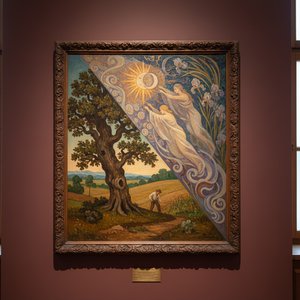
Carl Eduard Schuch: Bridging Realism & Symbolism in Late 19th-Century Austrian Painting
Explore the captivating landscapes & still lifes of Carl Eduard Schuch (1846-1903), a pivotal Austrian painter bridging realism and modernism. Discover his influences, unique style, and lasting legacy with OriginalUniqueArt.

The Inner Landscape: Exploring Themes of Introspection in Visual Art Across Movements & Eras
Explore the captivating world of introspective art! Discover how artists across eras – from Rembrandt to Kahlo – used self-portraiture to reveal their inner worlds and emotional depths. A journey through art history & psychology.

Mastering Form: The 25 Greatest Artworks by Paul Cézanne
Explore 25 iconic Paul Cézanne masterpieces and his Post-Impressionist legacy. Discover the full collection online at OriginalUniqueArt.com.
Explore artworks organized by themes, styles, and characteristics.


