1952
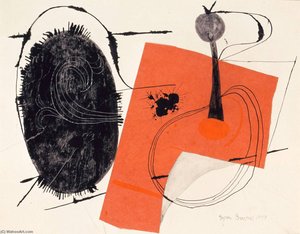
Jester (Byron Browne, 1952)
Byron Browne (1907–1961) made Jester. It dates from 1952. It measures 71 × 61 cm.
- 1952
- 71 × 61 cm

 Preview

 Hand Made Oil Painting
 Send
 Share
 Fact sheet


 Download
 Similars
 X-Ray
 Diaporama
 Q&A

 Stats
Jester, in brief
- Title
- Jester
- Artist
- Byron Browne (1907–1961)
- Artist born in
- Yonkers, United States
- Date
- 1952
- Dimensions
- 71 × 61 cm
High-resolution images of Jester

Protected by copyright: the image is shown for reference only.
Other sizes, crops and citation →Byron Browne, Jester (1952).
Questions on Jester, answered
What is the creation date of "Jester" by Byron Browne?
The creation of "Jester" by Byron Browne is dated 1952.
What size is "Jester" by Byron Browne in real life?
"Jester" measures 71 x 61 cm in its original form. Original dimensions are a useful reference when choosing a reproduction size.
Can the image of "Jester" by Byron Browne be freely reproduced?
The copyright answer for "Jester" by Byron Browne: the work is still protected by copyright. This determines whether reproductions of the image may be freely made.
Who created "Jester"?
"Jester" was created by Byron Browne. The information on this page describes Byron Browne's original work.
At what age did Byron Browne make "Jester"?
When "Jester" was created in 1952, Byron Browne - born in 1907 - was 45 years old.
Is "Jester" by Byron Browne in the public domain, and why?
The copyright status of "Jester" - still protected by copyright - follows from the artist's death in 1961.
About the artist, Byron Browne
1907–1961, United States
Byron Browne
Byron Browne: Pioneer of American Abstract Art Byron Browne (1907 – 1961) stands as a cornerstone figure in the burgeoning field of American Abstract Expressionism, recognized primarily for his contributions to mural commissions and collaborations with Hans Hofmann. Born in London, England, Browne’s artistic journey began amidst the vibrant Pre-Raphaelite movement, profoundly shaping his aesthetic sensibilities before he embraced the radical experimentation of postwar abstraction. His formative years were marked by exposure to influential artists like Ford Madox Brown, whose visionary approach to Victorian social commentary instilled a deep appreciation for conveying complex ideas through visual language. Early Influences: Browne’s initial artistic explorations centered around landscapes and portraits, reflecting the stylistic conventions of his time.
 Abstract Collage1933
 Untitled, from the portfolio American Abstract Artists1937
 Head1938
 White Still Life1947