Switch to Print
 Read More







































 For artworks or reproductions larger than 105 cm (approximately 41 inches) on any side, the frame will be shipped as a kit, disassembled. This method ensures safe delivery and prevents damage during transport.


A Dance of Shadows and Light
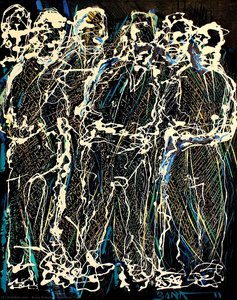
In the profound stillness of Bona Ezeudu’s 2011 masterpiece, "Awaiting Trial," the viewer is invited into a realm where the boundaries between the physical and the metaphysical begin to dissolve. This evocative oil painting serves as a hauntingly beautiful meditation on the human condition, captured through an expressive and gestural style that feels both ancient and urgently contemporary. At first glance, the canvas presents a striking contrast; a deep, somber background—infused with subtle, nocturnal whispers of blue and green—serves as the stage for a constellation of ethereal figures. These forms are not rendered with anatomical precision but are instead articulated through delicate white lines and luminous shapes that seem to pulse with an inner life, suggesting a movement that is as fluid as thought itself.
The technique employed by Ezeudu is nothing short of mesmerizing, characterized by visible, textured brushstrokes that lend the work a tactile depth. This impasto-like quality ensures that the painting is not merely a flat image but a living surface where light and shadow play a continuous game of hide-and-seek. The minimalist color palette focuses the observer's attention on the structural elegance of the white linework, which weaves through the darkness to interconnect the various figures. This web of light acts as a powerful symbol of human connection, communication, and the invisible threads of relationship that bind us all together, even in moments of profound isolation or uncertainty.
Symbolism and the Weight of Anticipation
The title, "Awaiting Trial," casts a poignant shadow over the composition, imbuing the abstract forms with a heavy sense of psychological weight. There is an undeniable tension held within the frame—a feeling of suspended animation where characters stand on the precipice of judgment or transformation. While the dark atmosphere evokes the gravity of legal or moral reckoning, there is a countervailing sense of hope found in the upward trajectory of certain lines and shapes. This upward movement suggests a yearning for transcendence, an aspiration to rise above the darkness toward clarity and resolution. It is this duality—the tension between the somber reality of the "trial" and the luminous potential of the spirit—that gives the piece its enduring emotional resonance.
For the discerning collector or interior designer, "Awaiting Trial" offers more than just aesthetic beauty; it provides a profound focal point for spaces that demand intellectual and emotional depth. The painting’s ability to command attention through its stark contrasts makes it an ideal centerpiece for sophisticated environments, such as modern galleries, executive studies, or curated living spaces. As a high-quality reproduction, this work allows the dramatic interplay of Ezeudu's expressive lines to transform a room, inviting guests to linger and contemplate the complex tapestry of human interaction and the eternal wait for justice and truth.
Questions & Answers
What stage of Bona Ezeudu's development does "Awaiting Trial" represent?
Within Bona Ezeudu's career, "Awaiting Trial" falls in the Mature Period. The phase helps compare it with the artist's other works.
Can the image of "Awaiting Trial" by Bona Ezeudu be freely reproduced?
Regarding copyright, "Awaiting Trial" is still protected by copyright.
What feeling is "Awaiting Trial" associated with?
The emotional tone recorded for "Awaiting Trial" by Bona Ezeudu is somber. It summarizes the feeling the work expresses.
More about this painting
 Preview
 Send
Send Share
Share
 Details
 Guide
Guide

 Download
 Similars
 X-Ray
X-Ray Diaporama
 Q&A
Q&A Stats
Stats