

 Preview
 Send
Send Share
Share
 Details
 Guide
Guide

 Download
 Similars
 X-Ray
X-Ray Diaporama
 Stats
StatsYellow Chicken


 Read More
Hand Made Oil Reproduction
Hand-painted oil on canvas in your size and frame, made to order by our artists. ( Switch to Print Switch to Digital Image)




P118B $10

P118H $10

P118W $10

P438Z $10

P508JH $12

P508YH $12

P805H $10

P805Z $10

P919BZ $10

P919G $10

P919XJ $10

P959ZH $10

P968JZ $12

W106C $8

W218G $10

W218JH $8

W218Y $10

W307PJ $10

W316G $10

W316PJ $8

W316Y $10

W398PJ $8

W4111J $10

W500HY $15

W500JH $15

W692G $12

W849H $8

W940BG $15

W953PJ $8




Pick from our preset sizes that match the artwork's original proportions.

Type the width and the height you need, to fit your frame or your wall. This is hand-painted, so for a size with a different shape the artist can paint a bit more around the picture, or cut a bit — you choose. We send you a digital mockup to approve before the painting starts. The picture shown on this page does not show the real result — only the mockup does.
After order, OriginalUniqueArt.com team will email client for instructions and provide a mockup preview
Worldwide Delivery () in 3/4 weeks instead of standard 5 weeks. (22 October). No compromise on quality.

Free Worldwide Express Shipping

High-Quality Linen Canvas

Full Shipping Insurance

Customs Tax Refund Guarantee

True Color Matching Guarantee

100-Day Return Policy (Defects Only)

100% Money-Back Guarantee

Bulk Discount Offer
 Glass option is only available in size under 110 CM

Yellow Chicken
Reproduction Medium
Reproduction Size
-


Total Price
$ 300
Yellow Chicken by Bill Traylor: A Study in Minimalism and Folklore
Bill Traylor’s “Yellow Chicken” (1940) stands as an arresting testament to the power of simplicity within abstract expressionism, capturing a profound connection to American folklore and embodying a singular vision of rural Alabama life during the Great Depression. Created by Traylor, this gouache and pencil drawing on cardboard resides at The Museum of Modern Art in New York, gifted by Charles and Eugenia Shannon—a serendipitous encounter that propelled Traylor’s work into the spotlight and continues to fuel scholarly debate regarding his artistic journey and enduring legacy. ### Visual Impression: Bold Strokes and Textured Depth The artwork immediately commands attention with its vertical composition centered around a stylized yellow chicken figure against a textured brown background. Traylor eschews meticulous realism, prioritizing emotional resonance over precise representation; instead, he employs loose brushstrokes and blending techniques that imbue the image with movement and an undeniable sense of energy. Lines are fluid and gestural, mirroring the organic form of the chicken while simultaneously conveying a feeling of spontaneity—a deliberate departure from conventional artistic conventions. Shapes are primarily derived from nature, reflecting Traylor’s deep roots in Alabama folklore and his fascination with the everyday experiences of rural communities. The dominant brown hue isn't merely a backdrop but actively contributes to the artwork’s textural richness, hinting at weathered earth and conveying an atmosphere of quiet contemplation. ### Technique: Wet-on-Wet Blending and Layered Texture Traylor’s masterful technique utilizes wet-on-wet blending—a process where paint is applied while still wet, allowing colors to merge seamlessly and creating a layered surface that invites exploration. This approach lends itself beautifully to capturing subtle tonal variations and enhancing the overall visual depth of the piece. Pencil lines provide delicate contours and textural contrast against the gouache pigment, emphasizing the artist’s meticulous attention to detail despite his overarching stylistic preference for abstraction. The resulting surface possesses an almost palpable quality—a tactile invitation to consider the materiality of art itself and its ability to evoke visceral responses. ### Historical Context: Outsider Art and Depression Era Expressionism “Yellow Chicken” emerged during a pivotal period in American history – the Great Depression – when Traylor, largely unrecognized by mainstream artistic circles, bravely pursued his creative vision independently. His work aligns squarely with the burgeoning field of “outsider art,” characterized by artists who operate outside established institutions and conventions—often drawing inspiration from personal experience and folklore rather than academic theory. Traylor’s style embodies the spirit of abstract expressionism, prioritizing emotional intensity over intellectual precision—a reaction against the formalism prevalent in European art during the same era. The image speaks to themes of resilience, identity, and connection to place—values deeply ingrained within Alabama’s cultural heritage. ### Symbolism: Folklore and Everyday Observation Beyond its aesthetic qualities, “Yellow Chicken” resonates with symbolic significance rooted in American folklore. Chickens are frequently depicted as symbols of fertility, abundance, and domestic tranquility—themes that align perfectly with Traylor's depiction of rural Alabama life. The artist’s deliberate simplification of form underscores the importance of observation and intuition—suggesting that profound truths can be gleaned from seemingly mundane subjects. Ultimately, “Yellow Chicken” serves as a poignant reminder that art can transcend mere representation, communicating emotion and conveying cultural memory in ways that are both understated yet undeniably powerful.Questions & Answers
Where can I download "Yellow Chicken" by Bill Traylor?
The image of "Yellow Chicken" by Bill Traylor can be downloaded from the artwork's Download page: a high-resolution digital image download.
What colors dominate "Yellow Chicken" by Bill Traylor?
"Yellow Chicken" is defined by a neutrals palette led by gray (#95856a).
Which artist is "Yellow Chicken" attributed to?
The artist behind "Yellow Chicken" is Bill Traylor. The work is catalogued under Bill Traylor's name.
Artist Biography
The Voice of Alabama Folklore
William “Bill” Traylor remains one of the most profound enigmas in the annals of American art history—a self-taught African American visionary whose striking drawings emerged from the quiet obscurity of rural Alabama during the Great Depression. His work, characterized by a hauntingly beautiful simplicity, serves as a window into a world shaped by the complexities of the Jim Crow South. While early critics often dismissed his compositions as mere “primitive” or “outsider” sketches, modern scholarship has undergone a dramatic reassessment, recognizing Traylor as a master of modernism whose rhythmic lines and symbolic figures command a place within the global canon of fine art. This rediscovery was catalyzed by the tireless efforts of Charles Shannon, who encountered Traylor’s captivating vision in 1940, effectively bringing his singular perspective to the attention of a wider, more appreciative audience.
Born into the harsh realities of slavery on the plantation of George Hartful Traylor, Bill’s early life was defined by the profound social upheavals of the nineteenth century. His parents, Sally and Bill Calloway, navigated the immense hardships inherent in the post-emancipation era, instilling in him a sense of resilience that would later permeate his creative output. Despite the systemic discrimination and economic struggles of the sharecropping system in Alabama, Traylor built a life of remarkable familial devotion, fathering approximately twenty children. His journey from the bondage of slavery through the reconstruction era to the twilight of his life in Montgomery is a testament to human endurance, a narrative arc that provides a heavy, soulful backdrop to the imagery he would eventually commit to paper.
A Visual Language of Resilience and Motion
Traylor’s artistic career began unexpectedly late in his life, following his relocation to Montgomery in 1939. Driven by a sudden impulse to create, he utilized whatever materials were at hand—often pencil, crayon, or ink on discarded paper—to capture the essence of his surroundings. His work is not merely a collection of figures; it is a dynamic lexicon of movement and memory. In pieces such as Untitled (Dog Fight with Writing), one can witness the raw energy and kinetic tension of two dogs locked in combat, a composition that captures the visceral intensity of folk life through sharp, decisive strokes. His ability to distill complex emotions into minimalist forms allows his subjects—ranging from livestock like pigs to human figures engaged in daily toil or sudden violence—to vibrate with an almost supernatural life.
The symbolism within Traylor’s repertoire is both subtle and profound, often blending the mundane with the mythic. His depictions of animals and people frequently inhabit a space that feels simultaneously grounded in the reality of Alabama folklore and elevated by a dreamlike abstraction. This unique stylistic approach allows him to explore themes of:
- The rhythms of rural life: Capturing the steady, often grueling pace of agricultural existence.
- Social tension: Using fragmented figures to mirror the fractured social landscape of the segregated South.
- Narrative movement: Utilizing a sense of "floating" or disconnected limbs to suggest action and transformation.
Legacy and Historical Significance
The historical significance of Bill Traylor cannot be overstated. He stands as a bridge between the oral traditions of the African American experience and the formal language of modern art. His work does not merely document history; it interprets the psychological landscape of an era marked by both extreme oppression and incredible creative survival. By transforming the scraps of everyday life into permanent artifacts of beauty, Traylor challenged the boundaries of what constitutes "fine art" and forced the art world to look toward the margins for true innovation.
Today, his legacy continues to resonate through museums and galleries worldwide, serving as a cornerstone for the study of self-taught artists. His ability to communicate the universal through the deeply personal ensures that his vision remains as vital and provocative today as it was when he first began drawing in the streets of Montgomery. Through his pencil and paper, Traylor achieved a form of immortality, ensuring that the voices of the Alabama landscape would never be silenced.

Bill Traylor
1854 - 1949
Quick Facts
- Artistic Movement Or Style: Self-taught, Modernism, Folk Art
- Full Name: William “Bill” Traylor
- Nationality: African American
- Notable Artworks:
- Untitled (Dog Fight with Writing)
- Black Turkey
- Untitled (Exciting Event)
- Date Of Birth: 1854
- Date Of Death: 1949
Related Articles

The Soul of Color: A Journey into the Emotional Resonance of Lyrical Abstraction
Embark on a cultural journey through Lyrical Abstraction. Explore how masters like Kandinsky used color and motion to translate emotion into visual poetry. Discover the profound beauty of abstract expressionism and learn to curate emotional resonance in your own art collection.

Abstract Expressionism's 10 Defining Masterpieces |
Explore 10 defining Abstract Expressionism masterpieces by Pollock, Rothko & de Kooning. Discover the stories behind these iconic paintings and find museum-quality art reproductions to elevate your home decor on .

Geometric Abstraction's 10 Defining Masterpieces | Art for Your Home - OriginalUniqueArt
Explore 10 defining masterpieces of Geometric Abstraction! Discover Kandinsky, Mondrian & Malevich’s iconic works. Find museum-quality art reproductions and curated decor ideas to elevate your home at OriginalUniqueArt.com.
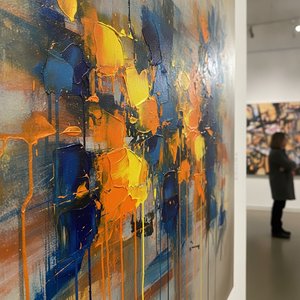
Beyond the Lines: Mastering the High-Impact World of Contemporary Abstraction
Master the high-impact world of contemporary abstraction. Discover how bold colors, textures, and modern movements like Abstract Expressionism can transform your space with premium, high-energy art curated for the design-conscious professional.

Kandinsky's Masterpieces: 25 Paintings That Define Abstract Art | OriginalUniqueArt
Journey through Wassily Kandinsky's 25 most iconic abstract paintings. Explore his revolutionary use of color, form & spiritual expressionism. Find museum-quality Kandinsky reproductions and elevate your home decor with OriginalUniqueArt.com. Discover all masterpieces on OriginalUniqueArt.com!


![Untitled [Man Carrying Dog on Object]](/media/artworks/images-thumb/4f/59/4f59e841a39991547f30e490eefe642c.jpg)
![Untitled [Black Elephant with a Brown Ear]](/media/artworks/images-thumb/bf/08/bf081cd66003ec06e2b3ea3c6cad0075.jpg)
![Untitled [Man and Woman]](/media/artworks/images-thumb/e6/86/e686a7a8ae6c5b95fc6d44752bb803de.jpg)
![Untitled [Cat]](/media/artworks/images-thumb/4d/d8/4dd8667a0edf9782c2cf4fa1988c471b.jpg)
![Untitled [Man with Pipe]](/media/artworks/images-thumb/94/60/9460fe73af6f1d4f4e63e12e622dc704.jpg)

![Untitled [Hen]](/media/artworks/images-thumb/a9/4d/a94d3481a3e2513e9b999a46989db3d1.jpg)
![Untitled [Blue and Brown Buildings]](/media/artworks/images-thumb/d2/fc/d2fc501a93375b76a15152ede5e0aec2.jpg)

![Untitled [Figure on Construction with Legs]](/media/artworks/images-thumb/0a/f9/0af94e805a446e8f244341a0dd906bed.jpg)
![Untitled [Woman Walking with Handbag]](/media/artworks/images-thumb/67/64/67643af0ba1a39876146e8b409b65eeb.jpg)
![Untitled [Smoking Man with Figure Construction]](/media/artworks/images-thumb/e8/b2/e8b267a3c2189f76a92d6690a4a74975.jpg)
![Untitled [Exciting Event with Animals]](/media/artworks/images-thumb/d0/c4/d0c4e3588497ed2a53d0e9df157da442.jpg)
![Untitled [Horse]](/media/artworks/images-thumb/9f/47/9f47d6355a42d62074e2be070fbd30bd.jpg)