Preview
 Send
Send Share
Share
 Details
 Guide
Guide

 Download
 Similars
 X-Ray
X-Ray Diaporama
 Q&A
Q&A Stats
StatsVirgil


 Read More
The artwork displayed on this page is protected by copyright law, which means we cannot legally create or sell an identical reproduction. This protection is enforced under international agreements such as the Berne Convention and by national laws, including those outlined by the U.S. Copyright Law - Title 17.
This method fully complies with copyright regulations because it does not involve copying or duplicating the protected artwork. Instead, it is a creative reinterpretation - a new painting that is influenced by the original but not identical to it.
Giclée / Art Print
Museum-quality giclée or canvas print with fast production and flexible finish options. ( Buy Hand Made Painting Switch to Digital Image)




P118B $10

P118H $10

P118W $10

P438Z $10

P508JH $12

P508YH $12

P805H $10

P805Z $10

P919BZ $10

P919G $10

P919XJ $10

P959ZH $10

P968JZ $12

W106C $8

W218G $10

W218JH $8

W218Y $10

W307PJ $10

W316G $10

W316PJ $8

W316Y $10

W398PJ $8

W4111J $10

W500HY $15

W500JH $15

W692G $12

W849H $8

W940BG $15

W953PJ $8




Pick from our preset sizes that match the artwork's original proportions.

Type the width and the height you need, to fit your frame or your wall. A print can only be cut, never made bigger than the picture, so a size with a different shape loses a part of the image. We send you a digital mockup to approve before we print anything. The picture shown on this page does not show the real cut — only the mockup does.
Worldwide Delivery () in 2 weeks instead of standard 4/5 weeks. (3 November)

Free Worldwide Express Shipping

High-Quality Linen Canvas

Full Shipping Insurance

Customs Tax Refund Guarantee

True Color Matching Guarantee

100-Day Return Policy (Defects Only)

100% Money-Back Guarantee

Bulk Discount Offer
 Glass option is only available in size under 110 CM

Virgil
Giclée / Art Print
Reproduction Size
-


Total Price
$ 81
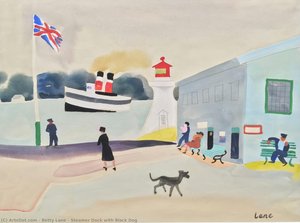
A Quiet Moment Captured in Watercolor: Betty Lane’s “Virgil”
Betty Lane's watercolor painting, "Virgil," embodies the spirit of Impressionism—a movement that sought to capture fleeting impressions of light and color rather than striving for photographic accuracy. Created sometime between 1930 and 1940, this unassuming landscape depicts two figures traversing a rural path, offering a glimpse into a serene tableau of everyday life. The artist’s masterful use of watercolor lends itself beautifully to conveying the subtle nuances of atmosphere and emotion.- Subject Matter: The painting centers around a man and woman walking along a dirt road, bathed in diffused sunlight. Their presence anchors the scene within a recognizable domestic setting—a rural landscape populated by rolling hills and scattered trees.
- Style & Technique: Lane’s approach aligns perfectly with Impressionistic principles. Loose brushstrokes dominate the composition, prioritizing tonal variation over meticulous detail. Notice how the artist skillfully blends hues to create an illusion of depth and luminosity—particularly evident in the depiction of the sky and vegetation.
- Historical Context: “Virgil” emerged during a period of significant artistic experimentation following World War I. Impressionism, championed by artists like Monet and Renoir, reacted against academic conventions, prioritizing subjective experience and capturing the immediacy of sensory perception. Lane’s work reflects this broader trend toward embracing emotion and atmosphere.
- Color Palette: The artist utilizes a restrained color palette, favoring earthy tones to evoke the tranquility of the countryside. The dominant hues are muted yellows and greens, reflecting the sunlight filtering through the trees and grasses.
- Brushwork & Texture: Lane’s brushstrokes are loose and expressive, capturing the movement of light and air. This technique creates a palpable sense of texture—particularly noticeable in the depiction of the hillside vegetation—enhancing the painting's visual richness.
Questions & Answers
Does "Virgil" by Betty Lane use strong contrasts or soft harmonies?
The color analysis of "Virgil" by Betty Lane records a gentle contrast and a strong color unity harmony.
Which artist is "Virgil" attributed to?
"Virgil" was created by Betty Lane. The information on this page describes Betty Lane's original work.
Where can I see the original "Virgil" by Betty Lane?
You can see the original "Virgil" at the niagara-historical-society-museum, Niagara-on-the-Lake, Canada.
Artist Biography
A Life Painted in Light and Shadow
Betty Lane, born Elizabeth Thoburn Lane in Washington D.C. in 1907, was an American artist whose evocative watercolors and oils quietly charted a course through the shifting currents of modernist art. Her life, spanning nearly a century, was one of constant exploration – not just of artistic technique but also of place and perspective. The daughter of a Marine officer and raised amidst a large family, Lane’s early exposure to diverse locales—her father's postings included the Philippines and Santo Domingo—likely instilled in her a lifelong wanderlust and an observant eye for detail. Even as a child, around the age of nine, she demonstrated a natural aptitude for painting, finding solace and expression in watercolor. Though initially enrolled at the Corcoran College of Art and Design, Lane soon realized it didn’t nurture her burgeoning talent; a transfer to the Massachusetts Normal Art School proved pivotal, offering an environment more attuned to her artistic needs. This early search for the right creative space would become a defining characteristic of her career.Parisian Transformations and Early Recognition
The year 1928 marked a turning point with Lane’s journey to Paris. Immersing herself in the vibrant art scene, she studied under the influential Cubist painter André Lhote. This mentorship profoundly impacted her artistic development, instilling a rigorous understanding of form and composition that would underpin her modernist style. Lhote's influence wasn’t about mimicry but rather a foundational training in seeing the world anew – breaking down shapes, exploring spatial relationships, and embracing abstraction as a means to convey deeper truths. Returning to the United States in 1929, Lane settled in Falls Church, Virginia, and Washington D.C., where her work quickly gained attention. A significant milestone arrived in April 1931 with an exhibition at the Phillips Memorial Gallery alongside established artists John Marin and Harold Weston – a testament to Duncan Phillips’s discerning eye and early belief in Lane's potential. This recognition provided crucial encouragement as she navigated the complexities of establishing herself as a professional artist.A Transatlantic Dialogue: Years Abroad and Artistic Refinement
The subsequent decade saw Lane embracing a nomadic existence, dividing her time between Cambridge, England, and Paris. These years were characterized by intense artistic exploration and a broadening of horizons. She wasn’t merely *depicting* landscapes; she was absorbing the atmosphere, light, and cultural nuances of each location. From the bustling streets of European cities to the serene countryside, Lane's canvases began to reflect her experiences – capturing not just what she saw but how it *felt*. This period also witnessed a diversification of her subject matter, encompassing portraits, domestic scenes, and increasingly abstract compositions. The influence of these travels is palpable in her evolving style, marked by expressive brushwork and a growing confidence in her use of color. Following the outbreak of World War II, Lane relocated to Ontario, Canada from 1939-1946, continuing to paint and refine her artistic voice amidst global upheaval.Expanding Horizons: Teaching, Experimentation, and Lasting Legacy
In 1946, Lane returned to the United States and embarked on a new chapter as a teacher at Miss Porter's School, where she remained for nearly two decades until 1965. This period wasn’t merely a professional obligation; it was an opportunity to share her passion for art and inspire a new generation of artists. Simultaneously, Lane continued to push the boundaries of her own creative practice, experimenting with woodblock printing, silkscreen, ceramics, and glass – demonstrating a remarkable versatility and willingness to embrace new mediums. After 1960, she settled in Brewster, Massachusetts, but her spirit of exploration remained undimmed. Extensive travels took her to Greece, Mexico, the Soviet Union, and Australia, each journey enriching her artistic vocabulary. Her commitment extended beyond the canvas; in 1977, she became an associate of the Women's Institute for Freedom of the Press (WIFP), demonstrating a dedication to social causes. Betty Lane passed away in Brewster in 1996, leaving behind a rich and varied body of work that is now gaining increasing recognition. Her paintings are held in prestigious institutions including The Metropolitan Museum of Art, The Phillips Collection, The Provincetown Art Association and Museum, and The Cape Cod Museum of Art. Lane’s legacy lies not just in the beauty of her paintings but also in her unwavering commitment to artistic exploration, her ability to synthesize diverse influences into a unique personal vision, and her quiet determination to forge her own path in a rapidly changing world. Her work serves as a reminder that true artistry is born from both skill and a deeply felt connection to life itself.Artistic Style and Significance
Lane’s artistic style is characterized by a compelling blend of modernist techniques, expressive brushwork, and an acute sensitivity to detail. She moved fluidly between representational and abstract forms, often imbuing her paintings with a palpable sense of atmosphere and emotional depth. Her landscapes are particularly noteworthy for their evocative use of color and light, capturing the essence of a place rather than merely its appearance. Her portraits, too, possess a remarkable psychological insight, revealing not just physical likeness but also the inner lives of her subjects. Lane’s contribution to American art resides in her ability to synthesize diverse influences – from Cubism to Impressionism and beyond – into a cohesive and deeply personal vision. While she may not have achieved widespread fame during her lifetime, her work is now being recognized for its artistic merit and historical significance as an example of a woman artist navigating the complexities of the 20th century art world with grace, intelligence, and unwavering dedication to her craft.
Betty Lane
1907 - 1996 , United States of America
Quick Facts
- Full Name: Betty Lane
- Nationality: American
- Date Of Birth: 1907
- Date Of Death: 1996
- Place Of Birth: Washington, United States of America
- Notable Artworks:
- Men in Truck
- Sketch of House...
- Boathouses & Lighthouse
- Artistic Movement Or Style: Modernist painting
- Artists Who Influenced This Artist: ['André Lhote']
Related Articles

Mastering the English Landscape: The Top 25 John Constable Artworks
Experience the soul of English landscapes through John Constable's top 25 works. Explore the full collection online at OriginalUniqueArt.com.

Watercolor Wonders: 10 Masterpieces That Redefined Art History | OriginalUniqueArt
Journey through 10 legendary watercolor masterpieces by Sargent, Turner & Homer! Explore iconic landscapes, portraits & floral art that redefined history. Find museum-quality reproductions and curated decor ideas at OriginalUniqueArt.com.

Idyllic Visions: Exploring the Pastoral Scene in Art History – From Arcadia to Modern Interpretations
Explore the captivating history of pastoral art from classical Arcadia to modern masterpieces. Discover key artists like Millet & Cole at OriginalUniqueArt. Find serene landscape paintings for your home.
Evoking Arcadia: A Historical & Aesthetic Exploration of Rural Landscape Art
Explore the rich history of pastoral landscape art, from classical Arcadia to Impressionism & beyond. Discover key artists, movements, and how to collect serene rural scenes for your home. Expert insights at OriginalUniqueArt.

Ephemeral Visions: Exploring the Artistic Legacy & Contemporary Practice of Watercolor Painting
Explore the captivating world of watercolor painting! Discover its rich history, essential techniques, influential artists & collecting tips. A comprehensive guide for art enthusiasts from OriginalUniqueArt.