Preview
 Send
Send Share
Share
 Details
 Guide
Guide

 Download
 Similars
 X-Ray
X-Ray Diaporama
 Q&A
Q&A Stats
StatsDaffodils


 Read More
Giclée / Art Print
Museum-quality giclée or canvas print with fast production and flexible finish options. ( Buy Hand Made Painting Switch to Digital Image)




P118B $10

P118H $10

P118W $10

P438Z $10

P508JH $12

P508YH $12

P805H $10

P805Z $10

P919BZ $10

P919G $10

P919XJ $10

P959ZH $10

P968JZ $12

W106C $8

W218G $10

W218JH $8

W218Y $10

W307PJ $10

W316G $10

W316PJ $8

W316Y $10

W398PJ $8

W4111J $10

W500HY $15

W500JH $15

W692G $12

W849H $8

W940BG $15

W953PJ $8




Pick from our preset sizes that match the artwork's original proportions.

Type the width and the height you need, to fit your frame or your wall. A print can only be cut, never made bigger than the picture, so a size with a different shape loses a part of the image. We send you a digital mockup to approve before we print anything. The picture shown on this page does not show the real cut — only the mockup does.
Worldwide Delivery () in 2 weeks instead of standard 4/5 weeks. (11 November)

Free Worldwide Express Shipping

High-Quality Linen Canvas

Full Shipping Insurance

Customs Tax Refund Guarantee

True Color Matching Guarantee

100-Day Return Policy (Defects Only)

100% Money-Back Guarantee

Bulk Discount Offer
 Glass option is only available in size under 110 CM

Daffodils
Giclée / Art Print
Reproduction Size
-


Total Price
$ 81
The Ephemeral Glow of Spring: An Encounter with Morisot's Daffodils
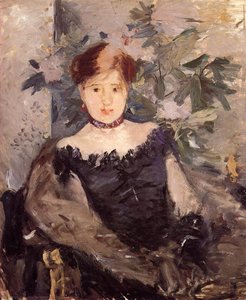
To stand before Berthe Morisot’s Daffodils is not merely to observe a still life; it is to step directly into a sun-drenched, breathlessly beautiful moment captured by the brush. Painted in 1885, this work radiates the delicate spirit of Impressionism, inviting the viewer into an intimate contemplation of nature’s cyclical promise. The composition centers on a simple arrangement: vibrant yellow daffodils gathered within a vase accented with cool blue hues, resting upon a humble table surface. Morisot has managed to elevate the ordinary—a cluster of spring blooms—into something luminous and profoundly emotional.
Mastery in Light and Brushstroke
Morisot’s technical brilliance is immediately apparent. Her handling of oil on canvas eschews hard lines for a breathtaking softness, giving the entire scene a dreamy, almost palpable atmosphere. Observe how she has rendered the daffodils themselves; they are not static objects but embodiments of movement. Some blossoms burst forth in full yellow glory, while others retain the tender green promise of unfolding life. This variety creates a wonderful sense of immediacy, as if the artist captured the very breath between one bloom opening and another swaying gently in a passing breeze. Her signature delicate brushwork is key here; it allows the light to play across the petals and the white porcelain of the vase with an almost ethereal quality.
Impressionism and the Modern Moment
This painting serves as a perfect encapsulation of the Impressionist ethos. The movement sought to capture modernity—the fleeting glance, the momentary effect of sunlight on water or flower—rather than adhering to historical grandeur. For Morisot, this meant finding profound beauty in domesticity and the everyday rhythms of life. By focusing on these simple floral elements, she challenged the established art conventions, asserting that the quiet poetry found in a garden corner was worthy subject matter for high art. It is a testament to her vision that such an intimate scene carries such monumental artistic weight.
Symbolism of Renewal and Feminine Grace
Beyond its technical merits, Daffodils resonates with deep symbolism. Daffodils have long been emblems of rebirth and the arrival of spring after winter’s dormancy. In Morisot's hands, this natural cycle takes on a layer of personal resonance, often associated with the gentle yet persistent spirit. The combination of bright yellow—symbolizing joy and vitality—against the cool blue accents speaks to a harmonious balance between exuberant life and serene contemplation. For collectors and designers alike, owning this piece brings not just decoration, but a feeling of enduring optimism into any space.
Bringing the Light Home
Whether adorning a formal drawing-room or lending an airy touch to a sunlit breakfast nook, a reproduction of Daffodils acts as a window to another time and mood. It is an artwork that whispers rather than shouts; it invites close looking, rewarding the viewer with new details every time they pause before it. To own this piece is to curate not just art, but a feeling—the exquisite, fleeting joy of a perfect spring morning.
Questions & Answers
Is "Daffodils" by Berthe Morisot a bright or a dark artwork?
Overall, "Daffodils" is recorded as bright. Perceived brightness describes how light or dark the work appears.
How saturated is the palette of "Daffodils"?
"Daffodils" by Berthe Morisot is recorded with a subtle color saturation.
What color leads the composition of "Daffodils" by Berthe Morisot?
The color that stands out most in "Daffodils" is gray (#7f745f). The dominant color is useful when matching an artwork to an interior.
Artist Biography
Early Life, Family and Artistic Training
Berthe Morisot was born on 14 January 1841 in Bourges, France. She grew up in an affluent bourgeois family where the lines between domestic life and art were often blurred. Her father, Edmé Tiburce Morisot, held the position of prefect of the department of Cher. Her mother, Marie-Joseph-Cornélie Thomas, brought a connection to the Rococo tradition as the great-niece of Jean-Honoré Fragonard. This lineage provided a backdrop of artistic familiarity from her earliest years.
Her training began with private lessons from Geoffroy-Alphonse Chocarne and Joseph Guichard. By 1858, she was spending her time in the Louvre, learning the mechanics of paint by copying the Old Masters. This period of study was supplemented by the guidance of Jean-Baptiste-Camille Corot and Achille-Francois Oudinot. During the winter of 1863–64, she also turned her attention to the physical form through the study of sculpture under Aimé Millet.
The Impressionist Movement and Exhibitions
In 1864, Morisot showed her work for the first time at the Paris Salon. This was a significant step, as the Salon was the official gatekeeper of the art world. She did not remain confined to these traditional spaces. Instead, she became a member of the circle of painters in Paris who would eventually be known as the Impressionists. Her presence in this group was constant. Between 1874 and 1886, she participated in all but one of the eight Impressionist exhibitions held during those years.
The first of these gatherings took place in the studio of the photographer Nadar. It opened on 15 April and ran until 15 May 1874. This exhibition was a departure from the established norms of the time. Morisot was there alongside the others, helping to define a new way of seeing. She continued to exhibit with the group, bringing her specific perspective to the various shows held throughout the following decade.
Personal Life and the Manet Connection
The boundaries between Morisot’s private life and her art were often blurred. She grew up in a household with two older sisters, Yves and Edma, and a younger brother, Tiburce. In 1868, she became acquainted with Édouard Manet, a connection that grew into a deep mutual influence. He painted her many times, capturing her in various states of dress and mood, while she found her own way through the shifting light of Paris. Their relationship was one of intellectual exchange and shared artistic purpose.
In 1874, Morisot married Eugène Manet, the brother of Édouard. This union further embedded her within the circle of artists who were redefining modern painting. A daughter, Julie Manet, was born in Paris in 1878. Julie would grow up in a home where the boundaries between domestic life and the radical debates of the avant-garde were thin, often serving as a presence in the very rooms where art was created and discussed.
Technique and Artistic Style
Morisot’s approach to the canvas relies on a lightness of touch. She often worked outdoors, using the plein air method to catch the shifting qualities of light and atmosphere directly from nature. This habit of working in the open air allowed her to translate the transient nuances of color through loose, confident strokes. Her brushwork is fluid, moving across the surface with a sense of immediacy that avoids heavy, labored layers. She did not rely solely on oil; her practice included working in watercolours and pastel to explore different textures and light effects.
There is a specific way she handles the edges of her subjects. Instead of hard, defined outlines, she uses broken color and small strokes of pigment to build form. This technique creates a shimmering effect, making the air between objects feel as tangible as the objects themselves. In her depictions of domestic life, this method captures the soft glow on skin or the way light filters through a garden. The result is a sense of spontaneity, as if the scene were being recorded in a single, unhurried moment of observation.
Key Works and Iconic Paintings
In 1872, Morisot painted The Cradle, an oil on canvas that captures her sister Edma watching over her sleeping daughter, Blanche. The composition uses a diagonal line formed by the mother's gaze and the fabric of the crib to draw the eye toward the infant. This work marks the first time she explored the theme of motherhood, using a reduced number of colors and a fluid brushstroke to create an atmosphere of quiet, protective love.
Her presence appears frequently in the works of others, most notably in 1872 when Édouard Manet painted Berthe Morisot with a Bouquet of Violets. In this portrait, she is dressed in black mourning attire, with a barely visible bouquet of violets near her neckline. The light hits her from one side, leaving the other half of her face in deep shadow. This study in black tones highlights the contrast between her dark clothing and the lighter background.
Other significant pieces include:
- The Rest, portrait of Berthe Morisot, 1870
- The Hydrangea, 1894
Later in her career, she produced The Hydrangea in 1894. Her ability to translate the nuances of light and color through loose, confident strokes remained a constant throughout her years of painting.
Where to See Her Works Today
To see her brushwork in person, one might start in Paris. The Musée d'Orsay holds six of her paintings, including The Cradle. This work, which she painted in 1872, shows her sister Edma watching over a sleeping child. The Musée Marmottan Monet also keeps five of her works within its collection.
Beyond France, her presence is felt in Washington, D.C. The National Gallery of Art holds six of her paintings. In this collection, you can find Mother and Sister of the Artist, which she painted in 1869. Other pieces held in Washington include In the Dining Room and Hanging the Laundry out to Dry, both from 1875.
A few of her other works reside in different locations, such as the Thyssen-Bornemisza Museum in Madrid and the Nationalmuseum in Stockholm. These pieces allow for a quiet look at how she handled light and domestic scenes across different settings.
- Psyche
- The Hydrangea

Berthe Morisot
1841 - 1895 , France
Quick Facts
- Artistic Movement Or Style: Impressionism
- Artists Or Movements Influenced By This Artist: ['Future generations of female artists']
- Artists Who Influenced This Artist:
- Jean-Honoré Fragonard
- Jean-Baptiste-Camille Corot
- Full Name: Berthe Marie Pauline Morisot
- Nationality: French
- Notable Artworks:
- The Cradle
- Woman in the Green Dress
- Summer's Day
- Place Of Birth: Bourges, France
- Date Of Birth: 1841
- Date Of Death: 1895
Related Articles

The Enduring Legacy of Oil on Canvas: Technique, History & Aesthetic Impact
Explore the rich history & techniques of oil painting – from Renaissance masters to Impressionism. Discover pigments, layering methods, and why this timeless medium endures. Expert insights for artists & art enthusiasts.
Golden Hues: Top 10 Paintings Dominated by Yellow Ochre |
Explore 10 iconic paintings bathed in golden yellow ochre! From Van Gogh's sunflowers to Monet’s haystacks, discover the stories behind these masterpieces. Find museum-quality art reproductions & elevate your home decor on .
Blossoming Symbolism: A Historical Journey Through Flowers in Western Painting
Explore the rich history of flower symbolism in Western painting! Discover how artists from the Renaissance to Modernism used blossoms to convey meaning, emotion & beauty. Learn about iconic artworks and movements.

Oil on Canvas: A Historical & Technical Exploration of a Timeless Artistic Medium
Explore the rich history & enduring techniques of oil painting on canvas. Discover the science behind its longevity, conservation practices, and contemporary relevance. Expert insights for art enthusiasts.

The Soul of Impressionism: Why Oil on Canvas Captures Eternal Light and Timeless Emotion
Discover the enchanting alchemy of Impressionism. Explore how the mastery of oil on canvas, through glazing and impasto, captures eternal light and emotion. Perfect for lovers of Monet and Van Gogh seeking the profound depth of hand-painted fine art.