Baroque · 1640
Berenice (Bernardo Strozzi, 1640)
Bernardo Strozzi (1581–1644) made Berenice. It dates from 1640. It belongs to the Baroque movement. It is made in oil on canvas.
- 1640
- Oil On Canvas

 Preview

 Hand Made Oil Painting
 Send
 Share
 Guide


 Download
 Similars
 X-Ray
 Diaporama
 Q&A

 Stats
Berenice: the essentials
- Title
- Berenice
- Artist
- Bernardo Strozzi (1581–1644)
- Artist born in
- Campo Ligure, Italy
- Date
- 1640
- Medium
- Oil On Canvas
- Movement
- Baroque
- Period
- Early Modern
- Subject
- baroque portraiture, noblewoman figure, classical armor, dramatic lighting, 17th century style, female warrior
What does Berenice depict?
A Moment of Revelation
A young woman gazes upward, her expression caught between sudden surprise and deep contemplation. She is draped in ornate armor and fine jewelry, suggesting the status of a noblewoman or a warrior. The composition is vertical, focusing on the upper body against a dark, undefined background that pushes her figure toward the viewer. Light descends from above and slightly to the left, carving her features out of the shadows through a heavy use of chiaroscuro. This dramatic lighting emphasizes the texture of her skin and the metallic sheen of her attire.
Technical Execution and Composition
The work is an oil on canvas, characterized by the energetic, painterly brushstrokes typical of the Venetian Baroque style. The artist employs a thick, impasto-like application of paint, particularly where light strikes the highlights of the subject's face and clothing. The visual language relies on a tension between organic and geometric forms:
- The flowing, soft curves of the hair and drapery.
- The rigid, structured lines of the ornamental armor.
- The deep, shadowed recesses of the background.
- The sharp, bright highlights on the sword hilt and jewelry.
The shallow perspective limits the sense of depth, forcing an intimate encounter with the subject. This technique directs all attention to the psychological state of the figure, making her internal reaction the central focus of the piece.
Historical Context
Created in 1640, this portrait reflects the stylistic shifts occurring in Italy during the mid-seventeenth century. The subject, Queen Berenice, is rendered with a realism that moves away from Mannerist artifice toward a more naturalistic, emotive portrayal. The painting's presence in the El Paso Museum of Art highlights its enduring physical presence. The use of a reddish-brown ground beneath the lighter pigments provides a warm, glowing foundation for the skin tones, a method used to achieve a sense of depth and luminosity without relying on atmospheric perspective.
Berenice in high resolution
Bernardo Strozzi, Berenice (1640). Public domain.
A digital expert checks the colors against the original painting and retouches the file, faithful to the artist's brushwork.
Buy the high-resolution imageQuestions about Berenice
Where in the home does a reproduction of "Berenice" fit well?
"Berenice" by Bernardo Strozzi is recommended for a restaurant (fine dining). This suggestion is based on the work's subject, colors and mood.
Are there works similar to "Berenice"?
Artworks similar to "Berenice" by Bernardo Strozzi are gathered on the artwork's Similars page.
In what period was "Berenice" by Bernardo Strozzi made?
"Berenice" belongs to the Early-Modern era.
What saturation and intensity does "Berenice" by Bernardo Strozzi show?
"Berenice" by Bernardo Strozzi is recorded with a muted saturation and a monochromatic intensity.
Is "Berenice" by Bernardo Strozzi a light or a dark artwork?
The recorded values for "Berenice" by Bernardo Strozzi are: deep_shadow brightness, soft shadow luminance.
What style does "Berenice" belong to?
The movement associated with "Berenice" by Bernardo Strozzi is Baroque. This classification situates the work among related artists and artworks.
What emotion does "Berenice" by Bernardo Strozzi convey?
"Berenice" is associated with a dramatic feeling. The emotional tone describes the impression the work gives.
What mood and emotion does "Berenice" by Bernardo Strozzi express?
"Berenice" by Bernardo Strozzi conveys a dramatic feeling within an overall dramatic mood.
When and with what materials was "Berenice" made?
"Berenice" was made in 1640, in oil on canvas.
About the artist, Bernardo Strozzi

1581–1644, Italy
Bernardo Strozzi
early life and training bernardo strozzi, also known as il cappuccino and il prete genovese, was a prominent italian baroque painter and engraver born in 1581 in genoa, italy. his early training took place in the workshop of cesare corte, a minor genoese painter, under whose guidance strozzi developed his skills until 1596. he then joined the workshop of pietro sorri, an innovative sienese painter, who led strozzi towards a more naturalistic style. artistic career strozzi's career can be divided into two main periods: his early years in genoa and his later work in venice.
Also by Bernardo Strozzi
 Sleeping Child
 Banquet at the House of Simon (detail)1630
 David with the Head of Goliath1635
 Allegory of Arts1640
Essays around Berenice
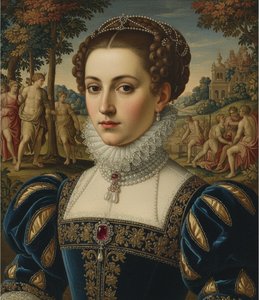 Agnolo Bronzino: Mastering Courtly Portraiture & the Enigmatic Gaze of Renaissance FlorenceExplore the captivating world of Agnolo Bronzino, Renaissance master portraitist. Discover his elegant style, symbolic depth & lasting infl…
 Italian Mannerist paintersItalian Mannerist painters like Bronzino, Pontormo, and Parmigianino defined an era of elegance. Shop museum-quality reproductions on Origi…
 16th century Italian paintersMasterpieces by Titian, Michelangelo, and Raphael define the Italian Renaissance. Explore the full collection online at OriginalUniqueArt.c…