Preview
 Send
Send Share
Share
 Details

 Download
 Similars
 X-Ray
X-Ray Diaporama
 Stats
StatsExhibition Sign
 Acrylic On Canvas
- WallArt
- Synthetic Cubism
 1933
1933 50.0 x 41.0 cm
 Kettle's Yard
 Read More
Giclée / Art Print
Museum-quality giclée or canvas print with fast production and flexible finish options. ( Buy Hand Made Painting Switch to Digital Image)




P118B $10

P118H $10

P118W $10

P438Z $10

P508JH $12

P508YH $12

P805H $10

P805Z $10

P919BZ $10

P919G $10

P919XJ $10

P959ZH $10

P968JZ $12

W106C $8

W218G $10

W218JH $8

W218Y $10

W307PJ $10

W316G $10

W316PJ $8

W316Y $10

W398PJ $8

W4111J $10

W500HY $15

W500JH $15

W692G $12

W849H $8

W940BG $15

W953PJ $8




Pick from our preset sizes that match the artwork's original proportions.

You may enter your own dimensions to fit a specific frame or space. If your selected size does not match the original image's proportions, we will either crop the artwork or extend the image with a mirrored or solid-fill edge. A digital mockup will be sent for your approval before production begins.
Please note that the on-screen preview does not reflect the actual cropping or extension. Only the mockup will accurately show the final composition.
While custom sizes are available, we recommend selecting a dimension from the predefined list to preserve the original proportions.
Worldwide Delivery () in 2 weeks instead of standard 4/5 weeks. (17 September)

Free Worldwide Express Shipping

High-Quality Linen Canvas

Full Shipping Insurance

Customs Tax Refund Guarantee

True Color Matching Guarantee

100-Day Return Policy (Defects Only)

100% Money-Back Guarantee

Bulk Discount Offer
 Glass option is only available in size under 110 CM

Exhibition Sign
Giclée / Art Print
Reproduction Size
-


Total Price
$ 81
The Quiet Geometry of “Exhibition Sign”
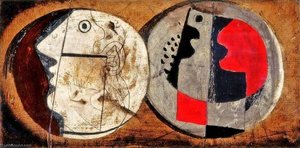
Ben Nicholson’s “Exhibition Sign,” painted in 1933, isn't merely a sign; it’s a distilled meditation on form, color, and the very act of looking. Created during a pivotal moment in British art – a period grappling with the legacy of Cubism while simultaneously seeking new avenues for abstraction – this work embodies Nicholson’s unique approach: a careful balance between geometric precision and an underlying sense of organic feeling. The painting captures a specific, almost clinical, view of a signage panel, transforming a mundane object into a compelling study in visual relationships. It's a testament to Nicholson’s belief that beauty could be found not just in grand narratives or natural landscapes, but within the simplest, most everyday elements of the world around us.A Symphony of Color and Shape
At first glance, “Exhibition Sign” appears remarkably restrained. Four rectangles – red, blue, yellow, and black – are arranged in a square formation against a subtly textured gray background. However, this simplicity is deceptive. Each rectangle isn’t merely a block of color; it's imbued with a palpable sense of weight and presence. Nicholson masterfully employs color not as decoration but as a fundamental building block, each hue carefully considered for its interaction with the others. The red, bold and assertive, commands attention while the blue offers a cool counterpoint. Yellow introduces warmth, and black grounds the composition, providing a necessary anchor. The thin black lines delineating each rectangle aren’t merely borders; they are active participants in the painting's structure, defining edges and creating a sense of contained space. The deliberate flatness of the forms – achieved through careful layering of paint – further emphasizes their geometric nature, recalling the principles of Constructivism while retaining Nicholson’s distinctly personal style.Contextualizing the Sign
To fully appreciate “Exhibition Sign,” it's crucial to understand its historical context. Created in 1933, the painting emerged from a vibrant and rapidly evolving art scene in Britain. The aftermath of World War I had profoundly impacted artistic sensibilities, leading to a rejection of traditional representational styles and an exploration of new modes of expression. Nicholson, along with other artists like Paul Nash and Christopher Wood, was deeply engaged with these developments, experimenting with abstraction, geometric forms, and the influence of European movements such as Cubism and Constructivism. The painting’s subject – a signage panel – reflects this broader interest in everyday objects and their potential for artistic transformation. It's a deliberate move away from grand historical or mythological themes, aligning with a growing desire to find meaning and beauty in the ordinary.Symbolic Resonance and Emotional Impact
Beyond its formal qualities, “Exhibition Sign” carries a subtle symbolic weight. The sign itself represents communication, information, and access – yet Nicholson strips it down to its essential components, removing any extraneous details. This reductionist approach invites viewers to contemplate the fundamental nature of representation and the relationship between form and meaning. The painting’s quiet intensity evokes a sense of contemplation and stillness. It's not an emotionally charged work in the traditional sense; rather, it offers a meditative experience through its carefully considered composition and harmonious color palette. The restrained use of color and shape creates a feeling of calm and order, inviting the viewer to slow down and appreciate the beauty of simplicity. The painting’s enduring appeal lies in its ability to resonate with our own desire for clarity and balance in an increasingly complex world.A Reproduction Worth Considering
Reproductions of “Exhibition Sign” capture much of the original's subtle power, offering a beautiful addition to any interior space. The meticulous attention to detail – from the textured background to the precise placement of each rectangle – is faithfully reproduced, ensuring that the painting’s visual impact remains intact. Whether displayed in a modern gallery or a carefully curated home, “Exhibition Sign” serves as a reminder of Nicholson's profound insights into the language of art and his ability to transform the mundane into something truly remarkable.Artist Biography
Ben Nicholson OM: A Life in Abstract Art
- Born: April 10, 1894, Denham, Buckinghamshire, United Kingdom
- Died: February 6, 1982, London, United Kingdom
Early Life and Artistic Training
- Ben Nicholson was born into an artistic family; his father, Sir William Nicholson, and mother, Mabel Pryde, were both accomplished painters. This environment fostered a deep appreciation for art from a young age.
- He received early education at Tyttenhangar Lodge Preparatory School, Seaford, Heddon Court, Hampstead, and Gresham's School in Holt, Norfolk.
- Nicholson formally studied at the Slade School of Fine Art (1910-1911), where he was a contemporary of notable artists like Paul Nash, Stanley Spencer, Mark Gertler, and Edward Wadsworth. Anecdotally, he spent considerable time playing billiards during this period, finding aesthetic appeal in the game's geometry and movement.
Artistic Development and Influences
- Early Works: Nicholson’s initial artistic endeavors involved naturalistic still lifes, influenced by his father’s style.
- Cubist Influence: Around 1926, he began to explore abstraction, heavily influenced by Synthetic Cubism and the work of Pablo Picasso.
- Neoplasticism & Primitive Style: A meeting with Piet Mondrian introduced him to Neoplasticism, while his encounter with Henri Rousseau sparked an interest in a primitive style. These influences significantly shaped his artistic direction.
- Key Movements: Nicholson became involved with several important art movements of the time, including the Seven and Five Society (of which he was chair), Unit One, and Abstraction-Création.
Major Works and Artistic Style
- Reliefs: Nicholson is particularly renowned for his abstract reliefs, beginning in 1933. These works combined painting with sculptural elements, creating a unique visual experience. The white reliefs of the mid-1930s are considered among his most significant achievements.
- Still Lifes and Landscapes: While known for abstraction, Nicholson also produced compelling still lifes and landscapes, often incorporating geometric forms and muted colors.
- The Nicholson Wall: A notable public work is the "Nicholson Wall," a mural created for the garden of Sutton Place in Guildford, Surrey, demonstrating his belief that abstract art should be accessible to a wider audience.
- Materials & Techniques: He experimented with various materials and techniques, including oil paint, pencil, gravel, and masonite, often combining them in innovative ways.
Legacy and Historical Significance
- Modern British Art: Ben Nicholson is recognized as a pivotal figure in modern British art, contributing significantly to the development of abstraction and relief sculpture.
- International Recognition: His work garnered international acclaim, with exhibitions at prestigious venues like the Venice Biennale and retrospectives at major museums worldwide. He received numerous awards, including the Order of Merit in 1968.
- Auction Records: Nicholson’s paintings command high prices at auction, reflecting their artistic merit and historical importance. For example, "Sept 53 (Balearic)" sold for $1,650,500 at Christie's New York in 2011, and “Fiddle and Spanish Guitar” fetched €3,313,000 at Christie’s Paris in 2012.
- Influence on Subsequent Artists: Nicholson’s innovative approach to abstraction and his exploration of form and space have influenced generations of artists.

Ben Nicholson OM
1894 - 1982 , United Kingdom
Quick Facts
- Artistic Movement Or Style:
- Abstract art
- Cubism
- Constructivism
- Artists Who Influenced This Artist:
- Henri Rousseau
- Piet Mondrian
- Pablo Picasso
- Cezanne
- Date Of Birth: April 10, 1894
- Date Of Death: 1982
- Full Name: Ben Nicholson OM
- Nationality: British
- Notable Artworks:
- Sept 53 (Balearic)
- Fiddle and Spanish guitar
- 1946 (still life)
- Place Of Birth: London, United Kingdom
Related Articles
Beyond Form & Color: Geometric Abstraction's Enduring Legacy in Art History
Explore the captivating world of geometric abstraction! Discover its origins, key artists like Malevich & Mondrian, and why this movement remains highly valued by art collectors today. Expert insights at OriginalUniqueArt.

Geometric Abstraction's 10 Defining Masterpieces | Art for Your Home - OriginalUniqueArt
Explore 10 defining masterpieces of Geometric Abstraction! Discover Kandinsky, Mondrian & Malevich’s iconic works. Find museum-quality art reproductions and curated decor ideas to elevate your home at OriginalUniqueArt.com.

Neo-Abstract Art: The High-Impact Evolution of Modern Visual Energy and Geometric Sophistication
Discover the power of Neo-Abstract art. Explore how bold geometric forms and high-impact visual energy are redefining modern design. Learn to curate sophisticated, high-energy spaces with the latest trends in contemporary abstraction and structural color.

Ben Nicholson OM: Modernism's Abstract Pioneer & the Poetics of Relief
Explore the revolutionary abstract art of Ben Nicholson OM. Discover his geometric masterpieces, collaborations with Barbara Hepworth & investment potential. Expert insights for collectors.

Beyond Form & Color: Geometric Abstraction's Evolution in 20th/21st Century Art
Explore the evolution of geometric abstraction from Cubism to contemporary art. Discover key artists like Malevich & Mondrian, investment insights, and expert collecting advice at OriginalUniqueArt.