Switch to Print
 Read More







































 For artworks or reproductions larger than 105 cm (approximately 41 inches) on any side, the frame will be shipped as a kit, disassembled. This method ensures safe delivery and prevents damage during transport.


The Genesis of a Void: Contextualizing Nicholson's '1935 (white relief)'
Ben Nicholson’s ‘1935 (white relief)’ isn’t merely a painting; it’s a distilled essence of the anxieties and aspirations simmering within Britain in the mid-1930s. Born into an artistic lineage steeped in tradition – his father, Sir William Nicholson, and mother, Mabel Pryde, were both celebrated painters – Nicholson initially navigated the vibrant currents of early 20th-century art, absorbing influences from Cubism and exploring figurative forms before ultimately embracing a radical shift towards abstraction. The painting emerged during a period of profound social and political upheaval; the Great Depression cast a long shadow over Europe, while the rise of totalitarian regimes fueled fears of cultural stagnation and spiritual emptiness. This context is crucial to understanding Nicholson’s deliberate choice to strip away all representational elements, creating instead a carefully constructed void – a space pregnant with suggestion and imbued with an almost unsettling purity.
The work was conceived in 1935, a year marked by intense debate within the British art world regarding the direction of modernism. Critics like Gordon Porteus, writing for *New English Weekly*, grappled with the perceived ‘abyss of the absolute’ Nicholson seemed to be charting, contrasting it with the more emotionally charged and spiritually rooted approaches of artists like Stanley Spencer. Nicholson's approach aligned with a broader movement seeking to establish a new visual language – one that prioritized form, structure, and geometric relationships over narrative or subjective experience. The painting reflects this desire for clarity and order, mirroring the architectural principles championed by figures like Erich Mendelsohn and Berthold Lubetkin, who were actively shaping the modernist landscape of Britain at the time.
Deconstructing Form: A Study in Circles and Space
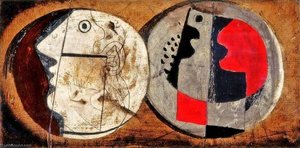
At first glance, ‘1935 (white relief)’ appears deceptively simple. Four circles, varying subtly in size and placement, are arranged within a square frame on a pristine white background. However, this apparent simplicity belies a complex interplay of visual elements. Nicholson’s technique is characterized by a meticulous attention to detail – each circle is rendered with precise lines, creating a sense of tactile presence despite its two-dimensional nature. The circles aren't merely painted; they are subtly carved into the board, adding another layer of dimensionality and emphasizing their physical form. The arrangement itself is deliberately asymmetrical, preventing any sense of static equilibrium. This deliberate imbalance creates a dynamic tension within the composition, drawing the eye across the canvas and inviting contemplation.
Crucially, Nicholson avoids any illusionistic depth. The circles don’t recede into space; instead, they occupy a flat plane, confronting the viewer directly. This flattening of perspective is a hallmark of his style, reflecting a desire to break free from traditional representational conventions and explore the inherent qualities of form itself. The white background serves not as a mere backdrop but as an active participant in the composition, amplifying the impact of the circles and creating a sense of luminous clarity.
Symbolism and Emotional Resonance: A Space for Contemplation
While Nicholson resisted overt symbolism, ‘1935 (white relief)’ undoubtedly evokes a profound emotional response. The stark white background can be interpreted as representing purity, innocence, or even the emptiness of modern life – a void waiting to be filled with meaning. The circles themselves have been suggested to symbolize wholeness, unity, or perhaps the cyclical nature of time and existence. However, Nicholson deliberately avoids providing definitive answers, leaving it up to the viewer to project their own interpretations onto the work.
The painting’s enduring appeal lies in its ability to stimulate introspection and invite contemplation. It's a testament to the power of minimalism – demonstrating that profound meaning can be achieved through the careful arrangement of simple forms. ‘1935 (white relief)’ is not simply an object; it’s an experience—a quiet invitation to engage with the fundamental questions of art, space, and the human condition.
A Legacy in Reproduction: Bringing Nicholson's Vision Home
Reproductions of ‘1935 (white relief)’ offer a remarkable opportunity to bring this seminal work into your own home or studio. High-quality prints capture the subtle nuances of Nicholson’s technique and the painting’s luminous quality, allowing you to appreciate its beauty and complexity on a personal level. Consider framing options that complement the artwork's minimalist aesthetic – a simple white frame will best highlight the circles and create a sense of visual harmony. This piece is more than just decoration; it’s a conversation starter—a window into the mind of one of Britain’s most influential abstract artists.
Questions & Answers
What technique and style characterize "1935 (white relief)" by Ben Nicholson OM?
In "1935 (white relief)", the acrylic on canvas technique meets the Abstract Constructivism movement.
How is the mood of "1935 (white relief)" by Ben Nicholson OM described?
The overall mood of "1935 (white relief)" by Ben Nicholson OM is calm. The mood describes the general atmosphere of the work.
Does "1935 (white relief)" show strong light-dark contrasts?
"1935 (white relief)" by Ben Nicholson OM shows a serene contrast between its light and dark areas.
More about this painting
 Preview
 Send
Send Share
Share
 Details
 Guide
Guide

 Download
 Similars
 X-Ray
X-Ray Diaporama
 Q&A
Q&A Stats
Stats