Preview
 Send
Send Share
Share
 Details
 Guide
Guide

 Download
 Similars
 X-Ray
X-Ray Diaporama
 Stats
StatsTurning Form


 Read More
The artwork displayed on this page is protected by copyright law, which means we cannot legally create or sell an identical reproduction. This protection is enforced under international agreements such as the Berne Convention and by national laws, including those outlined by the U.S. Copyright Law - Title 17.
As a respectful and legal alternative, we offer custom, hand-painted artworks inspired by the original. Our skilled and professional artists carefully study the original's style, mood, and artistic essence to create a new, unique piece that evokes the same feeling - while remaining an original creation in its own right.
This method fully complies with copyright regulations because it does not involve copying or duplicating the protected artwork. Instead, it is a creative reinterpretation - a new painting that is influenced by the original but not identical to it.
Hand Made Oil Reproduction
Hand-painted oil on canvas in your size and frame, made to order by our artists. ( Switch to Print Switch to Digital Image)




P118B $10

P118H $10

P118W $10

P438Z $10

P508JH $12

P508YH $12

P805H $10

P805Z $10

P919BZ $10

P919G $10

P919XJ $10

P959ZH $10

P968JZ $12

W106C $8

W218G $10

W218JH $8

W218Y $10

W307PJ $10

W316G $10

W316PJ $8

W316Y $10

W398PJ $8

W4111J $10

W500HY $15

W500JH $15

W692G $12

W849H $8

W940BG $15

W953PJ $8




Pick from our preset sizes that match the artwork's original proportions.

Type the width and the height you need, to fit your frame or your wall. This is hand-painted, so for a size with a different shape the artist can paint a bit more around the picture, or cut a bit — you choose. We send you a digital mockup to approve before the painting starts. The picture shown on this page does not show the real result — only the mockup does.
After order, OriginalUniqueArt.com team will email client for instructions and provide a mockup preview
Worldwide Delivery () in 3/4 weeks instead of standard 5 weeks. (22 October). No compromise on quality.

Free Worldwide Express Shipping

High-Quality Linen Canvas

Full Shipping Insurance

Customs Tax Refund Guarantee

True Color Matching Guarantee

100-Day Return Policy (Defects Only)

100% Money-Back Guarantee

Bulk Discount Offer
 Glass option is only available in size under 110 CM

Turning Form
Reproduction Medium
Reproduction Size
-


Total Price
$ 300
Turning Form: An Exploration of Barbara Hepworth’s Sculptural Vision
Barbara Hepworth (1903–1975) stands as an icon of British Modernism, her sculptures embodying a radical departure from traditional representational art and establishing herself as one of the foremost female artists of her era. This essay delves into Hepworth's artistic journey, examining her formative influences, groundbreaking techniques, and enduring legacy—particularly her seminal work, *Turning Form*, created in 1946.Early Influences and Artistic Development
Born in Wakefield, Yorkshire, Hepworth’s early life was marked by a profound connection to the landscape of her childhood – specifically the rugged beauty of the Pennines. This formative experience instilled within her an unwavering fascination with organic forms and textures, shaping her artistic sensibilities from the outset. Studying at Leeds School of Art and subsequently earning a prestigious scholarship to the Royal College of Art in London, Hepworth honed her skills in sculpture alongside fellow artists like Henry Moore, forging a collaborative spirit that would characterize much of their careers. Her embrace of abstraction—influenced by movements such as Surrealism and Constructivism—represented a bold assertion of artistic freedom against prevailing conventions.Technique and Material Exploration: The Essence of Hepworth’s Style
Hepworth's sculptural practice was distinguished by her meticulous attention to detail and her masterful manipulation of materials, primarily stone – Galway limestone being particularly favored for monumental commissions like *Turning Form*. Unlike Moore’s more tactile approach, Hepworth prioritized precision and geometric abstraction, employing techniques such as carving and polishing to achieve surfaces that appeared deceptively smooth despite their underlying complexity. Her method involved painstakingly removing material from blocks of stone, guided by an intuitive understanding of form and space—a process she described as “more interesting than modelling,” emphasizing the importance of responding directly to the inherent qualities of the chosen medium. The resulting sculptures possessed a remarkable stillness and serenity, reflecting Hepworth’s belief that art should communicate profound emotional truths without resorting to overt symbolism.Symbolism and Conceptual Depth: Interpreting *Turning Form*
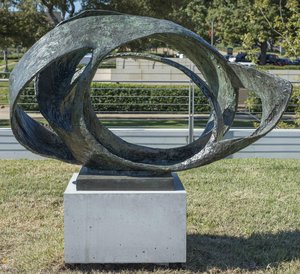
*Turning Form*, created in 1946 during Hepworth's relocation to St Ives—a pivotal moment in her artistic life—is arguably her most celebrated masterpiece. The sculpture comprises two interlocking forms, meticulously carved from Galway limestone, which appear to defy gravity and simultaneously embody notions of balance and dynamism. While Hepworth herself resisted interpretations laden with explicit symbolism, scholars have discerned references to geological processes – specifically erosion – mirroring the sculptor’s own engagement with the natural world. More broadly, *Turning Form* speaks to themes of transformation and resilience—suggesting that beauty can emerge from apparent instability and fragmentation. Its contemplative stillness invites viewers to contemplate the relationship between form and space, prompting reflection on fundamental questions about perception and existence.Hepworth's Legacy: An Enduring Influence on Contemporary Art
Barbara Hepworth’s contribution to Modern sculpture transcends mere stylistic innovation; she fundamentally altered artistic discourse by prioritizing conceptual depth alongside formal elegance. Her unwavering commitment to exploring the expressive potential of abstract forms continues to inspire artists today, demonstrating the enduring relevance of her vision—a testament to her profound understanding of art's capacity to communicate emotion and intellect simultaneously. Hepworth’s sculptures remain treasured objects of contemplation and admiration, embodying a timeless aesthetic that speaks to our deepest sensibilities.Questions & Answers
Which museum holds the original "Turning Form"?
You can see the original "Turning Form" at The Hepworth Wakefield, Wakefield, United Kingdom.
What is the format of "Turning Form"?
"Turning Form" by Barbara Hepworth has a portrait format. The format describes the proportions of the composition.
What technique was used for "Turning Form" by Barbara Hepworth?
The medium of "Turning Form" by Barbara Hepworth is acrylic on canvas. Reproductions aim to render the appearance of this technique.
Artist Biography
early life and education
dame barbara hepworth, a renowned english artist and sculptor, was born on january 10, 1903, in wakefield, yorkshire. she attended the leeds school of art from 1920 and later won a county scholarship to study at the royal college of art (rca) in london from 1921 until she was awarded the diploma in 1924.artistic career
- dame barbara hepworth's work exemplifies modernism, particularly modern sculpture. she was one of the few female artists to achieve international prominence.
- in 1933, she co-founded the unit one art movement with ben nicholson, paul nash, and others, seeking to unite surrealism and abstraction in british art.
- hepworth's early work was characterized by abstraction and her involvement with the paris-based art movement, abstraction-création.
notable works and exhibitions
- oval form (trezion), a bronze sculpture, is part of the kimbell art museum collection in fort worth, united states. (view on OriginalUniqueArt)
- two forms, a sculpture, is exhibited at the hepworth wakefield in wakefield, united kingdom. (view on OriginalUniqueArt)
- totem, a marble sculpture, is also part of the collection at the hepworth wakefield. (view on OriginalUniqueArt)
legacy and museum collections
barbara hepworth's work is widely recognized, with her sculptures and paintings forming part of various museum collections worldwide. the hepworth wakefield, named after the artist, houses numerous masterpieces from renowned artists, including hepworth's own works. (discover more about the hepworth wakefield on OriginalUniqueArt)conclusion
dame barbara hepworth's pioneering work in modern british sculpture has left an indelible mark on the art world. her legacy continues to inspire artists and art enthusiasts alike, with her works remaining a testament to her innovative spirit and artistic genius. more about barbara hepworth on wikipedia
Barbara Hepworth
1903 - 1975 , United Kingdom
Quick Facts
- Full Name: Barbara Hepworth
- Nationality: British
- Date Of Birth: 1903
- Date Of Death: 1975
- Place Of Birth: Wakefield, United Kingdom
- Notable Artworks:
- Oval Form (Trezion)
- Two Forms
- Totem
- Artistic Movement Or Style: Modernism, Abstraction
- Artists Who Influenced This Artist:
- Henry Moore
- Ben Nicholson
- Artists Or Movements Influenced By This Artist:
- Abstraction-Création
- Unit One
Related Articles
Barbara Hepworth: A Sculptural Dialogue with Form, Space & the Human Condition
Explore the profound world of Barbara Hepworth's sculpture. Discover her artistic evolution, iconic forms, and lasting influence on modern art. A guide for collectors & enthusiasts.

Kandinsky's Masterpieces: 25 Paintings That Define Abstract Art | OriginalUniqueArt
Journey through Wassily Kandinsky's 25 most iconic abstract paintings. Explore his revolutionary use of color, form & spiritual expressionism. Find museum-quality Kandinsky reproductions and elevate your home decor with OriginalUniqueArt.com. Discover all masterpieces on OriginalUniqueArt.com!

Fernand Léger's Masterpieces: 25 Iconic Paintings & The Machine Age Aesthetic | OriginalUniqueArt
Explore 25 iconic Fernand Léger paintings that defined the Machine Age & Cubism. Discover the stories behind his bold colors, geometric forms & avant-garde style. Find museum-quality art reproductions on OriginalUniqueArt.com.

Geometric Abstraction's 10 Defining Masterpieces | Art for Your Home - OriginalUniqueArt
Explore 10 defining masterpieces of Geometric Abstraction! Discover Kandinsky, Mondrian & Malevich’s iconic works. Find museum-quality art reproductions and curated decor ideas to elevate your home at OriginalUniqueArt.com.

Beyond Form & Color: Geometric Abstraction's Evolution in 20th/21st Century Art
Explore the evolution of geometric abstraction from Cubism to contemporary art. Discover key artists like Malevich & Mondrian, investment insights, and expert collecting advice at OriginalUniqueArt.