Send
Send Share
Share
 Details
 Guide
Guide

 Download
 Similars
 Diaporama
 Stats
StatsRhythmic Form


 Read More
The artwork displayed on this page is protected by copyright law, which means we cannot legally create or sell an identical reproduction. This protection is enforced under international agreements such as the Berne Convention and by national laws, including those outlined by the U.S. Copyright Law - Title 17.
This method fully complies with copyright regulations because it does not involve copying or duplicating the protected artwork. Instead, it is a creative reinterpretation - a new painting that is influenced by the original but not identical to it.
Giclée / Art Print
Museum-quality giclée or canvas print with fast production and flexible finish options. ( Buy Hand Made Painting Switch to Digital Image)




































Pick from our preset sizes that match the artwork's original proportions.

You may enter your own dimensions to fit a specific frame or space. If your selected size does not match the original image's proportions, we will either crop the artwork or extend the image with a mirrored or solid-fill edge. A digital mockup will be sent for your approval before production begins.
Please note that the on-screen preview does not reflect the actual cropping or extension. Only the mockup will accurately show the final composition.
While custom sizes are available, we recommend selecting a dimension from the predefined list to preserve the original proportions.
Worldwide Delivery () in 2 weeks instead of standard 4/5 weeks. (11 October)

Free Worldwide Express Shipping

High-Quality Linen Canvas

Full Shipping Insurance

Customs Tax Refund Guarantee

True Color Matching Guarantee

100-Day Return Policy (Defects Only)

100% Money-Back Guarantee

Bulk Discount Offer
 Glass option is only available in size under 110 CM

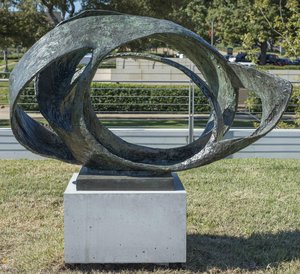
Rhythmic Form
Giclée / Art Print
Reproduction Size
-


Total Price
$ 81
Rhythmic Form: A Dialogue Between Space and Spirit
Barbara Hepworth’s “Rhythmic Form,” created in 1949, stands as a testament to the profound influence of Surrealist ideas on British sculpture during World War II. More than just an aesthetically pleasing object, it embodies Hepworth's unwavering belief that sculpture could translate thought into tangible form—a conviction deeply rooted in her engagement with artists like Arp and Brancusi who championed direct carving and explored the relationship between art and nature. The piece itself is a striking example of Hepworth’s signature style: monumental forms sculpted from wood, meticulously shaped to evoke movement and resonance. Its central hole isn't merely an incision; it’s a deliberate gesture that seeks to unify opposing forces—a visual metaphor for Hepworth’s exploration of duality and balance within the creative process.- Material & Technique: Crafted from Rosewood, “Rhythmic Form” utilizes a technique honed during Hepworth's formative years in Paris – a method characterized by careful consideration of material properties and an intuitive understanding of how form interacts with space. The sculptor’s hand meticulously removes wood shavings to reveal the underlying structure, resulting in a surface that is both smooth and subtly textured.
- Historical Context: Hepworth's work emerged from a period marked by significant artistic experimentation and intellectual ferment. The Unit One group—which included Nicholson, Gabo, and Nash—challenged conventional sculptural approaches, prioritizing abstraction and responding to the anxieties of wartime Britain with an embrace of geometric forms and organic shapes.
- Symbolism & Inspiration: Hepworth drew inspiration from Neolithic Menhirs – monolithic stones erected as memorials to ancient rituals – recognizing their ability to convey timelessness and spiritual significance. She likened her sculptures to these stones, emphasizing the desire for them to “furnish a means of egress for the soul,” reflecting her belief in sculpture’s capacity to transcend mere visual representation.
- Hepworth's Philosophy: Hepworth famously described sculpture as "the plastic projection of thought," highlighting its role in capturing intangible ideas and emotions. She insisted that the work should “put no pressure on anything,” signifying a rejection of didacticism and an affirmation of art’s autonomy—a stance that aligns with her broader philosophical commitment to embracing spontaneity and responding authentically to the material at hand.
- Legacy & Influence: Hepworth's pioneering approach to sculpture continues to inspire artists today, particularly those interested in exploring spatial relationships and investigating the interplay between form and gesture. Her enduring impact is evident in the work of subsequent sculptors who adopted similar techniques and pursued similar conceptual concerns—a legacy cemented by her inclusion in Tate’s collection and celebrated as a cornerstone of British Modernism.
Questions & Answers
Where can I buy a hand-painted reproduction of "Rhythmic Form" by Barbara Hepworth?
You can order a hand-painted reproduction of "Rhythmic Form" by Barbara Hepworth directly on this page: a hand-painted oil reproduction on linen canvas, made to order.
Who created "Rhythmic Form"?
The artist behind "Rhythmic Form" is Barbara Hepworth. The work is catalogued under Barbara Hepworth's name.
Is "Rhythmic Form" more bright or more dark overall?
"Rhythmic Form" is brilliant overall, and its luminance is luminous.
What is the creation date of "Rhythmic Form" by Barbara Hepworth?
"Rhythmic Form" by Barbara Hepworth was created in 1949.
What is the recommended use of a print of "Rhythmic Form"?
The suggested use for "Rhythmic Form" by Barbara Hepworth is accent. It can serve other purposes as well.
How old was Barbara Hepworth when creating "Rhythmic Form" in 1949?
Barbara Hepworth was 46 years old when creating "Rhythmic Form" in 1949. The age is computed from the artist's birth year, 1903.
Where is "Rhythmic Form" by Barbara Hepworth on display today?
"Rhythmic Form" by Barbara Hepworth is on display at the British Council, London, United Kingdom. The museum listing refers to the original work, not to reproductions.
Artist Biography
early life and education
dame barbara hepworth, a renowned english artist and sculptor, was born on january 10, 1903, in wakefield, yorkshire. she attended the leeds school of art from 1920 and later won a county scholarship to study at the royal college of art (rca) in london from 1921 until she was awarded the diploma in 1924.artistic career
- dame barbara hepworth's work exemplifies modernism, particularly modern sculpture. she was one of the few female artists to achieve international prominence.
- in 1933, she co-founded the unit one art movement with ben nicholson, paul nash, and others, seeking to unite surrealism and abstraction in british art.
- hepworth's early work was characterized by abstraction and her involvement with the paris-based art movement, abstraction-création.
notable works and exhibitions
- oval form (trezion), a bronze sculpture, is part of the kimbell art museum collection in fort worth, united states. (view on OriginalUniqueArt)
- two forms, a sculpture, is exhibited at the hepworth wakefield in wakefield, united kingdom. (view on OriginalUniqueArt)
- totem, a marble sculpture, is also part of the collection at the hepworth wakefield. (view on OriginalUniqueArt)
legacy and museum collections
barbara hepworth's work is widely recognized, with her sculptures and paintings forming part of various museum collections worldwide. the hepworth wakefield, named after the artist, houses numerous masterpieces from renowned artists, including hepworth's own works. (discover more about the hepworth wakefield on OriginalUniqueArt)conclusion
dame barbara hepworth's pioneering work in modern british sculpture has left an indelible mark on the art world. her legacy continues to inspire artists and art enthusiasts alike, with her works remaining a testament to her innovative spirit and artistic genius. more about barbara hepworth on wikipedia
Barbara Hepworth
1903 - 1975 , United Kingdom
Quick Facts
- Full Name: Barbara Hepworth
- Nationality: British
- Date Of Birth: 1903
- Date Of Death: 1975
- Place Of Birth: Wakefield, United Kingdom
- Notable Artworks:
- Oval Form (Trezion)
- Two Forms
- Totem
- Artistic Movement Or Style: Modernism, Abstraction
- Artists Who Influenced This Artist:
- Henry Moore
- Ben Nicholson
- Artists Or Movements Influenced By This Artist:
- Abstraction-Création
- Unit One
Related Articles

Kandinsky's Masterpieces: 25 Paintings That Define Abstract Art | OriginalUniqueArt
Journey through Wassily Kandinsky's 25 most iconic abstract paintings. Explore his revolutionary use of color, form & spiritual expressionism. Find museum-quality Kandinsky reproductions and elevate your home decor with OriginalUniqueArt.com. Discover all masterpieces on OriginalUniqueArt.com!

The Enduring Form: Exploring Themes & Techniques in Sculpture Across Historical Periods
Explore the rich history of sculpture from ancient masterpieces to contemporary innovations. Discover key techniques, influential artists & investment potential for discerning art collectors.

Geometric Abstraction's 10 Defining Masterpieces | Art for Your Home - OriginalUniqueArt
Explore 10 defining masterpieces of Geometric Abstraction! Discover Kandinsky, Mondrian & Malevich’s iconic works. Find museum-quality art reproductions and curated decor ideas to elevate your home at OriginalUniqueArt.com.

Bronze Sculptures That Defined Art History | OriginalUniqueArt
Journey through art history with our Top 10 bronze sculptures! Explore masterpieces by Rodin, Michelangelo & more. Discover stories behind iconic statues and find museum-quality reproductions for your home decor at OriginalUniqueArt.com.
Barbara Hepworth: A Sculptural Dialogue with Form, Space & the Human Condition
Explore the profound world of Barbara Hepworth's sculpture. Discover her artistic evolution, iconic forms, and lasting influence on modern art. A guide for collectors & enthusiasts.