Preview
 Send
Send Share
Share
 Details
 Guide
Guide

 Download
 Similars
 X-Ray
X-Ray Diaporama
 Stats
StatsOblique Forms


 Read More
The artwork displayed on this page is protected by copyright law, which means we cannot legally create or sell an identical reproduction. This protection is enforced under international agreements such as the Berne Convention and by national laws, including those outlined by the U.S. Copyright Law - Title 17.
This method fully complies with copyright regulations because it does not involve copying or duplicating the protected artwork. Instead, it is a creative reinterpretation - a new painting that is influenced by the original but not identical to it.
Giclée / Art Print
Museum-quality giclée or canvas print with fast production and flexible finish options. ( Buy Hand Made Painting Switch to Digital Image)




P118B $10

P118H $10

P118W $10

P438Z $10

P508JH $12

P508YH $12

P805H $10

P805Z $10

P919BZ $10

P919G $10

P919XJ $10

P959ZH $10

P968JZ $12

W106C $8

W218G $10

W218JH $8

W218Y $10

W307PJ $10

W316G $10

W316PJ $8

W316Y $10

W398PJ $8

W4111J $10

W500HY $15

W500JH $15

W692G $12

W849H $8

W940BG $15

W953PJ $8




Pick from our preset sizes that match the artwork's original proportions.

Type the width and the height you need, to fit your frame or your wall. A print can only be cut, never made bigger than the picture, so a size with a different shape loses a part of the image. We send you a digital mockup to approve before we print anything. The picture shown on this page does not show the real cut — only the mockup does.
Worldwide Delivery () in 2 weeks instead of standard 4/5 weeks. (23 October)

Free Worldwide Express Shipping

High-Quality Linen Canvas

Full Shipping Insurance

Customs Tax Refund Guarantee

True Color Matching Guarantee

100-Day Return Policy (Defects Only)

100% Money-Back Guarantee

Bulk Discount Offer
 Glass option is only available in size under 110 CM

Oblique Forms
Giclée / Art Print
Reproduction Size
-


Total Price
$ 81
A Dance of Geometry and Soul
In the quiet realm of Barbara Hepworth’s Oblique Forms, created in 1969, the boundaries between the physical and the metaphysical begin to dissolve. This exquisite lithograph, part of her celebrated series of twelve lithographs produced under the guidance of Stanley Jones, serves as a profound meditation on the balance between structure and spontaneity. At first glance, the viewer is met with a striking arrangement of geometric shapes—two primary circles intersecting at a deliberate, oblique angle—set against a soft, luminous yellow backdrop. Yet, to look merely at the shapes is to miss the heartbeat of the work. There is an inherent tension in that intersection, a subtle disruption of symmetry that invites the eye to wander through a space that feels both mathematically precise and deeply organic.
The technique of lithography allows Hepworth to translate her monumental sculptural language onto the delicate surface of paper. Through the careful application of color and form, she achieves a sense of depth that mimics the hollowed spaces of her famous bronze and stone works. The muted yellow atmosphere acts as a warm, contemplative void, while the blue centers of the intersecting circles provide a cool, rhythmic counterpoint. Small, strategically placed secondary circles float around the main composition like celestial bodies or pebbles in a stream, reinforcing a sense of interconnectedness and spatial exploration. This is not merely a drawing of shapes; it is an architectural blueprint for an emotional landscape.
The Legacy of Modernist Intuition
To understand Oblique Forms, one must look back to the artist’s roots in Wakefield and her transformative years at the Royal College of Art. Hepworth was a pioneer of the Modernist movement, a woman who successfully bridged the gap between the rational precision of abstraction and the raw, intuitive power of Surrealism. Her fascination with the natural world—the weathered textures of rocks, the spiral of shells, and the rhythmic flow of tides—is distilled here into pure, essential geometry. In this print, the "oblique" nature of the forms suggests a movement that is never static; it captures the very essence of growth and change found in the natural environment.
For the discerning collector or interior designer, this piece offers more than just aesthetic beauty; it provides a focal point of intellectual and emotional gravity. The artwork possesses a unique ability to anchor a room, bringing with it a sense of stillness and sophisticated grace. Whether placed in a minimalist contemporary gallery or a richly textured classical study, Oblique Forms commands attention through its subtlety. It is a masterpiece of balance, offering a window into a world where geometry does not constrain emotion, but rather provides the very framework through which we might understand it.
Questions & Answers
Is "Oblique Forms" by Barbara Hepworth a bright or a dark artwork?
The perceived brightness of "Oblique Forms" by Barbara Hepworth is brilliant. It can be matched to the light of the intended space.
What is the recommended use of a print of "Oblique Forms"?
A reproduction of "Oblique Forms" by Barbara Hepworth is recommended for accent. This suggestion follows from the work's subject, mood and colors.
What kind of colors does "Oblique Forms" use?
The palette of "Oblique Forms" by Barbara Hepworth is described as neutrals. It is a compact description of the work's colors.
Artist Biography
early life and education
dame barbara hepworth, a renowned english artist and sculptor, was born on january 10, 1903, in wakefield, yorkshire. she attended the leeds school of art from 1920 and later won a county scholarship to study at the royal college of art (rca) in london from 1921 until she was awarded the diploma in 1924.artistic career
- dame barbara hepworth's work exemplifies modernism, particularly modern sculpture. she was one of the few female artists to achieve international prominence.
- in 1933, she co-founded the unit one art movement with ben nicholson, paul nash, and others, seeking to unite surrealism and abstraction in british art.
- hepworth's early work was characterized by abstraction and her involvement with the paris-based art movement, abstraction-création.
notable works and exhibitions
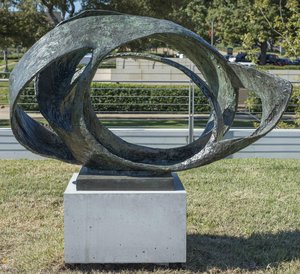
- oval form (trezion), a bronze sculpture, is part of the kimbell art museum collection in fort worth, united states. (view on OriginalUniqueArt)
- two forms, a sculpture, is exhibited at the hepworth wakefield in wakefield, united kingdom. (view on OriginalUniqueArt)
- totem, a marble sculpture, is also part of the collection at the hepworth wakefield. (view on OriginalUniqueArt)
legacy and museum collections
barbara hepworth's work is widely recognized, with her sculptures and paintings forming part of various museum collections worldwide. the hepworth wakefield, named after the artist, houses numerous masterpieces from renowned artists, including hepworth's own works. (discover more about the hepworth wakefield on OriginalUniqueArt)conclusion
dame barbara hepworth's pioneering work in modern british sculpture has left an indelible mark on the art world. her legacy continues to inspire artists and art enthusiasts alike, with her works remaining a testament to her innovative spirit and artistic genius. more about barbara hepworth on wikipedia
Barbara Hepworth
1903 - 1975 , United Kingdom
Quick Facts
- Full Name: Barbara Hepworth
- Nationality: British
- Date Of Birth: 1903
- Date Of Death: 1975
- Place Of Birth: Wakefield, United Kingdom
- Notable Artworks:
- Oval Form (Trezion)
- Two Forms
- Totem
- Artistic Movement Or Style: Modernism, Abstraction
- Artists Who Influenced This Artist:
- Henry Moore
- Ben Nicholson
- Artists Or Movements Influenced By This Artist:
- Abstraction-Création
- Unit One
Related Articles

Geometric Abstraction's 10 Defining Masterpieces | Art for Your Home - OriginalUniqueArt
Explore 10 defining masterpieces of Geometric Abstraction! Discover Kandinsky, Mondrian & Malevich’s iconic works. Find museum-quality art reproductions and curated decor ideas to elevate your home at OriginalUniqueArt.com.
Fernand Léger's Masterpieces: 25 Iconic Paintings & The Machine Age Aesthetic | OriginalUniqueArt
Explore 25 iconic Fernand Léger paintings that defined the Machine Age & Cubism. Discover the stories behind his bold colors, geometric forms & avant-garde style. Find museum-quality art reproductions on OriginalUniqueArt.com.

Kandinsky's Masterpieces: 25 Paintings That Define Abstract Art | OriginalUniqueArt
Journey through Wassily Kandinsky's 25 most iconic abstract paintings. Explore his revolutionary use of color, form & spiritual expressionism. Find museum-quality Kandinsky reproductions and elevate your home decor with OriginalUniqueArt.com. Discover all masterpieces on OriginalUniqueArt.com!
Barbara Hepworth: A Sculptural Dialogue with Form, Space & the Human Condition
Explore the profound world of Barbara Hepworth's sculpture. Discover her artistic evolution, iconic forms, and lasting influence on modern art. A guide for collectors & enthusiasts.

Beyond Form & Color: Geometric Abstraction's Evolution in 20th/21st Century Art
Explore the evolution of geometric abstraction from Cubism to contemporary art. Discover key artists like Malevich & Mondrian, investment insights, and expert collecting advice at OriginalUniqueArt.